DP Pulveriser UK - Innovating the Future of Size Reduction
A blocked sieve, uneven tablet weights or poorly flowing powder rarely begins at the final packaging stage. In many plants, the issue is oversized agglomerates, inconsistent feed material or a powder that has compacted during storage and transfer. Understanding when to use cone mills helps process teams correct these problems without applying more energy than the product or process can tolerate.
Cone mills, also called conical mills or comills, are designed primarily for controlled particle size reduction, deagglomeration and conditioning. They are not the first choice for every milling duty. Their value lies in producing a more uniform, free-flowing material while preserving particle shape, limiting fines and supporting repeatable downstream processing.
When to Use Cone Mills for Controlled Sizing
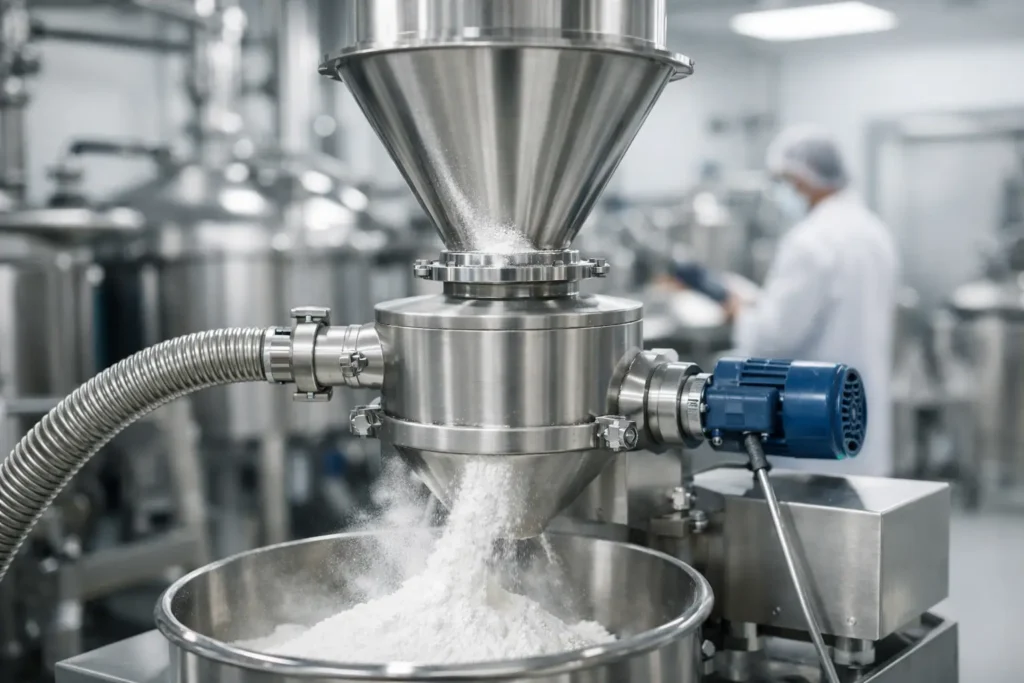
A cone mill is appropriate when the required outcome is a consistent top-size reduction rather than intensive grinding. Material enters a conical screen chamber, where an impeller guides it through the selected aperture. The combination of screen size, impeller profile, speed and feed rate determines the final particle size distribution.
This makes cone milling particularly effective where lumps, soft agglomerates or compacted powder must be broken down before blending, granulation, tabletting, encapsulation, filling or packaging. It is commonly used to condition powders that have changed during transport, storage or intermediate handling.
The process is generally low heat and relatively low impact compared with high-speed hammer milling. That distinction matters for heat-sensitive products, friable granules and formulations where excess fines can compromise flow, blend uniformity, dissolution behaviour or dust control.
Typical duties include conditioning dried granules before compression, deagglomerating nutraceutical ingredients before blending, reclaiming oversize material from a production stream and preparing food powders for reliable dosing. In chemical and mineral applications, cone mills can also provide controlled screening and sizing ahead of mixing, coating or conveying operations.
The Material Conditions That Favour a Cone Mill
Cone mills perform best with dry or low-moisture materials that can pass through a screen once agglomerates have been opened. Granules, crystalline materials, powders, flakes and relatively soft solids are often suitable. The machine is especially useful where a narrow operational change, such as a different screen aperture or impeller speed, can correct a flow or sizing problem.
A cone mill should be considered when the material is:
- prone to lump formation after storage, drying or compaction;
- required to meet a defined maximum particle size before a downstream process;
- sensitive to excessive heat generation or high mechanical impact;
- destined for a process that depends on consistent flow, such as tablet presses, capsule fillers or automated packing lines;
- handled in a regulated environment where cleanability, containment and batch repeatability are critical.
The choice still depends on the powder. A highly cohesive, sticky or wet material can blind the screen and restrict throughput. Very abrasive products may accelerate wear on the impeller and screen. A material requiring fine grinding into the low-micron range needs a different technology, such as a jet mill, pin mill or air classifier mill, depending on the specification.
Where Cone Milling Adds Value in the Process Line
The strongest case for a cone mill is often found at the interface between process stages. It is not simply a standalone size-reduction machine. Properly positioned, it stabilises feed quality and reduces variation further down the line.
Before blending and mixing
Ingredients with different storage histories can enter a blender with significantly different bulk density, particle size and agglomeration levels. A cone mill upstream can break down soft lumps and improve the consistency of the feed. This supports more predictable blending, particularly where minor ingredients need to distribute evenly through a larger bulk powder.
However, milling every ingredient is not always beneficial. If the formulation relies on a deliberate particle-size difference to control segregation or dissolution, the milling duty must be validated against the finished-product requirement. The aim is to remove undesirable variability, not to make every component identical.
After drying or granulation
Dry granulation and fluid-bed drying can create material with oversized granules or hard clusters. Cone milling is widely used to calibrate this material to a suitable size before tabletting or encapsulation. It can produce a more controlled granule population while avoiding the high attrition that may occur in more aggressive mills.
For pharmaceutical production, this stage directly influences die filling, tablet weight consistency and compression behaviour. In food and nutraceutical manufacturing, it can improve dosing accuracy and reduce interruptions caused by bridging in hoppers or feeders.
Before filling, packing and pneumatic conveying
Fine powders and granules can behave unpredictably when transferred. A small proportion of oversize particles may obstruct pipework, damage dosing equipment or cause inconsistent filling. Cone milling before a critical transfer point can remove these problematic fractions and establish a more manageable material condition.
It is worth assessing the full conveying arrangement rather than treating the mill in isolation. If the powder is fragile, a high-velocity pneumatic system may generate fines after cone milling. If it is hygroscopic, the time spent exposed during transfer may be the real cause of caking. Equipment selection must reflect the complete process, not just the sample collected at the mill outlet.
Selecting the Right Cone Mill Configuration
A cone mill is only as effective as its configuration. Screen aperture is the most visible parameter, but it is not the only one. Smaller apertures generally reduce top particle size, yet they can lower capacity and increase the likelihood of heat build-up or screen blockage. A larger aperture may improve throughput but allow too much oversize material to pass.
Impeller design and rotational speed shape the milling action. A low-speed, gently configured impeller is often suitable for deagglomeration and fragile granules. Higher tip speeds can provide more reduction but may create additional fines. The correct setting is based on measured product performance, not simply the finest achievable output.
Feed control also deserves attention. An inconsistent feed can overload the screen zone, create residence-time variation and distort the resulting particle size distribution. Loss-in-weight feeders, controlled hopper discharge and appropriate upstream buffer capacity can improve milling consistency, particularly in continuous production.
For hygienic and regulated applications, construction and access arrangements are equally important. Stainless-steel contact parts, polished finishes, quick-release screens, tool-free dismantling and clean-in-place compatibility can reduce changeover time and support documented cleaning procedures. Where operator exposure or dust release is a concern, contained charging and discharge interfaces should be specified as part of the system design.
When Another Mill Is the Better Choice
Cone mills are controlled conditioning machines, not universal solutions. Selecting one for the wrong duty can add cost without achieving the required particle size or throughput.
A hammer mill may be more appropriate for tougher, larger feedstock that needs more aggressive impact reduction. A pin mill can suit materials requiring a finer powder and may be selected where centrifugal impact is needed to break brittle products. Jet milling is typically considered where micron-scale particle sizes, low contamination and minimal heat are essential. Air classifier mills provide fine grinding with classification control, while cryogenic systems can be necessary for elastic, fatty or temperature-sensitive materials that become difficult to mill at ambient conditions.
The decision is not solely about target size. It should consider hardness, moisture, abrasiveness, thermal sensitivity, explosibility, required throughput, cleaning regime and acceptable level of fines. Laboratory trials and pilot-scale evaluation are often the most reliable way to identify the operating window before committing to production equipment.
Engineering for Scale-Up and Repeatability
A successful trial is useful only if it can be transferred to commercial scale. During development, record the screen type and aperture, impeller geometry, rotational speed, feed rate, product temperature, bulk density and particle-size distribution. These parameters form the basis for a scale-up specification and reduce the risk of unexpected changes in performance on a larger unit.
Process engineers should also define what success means in measurable terms. It may be a maximum oversize fraction, a specified flow rate, a narrower particle-size distribution, improved tablet weight control or a reduction in line stoppages. Without this definition, there is a risk of selecting a machine based on nominal capacity rather than the quality outcome that the process requires.
DP Pulveriser UK approaches cone milling as part of the wider powder-processing system, including feeding, containment, conveying and downstream equipment. That engineering view is essential where product quality, operator safety and production efficiency must be maintained together.
The most useful question is not whether a cone mill can reduce particle size. It is whether controlled deagglomeration and calibration will remove the source of variation in your process. When the answer is yes, a correctly specified cone mill can turn an inconsistent powder stream into a dependable production input.