DP Pulveriser UK - Innovating the Future of Size Reduction
A blender can become the production line’s limiting operation long before a mill, classifier or packing station reaches its capacity. The batch blender vs continuous blender decision therefore affects far more than mixing time. It influences formulation control, material traceability, cleaning strategy, downstream flow, labour demand and the practical route from pilot trials to commercial output.
For manufacturers handling powders with tight uniformity requirements, there is no universal answer. A batch system can provide exceptional control and segregation management, while a continuous system can transform throughput and line efficiency. The correct choice depends on the material, recipe profile, compliance obligations and production model.
Batch blender vs continuous blender: the operating difference
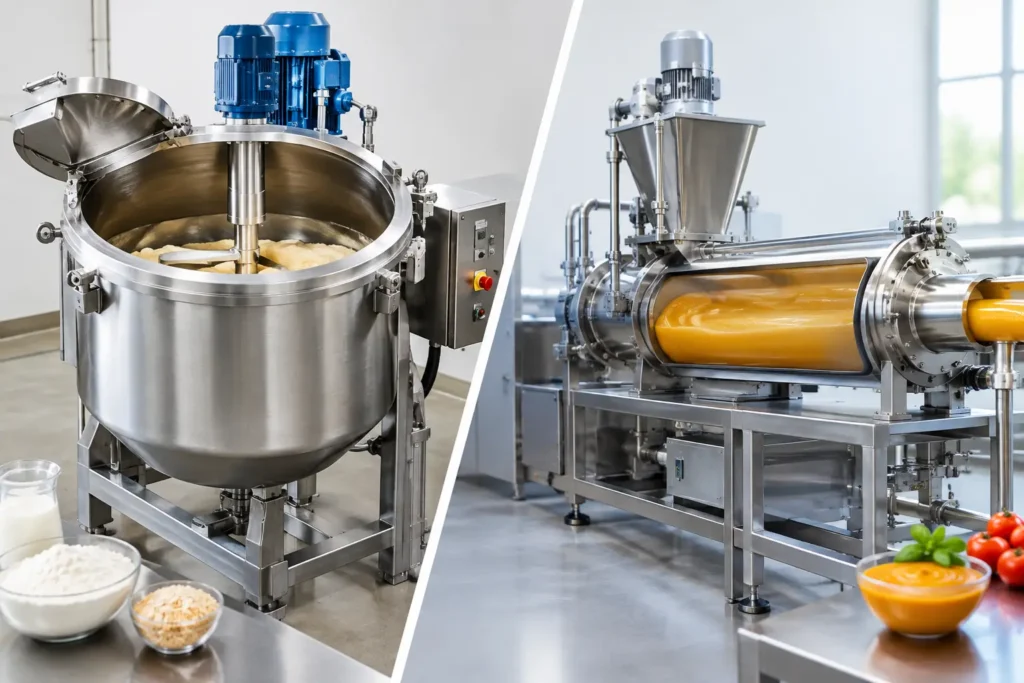
A batch blender processes a defined quantity of material at one time. Ingredients are weighed, charged into the vessel, blended for a specified period and discharged once the blend meets the required standard. The next batch begins only after discharge and, where necessary, cleaning and inspection.
This operating model provides clear batch boundaries. For pharmaceuticals, nutraceuticals, speciality chemicals and high-value food ingredients, those boundaries support traceability, recipe verification and retained-sample procedures. They also allow operators to adjust a blend based on in-process checks before material progresses to the next stage.
A continuous blender receives materials at controlled feed rates and discharges blended product continuously. Loss-in-weight feeders, volumetric feeders or other dosing systems supply each component at a defined rate, while the blender maintains a consistent mass flow. Rather than producing separate lots, it establishes a stable processing condition over time.
Continuous blending is particularly effective where formulations run for extended campaigns, demand is high and upstream and downstream equipment can operate at matched rates. The process can feed conveying, milling, compaction, granulation, filling or packing operations without the stop-start pattern associated with individual batches.
When a batch blender is the stronger engineering choice
Batch blending is often the preferred option where product flexibility and quality assurance take priority over maximum hourly output. A production facility making frequent recipe changes can isolate each formulation, verify ingredient additions and clean the system between campaigns. This is valuable where cross-contamination risk is high or allergens, active ingredients, colours and potent materials are present.
The defined residence time within a batch also gives engineers a direct means of managing difficult blends. Powders with different particle sizes, densities, shapes or moisture contents may require specific fill levels, blending speeds and cycle durations. A batch system makes these variables straightforward to set, test and document.
It is also generally easier to reconcile material use on a batch basis. If 500 kg of a formulation enters a blender, the production team can compare the discharge quantity, process loss and packaging yield against a known record. That level of accounting is useful in regulated environments and when processing expensive active ingredients, pigments or battery materials.
However, batch systems introduce non-productive time. Loading, discharge, vessel changeover, cleaning and quality checks all reduce effective capacity. The nominal vessel volume is not the same as usable hourly throughput. A 1,000-litre blender may deliver far less output than expected if it requires lengthy cleaning between several short product runs.
Where continuous blending delivers value
Continuous blending is designed for stable, high-volume manufacture. Once feeder performance, blender speed and material flow have reached steady state, the process can achieve high output from a relatively compact footprint. This reduces handling steps and can remove intermediate storage between unit operations.
The most significant advantage is usually overall line efficiency. Instead of charging and emptying vessels repeatedly, material moves through the process at a controlled rate. For high-throughput food powders, mineral products, agricultural formulations, detergents and commodity chemicals, this can reduce labour requirements and increase annual production capacity without adding multiple batch vessels.
Continuous systems can also support advanced process control. Feeder rates, torque, power draw, moisture and in-line analytical measurements can be monitored to identify drift before it becomes a quality issue. When properly engineered, this approach supports consistent composition and faster response to changes in raw-material behaviour.
The trade-off is that the blender cannot compensate for poor feeding. Variability in bulk density, particle flow, bridging, rat-holing or feeder refill behaviour can affect component ratios. Material handling, hopper design, agitation and dosing accuracy must therefore be considered as part of the complete system, not as separate equipment decisions.
Continuous blending also requires careful start-up and shutdown procedures. Material produced while the process is reaching steady state may need to be segregated, reworked or discarded. Product changeovers can be efficient on compatible formulations, but they demand a cleaning design that matches the hygiene and validation requirements of the plant.
Product behaviour matters more than blender capacity
A blender is not selected from throughput alone. Powder characteristics determine whether a blend remains uniform through discharge, conveying and filling. Materials with wide particle-size distributions or major density differences can segregate after blending, particularly where transfer distances are long or the product passes through multiple handling stages.
For batch processing, engineers can evaluate blend uniformity at different cycle times and assess whether over-blending creates segregation. For continuous processing, the equivalent task is to establish the residence-time distribution and verify that fluctuations at each feeder do not appear in the discharged product beyond acceptable limits.
Cohesive powders create another consideration. Fine materials may form agglomerates, adhere to vessel surfaces or resist uniform distribution of low-dose ingredients. In these cases, the answer may involve intensifier bars, high-shear mixing zones, pre-conditioning or a different blending principle. A simple tumble blender is not automatically the right solution for every free-flowing-looking powder.
Liquid addition requires similar scrutiny. Batch systems can offer ample time for controlled spraying and wetting, particularly where a minor liquid ingredient must disperse through a large powder mass. Continuous systems can handle liquid dosing effectively, but spray position, atomisation, mixer energy and residence time must be matched to the formulation. Otherwise, localised wet spots and build-up can reduce both quality and availability.
Throughput, scale-up and total cost of ownership
A batch blender is often easier to introduce at development and pilot scale because the process resembles laboratory formulation work. The production team can establish a defined recipe, blend time and operating sequence before moving to a larger vessel. Scale-up is still not purely geometric, since fill level and powder movement change with equipment size, but the approach is familiar and readily validated.
Continuous processing can provide a more direct path to high output once the operating window is understood. A development unit may run at lower feed rates using the same underlying process principle as a production line. This can be attractive for organisations planning major volume growth, provided that raw-material feeding and quality-control systems are developed alongside the blender.
Capital cost should be assessed at line level. A batch installation may require feed stations, multiple vessels, lifting or vacuum transfer equipment, buffer hoppers and additional operator intervention. A continuous system may require precise feeders, controls, instrumentation and engineered dust containment. Neither arrangement is automatically lower cost.
The more meaningful measure is total cost of ownership. Consider energy use, cleaning time, consumable parts, maintenance access, production losses, labour, floor space and the cost of rejected or reworked product. In a high-value formulation, a small improvement in blend consistency may outweigh a modest difference in equipment purchase price. In a high-volume commodity operation, higher annual output may justify the investment in a continuous line.
Cleaning, containment and compliance
Cleaning requirements can decide the project before throughput is even discussed. Batch blenders offer physical separation between lots and can be designed for manual cleaning, wash-in-place operation or fast access to contact parts. The appropriate method depends on the product, validation method and acceptable downtime.
Continuous blenders have fewer large vessels to open and clean, but their feeders, transfer points and blending zones need thorough access. Systems handling potent, dusty or allergenic powders may require contained charging, split butterfly valves, local extraction and controlled discharge arrangements. The objective is not merely a clean machine. It is a repeatable cleaning process that protects operators and prevents carryover.
For regulated production, documentation should cover the entire process path, including ingredient dosing, blending, sampling, discharge and cleaning. A blender with excellent mechanical performance cannot resolve an inadequate traceability or containment strategy.
Selecting the right blending system
Choose batch blending when your operation relies on frequent formulation changes, defined lot control, intensive cleaning between products or careful management of complex, lower-volume blends. Choose continuous blending when recipes are stable, demand is sustained and the wider line can support precise, uninterrupted material feeding.
Many facilities benefit from both approaches. A batch blender may serve development, specialist products and short campaigns, while a continuous line produces the highest-volume formulations. The decision should be based on trials using actual materials rather than assumptions drawn from bulk-density data alone.
A well-planned test programme should examine blend uniformity, feeder accuracy, segregation after transfer, cleaning access and realistic production rates. DP Pulverizer UK applies this application-led approach to specify blending and powder handling systems that perform reliably from initial trials through to full-scale manufacture. The most useful next step is to define the material behaviour and production constraints clearly, then engineer the blender around the process rather than forcing the process around the machine.