DP Pulveriser UK - Innovating the Future of Size Reduction
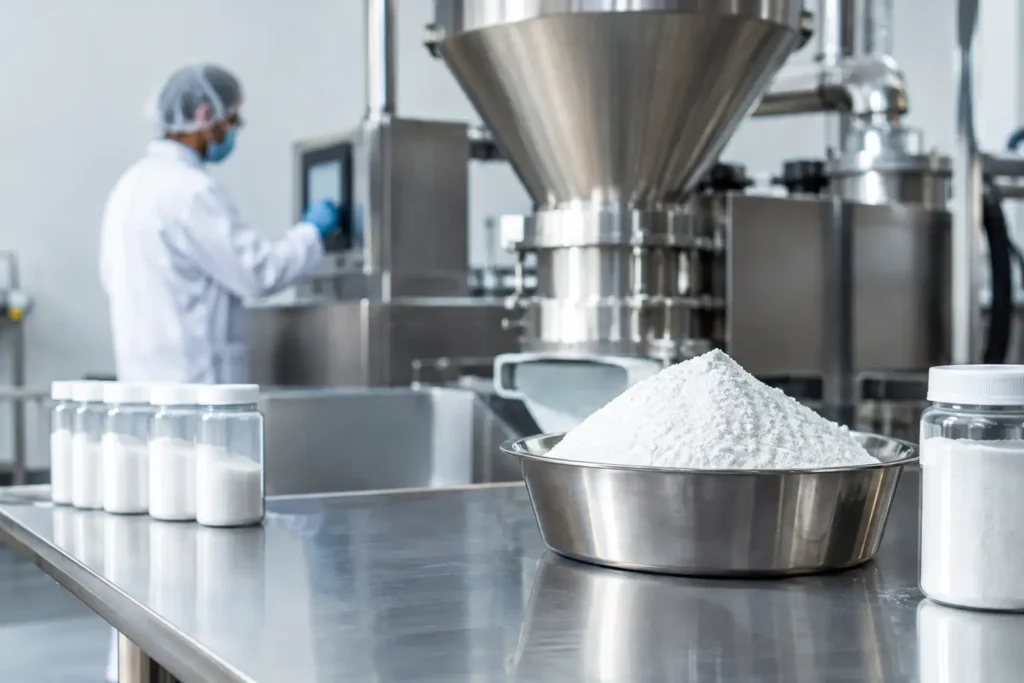
A laboratory mill can produce an excellent result from a few kilograms of material, yet the same formulation may behave very differently at production rate. Heat generation, air volume, feed consistency, residence time and powder transfer all change as equipment capacity increases. This process scale up guide sets out how to move from development trials to stable commercial production without sacrificing particle size control, yield or product quality.
Start with the product specification, not the machine
Scale-up should begin with a defined product outcome rather than an assumed equipment type. A target median particle size alone is rarely sufficient. Process engineers should establish the acceptable particle size distribution, maximum oversize content, bulk density, moisture range, flow characteristics, temperature limit, colour retention where relevant, and required throughput.
The specification must also reflect how the powder performs downstream. A material may meet its particle size target but still fail during tabletting, blending, coating, filling or conveying because its particle shape, electrostatic charge or bulk density has changed. For food, pharmaceutical and nutraceutical applications, allergen control, cleanability and batch traceability may be equally decisive. For chemical, mineral and battery materials, contamination control and material degradation can be critical.
This definition gives the scale-up programme a measurable basis. It prevents a common mistake: selecting a larger mill based solely on hourly capacity, then trying to correct a quality issue after installation.
Build a process window during pilot trials
A successful pilot programme identifies a repeatable operating window rather than one favourable test result. The objective is to understand which inputs drive product quality and where the process becomes unstable.
For a milling operation, the main variables normally include feed rate, feed particle size, rotor or classifier speed, grinding media or nozzle configuration, air flow, inlet air temperature, system pressure and screen or classifier settings. Material characteristics also matter. Moisture, fat content, friability, abrasiveness, melting point and initial particle size can alter the result substantially between batches.
Record each test condition alongside the resulting particle size distribution, product temperature, yield, energy consumption and retained material in the system. Where practical, assess the powder after subsequent handling steps as well. Fine powders can agglomerate in transfer lines or lose flowability after collection, making an apparently successful mill test unrepresentative of full-line performance.
The most useful outcome is a documented operating envelope. For example, a process may consistently achieve the required distribution at a defined range of classifier speeds and feed rates, but produce excessive fines outside that range. This evidence supports equipment selection, control strategy and production planning.
Use representative feedstock and realistic run times
Small test samples can conceal problems caused by feedstock variation. Pilot material should represent expected commercial raw material, including likely changes in moisture, particle size and supplier batches. If incoming material will be stored in bulk bags, drums or silos, its condition after storage should also be considered.
Run duration matters. A short trial may not reveal mill warming, filter loading, screen blinding, build-up within pipework or segregation in a hopper. Extended trials provide better evidence of steady-state performance, cleaning requirements and realistic output.
Scale the system, not just the mill
Milling capacity is only one part of production performance. The wider system must receive, condition, process, classify, collect and transfer powder at the required rate. A larger machine cannot compensate for an undersized feeder, restricted conveying line or poorly designed dust collection arrangement.
Feed control is particularly influential. Variable feed density or bridging in a hopper produces fluctuating mill loading, which can widen particle size distribution and reduce throughput. Agitated hoppers, loss-in-weight feeders, screw feeders and suitable flow aids should be selected according to the powder’s flow behaviour, not added as an afterthought.
Air handling must be assessed with the same care. In air classifier mills and jet mills, air flow directly affects classification and product transport. Duct diameter, bends, pressure losses, filter area and fan duty can all influence performance. A production-scale filter must manage the expected solids loading while maintaining stable differential pressure and effective powder recovery.
Collection and discharge arrangements also require validation. Cyclones, bag filters, rotary valves and intermediate bulk containers can change the final powder’s density and segregation tendency. For high-value products, recovery from the entire system should be quantified, including residues in the mill, classifier, ductwork and filter.
Select the right scale-up route
There is no universal scale factor between laboratory and industrial equipment. The correct route depends on the material, target size, machine principle and level of process sensitivity.
A cone mill may scale effectively where deagglomeration or controlled sizing is the requirement and heat generation is modest. A hammer mill can offer high throughput for friable materials, but screen choice, tip speed and feed presentation must be carefully matched to the product. Pin mills and turbo mills are often suited to fine grinding with adjustable intensity, while air classifier mills provide close control of fines and oversize through an integrated classification stage.
For very fine products, jet milling may be appropriate where contamination, heat sensitivity or tight particle size distribution demands a fluid-energy process. Cryogenic milling can be justified when materials soften, smear or oxidise at ambient temperature. These routes have different utilities, operating costs and maintenance implications, so the smallest achievable particle size is not always the best selection criterion.
Equipment geometry is rarely identical across sizes. Tip speed, air-to-solids ratio, residence time and classifier performance need to be translated using process data and engineering judgement. This is why pilot trials on geometrically and operationally relevant equipment are more valuable than relying on a simple capacity multiplier.
Engineer for safety, containment and cleanability
Scale-up is also the point at which hazards become more consequential. Dust explosibility testing should inform the design of the milling, extraction and collection system. Depending on the material and site assessment, this may require explosion venting, suppression, isolation, inerting, conductive components, earthing and carefully managed ignition sources.
Toxic, potent or sensitising powders may require contained charging, enclosed transfer, glovebox interfaces, split butterfly valves or negative-pressure operation. The containment target should be defined before layout and equipment selection, because retrofitting containment can compromise access, cleanability and maintainability.
Hygienic design deserves the same early attention. Product contact surfaces, gasket design, internal ledges, inspection access and clean-in-place requirements affect changeover time and cross-contamination risk. In regulated production, the system must also support practical validation, sampling and documentation.
Prove commercial performance before final acceptance
Factory and site acceptance testing should confirm more than mechanical operation. The acceptance protocol should state the material, feed condition, operating range, target production rate, particle size limits, yield and acceptable product temperature. It should also define how samples will be taken and analysed.
Where throughput is the priority, test at realistic continuous rates rather than a short peak-rate demonstration. Where quality is critical, include multiple sampling points and sufficient run time to show that the process remains in control. Production teams should be involved during commissioning, because operator access, recipe control, cleaning time and maintenance routines often determine whether a well-designed system delivers its intended output.
DP Pulverizer UK approaches this stage as a complete powder processing challenge, combining milling, classification, mixing, conveying and control requirements into an application-specific system. That integrated approach reduces the risk of individual components performing well in isolation but underperforming as a production line.
Treat data as part of the equipment package
Commercial scale-up is strongest when process knowledge is retained in operating procedures, control limits and maintenance plans. Setpoints should not exist only in the memory of the commissioning engineer. Define normal operating ranges, alarm limits, start-up and shutdown sequences, cleaning instructions, inspection intervals and response actions for common deviations.
Trend data from feeder rate, motor load, differential pressure, air flow and product temperature can provide early warning of wear, filter blockage, feed variability or build-up. When paired with scheduled particle size testing, these indicators help maintain consistency between batches and reduce unplanned stoppages.
A production line should be designed with enough adjustment to accommodate genuine raw-material variation, but not so much freedom that every shift runs a different process. The practical goal is controlled flexibility: a system capable of meeting the specification reliably while giving operators clear, evidence-based choices when the material changes.
The right scale-up decision is the one that makes commercial output predictable, not merely possible. Start with representative material, prove the complete process under sustained load, and carry the lessons from every trial into the final engineered line.