



Choosing Particle Size Reduction Equipment
A practical guide to particle size reduction equipment, covering mill types, material behaviour, ...
 DP Pulveriser UK - Innovating the Future of Size Reduction
Industrial Size Reduction Solutions for Food, Pharmaceutical, Chemical & Mineral Processing
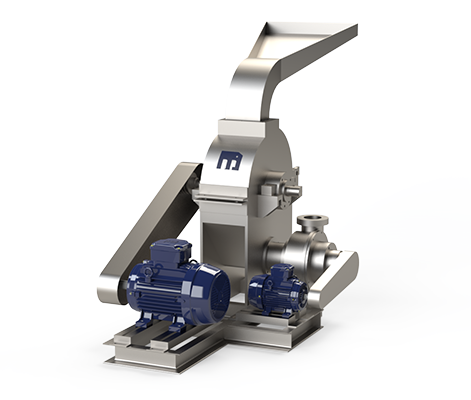
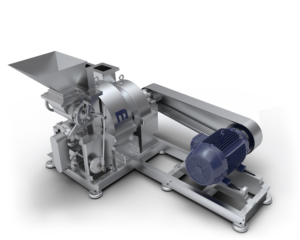
High-Performance Hammer Mills by DP Pulveriser UK
Hammer mills remain one of the most widely used and versatile particle size reduction technologies in modern manufacturing. Their ability to process a diverse range of materials, from food ingredients and pharmaceuticals to minerals, biomass, chemicals, and recycling materials, makes them an essential component of many production facilities throughout the United Kingdom and Europe.
At DP Pulveriser UK, we design and supply advanced hammer mill systems engineered for efficient particle size reduction, high throughput production, and long-term reliability. Whether you require coarse grinding, intermediate size reduction, powder preparation, or pre-processing before fine grinding, our hammer mills provide a proven and cost-effective solution.
Not Sure Which System You Need? Speak With Hammer Mills Specialist.

A hammer mill is a mechanical grinding machine that reduces particle size through repeated impact between rapidly rotating hammers and the material being processed.
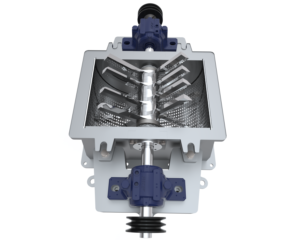
As product enters the grinding chamber, rotating hammers strike the material at high velocity. The particles are shattered and repeatedly impacted until they become small enough to pass through a screen or classification system.
Hammer mills are capable of processing a broad range of materials and are often selected when manufacturers require:
Depending on the application, hammer mills can produce particle sizes ranging from several millimetres down to approximately 100 microns.
The hammer milling process begins with the controlled feeding of material into the grinding chamber.
Inside the mill:
The screen opening, hammer configuration, rotor speed, and feed rate all influence the final particle size distribution.
Hammer mills can process an extensive range of materials including:
This versatility makes hammer mills one of the most widely used milling technologies globally.
Hammer mills are capable of processing large volumes of material efficiently, making them ideal for industrial-scale production.
Many systems can process several tonnes per hour depending on material characteristics and required particle size.
Compared to many fine grinding technologies, hammer mills offer:
By selecting the appropriate screen size and operating parameters, manufacturers can achieve a wide range of particle size distributions.
Hammer mills are engineered to withstand demanding industrial environments and continuous production schedules.
Food manufacturers utilise hammer mills for:
Their ability to process large volumes efficiently makes them popular throughout Europe’s food industry.
Hammer mills are commonly used for:
Sanitary construction ensures compliance with pharmaceutical manufacturing standards.
Applications include:
Hammer mills are frequently specified for:
Hammer mills play a critical role in sustainable processing applications such as:
As Europe continues investing in circular economy initiatives, hammer mills remain an important technology for resource recovery and recycling.
These systems rely on gravity for product discharge and are commonly used for standard grinding applications.
Advantages include:
Pneumatic systems utilise airflow to transport product from the mill.
Benefits include:
These mills maximise screen area around the grinding chamber.
Advantages include:
Both technologies utilise impact grinding, but each serves different purposes.
Many manufacturers utilise hammer mills as a primary size reduction stage before finer milling processes.
Jet mills are designed for micronisation and ultra-fine particle production.
Hammer mills are preferred when:
Air classifier mills combine impact grinding with dynamic classification.
Hammer mills offer:
Air classifier mills provide tighter particle size control for fine grinding applications.
Selecting the correct hammer mill requires evaluating several critical factors.
Hammer mills are available from laboratory and pilot systems to industrial units processing tens of tonnes per hour.
Food and pharmaceutical manufacturers often require:
Certain powders present combustible dust hazards.
DP Pulveriser offers:
These features help manufacturers meet European safety requirements.
DP Pulveriser supports manufacturers throughout:
Our hammer mills serve food processors, pharmaceutical manufacturers, chemical producers, recycling facilities, biomass operators, and industrial mineral processors throughout Europe.
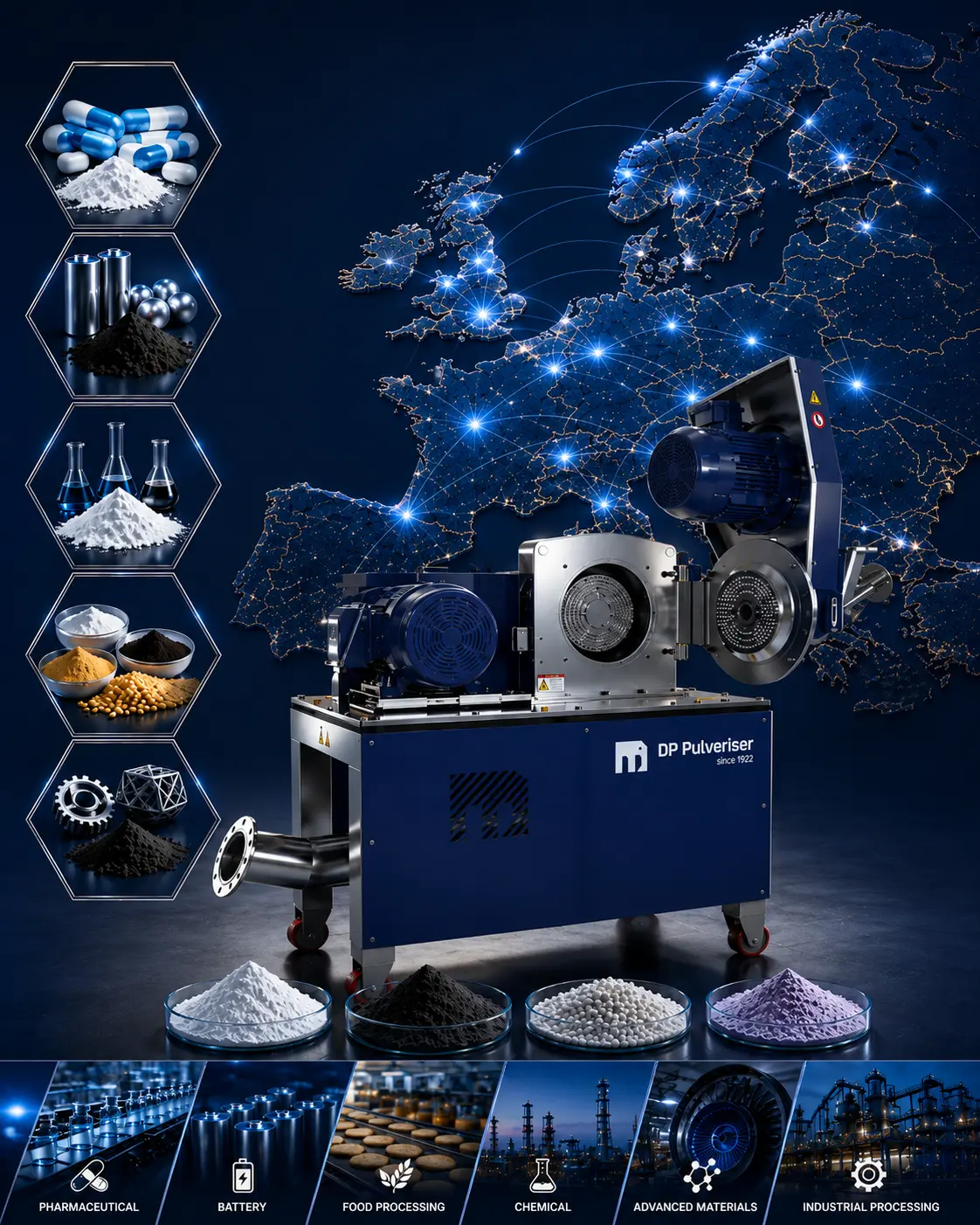
DP Pulveriser supports manufacturers throughout:
Our hammer mills serve food processors, pharmaceutical manufacturers, chemical producers, recycling facilities, biomass operators, and industrial mineral processors throughout Europe.
Whether you are reducing particle size for food production, pharmaceuticals, chemicals, minerals, biomass, or recycling applications, DP Pulveriser UK can provide a hammer milling solution tailored to your process requirements.
Contact our engineering team today to discuss your material, target particle size, throughput requirements, and plant integration needs.
Engineered for precision grinding, dynamic classification, and consistent powder processing performance.
Precision particle reduction for consistent powder performance.
Explore Fine GrindingUltra-fine particle engineering for advanced powder applications.
Explore MicronizationControlled milling for accurate particle size distribution.
Explore Particle Size ReductionIntegrated powder handling for reliable material processing.
Explore Powder Processing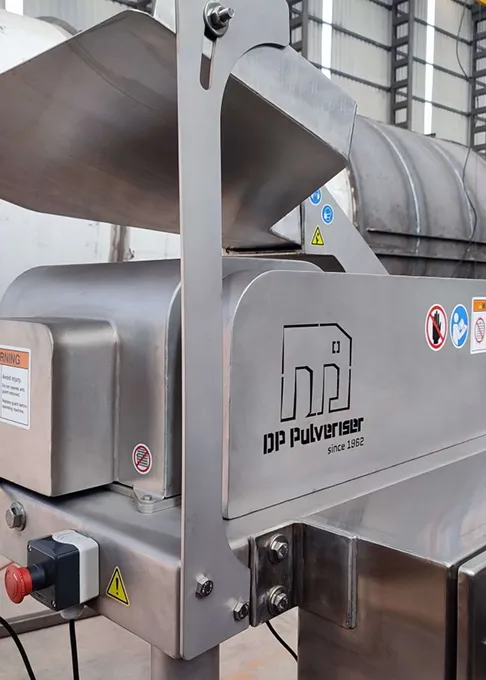
DP Pulveriser combines decades of particle processing experience with modern engineering expertise to deliver hammer mill systems designed for maximum performance and reliability.
Our capabilities include:
Every system is engineered around the specific requirements of the application, ensuring optimal performance, efficiency, and product quality.
Not Sure Which System You Need? Speak With an Engineer
A practical guide to particle size reduction equipment, covering mill types, material behaviour, ...
What is particle size reduction? Learn how milling changes powder performance, throughput, consis...