

Choosing Particle Size Reduction Equipment
A practical guide to particle size reduction equipment, covering mill types, material behaviour, ...
 DP Pulveriser UK - Innovating the Future of Size Reduction
The Ultimate Guide to Ultra-Fine Particle Size Reduction
Advanced Jet Milling Technology by DP Pulveriser UK
When manufacturers require particle sizes measured in microns rather than millimetres, conventional milling technologies often reach their limits. Jet milling represents one of the most advanced methods of particle size reduction available today, delivering ultra-fine powders with exceptional particle size distribution while eliminating contamination associated with traditional mechanical grinding systems.
At DP Pulveriser UK, we design and supply advanced jet milling solutions for pharmaceutical, chemical, food, nutraceutical, battery, mineral, pigment, and advanced materials manufacturers throughout the United Kingdom and Europe.
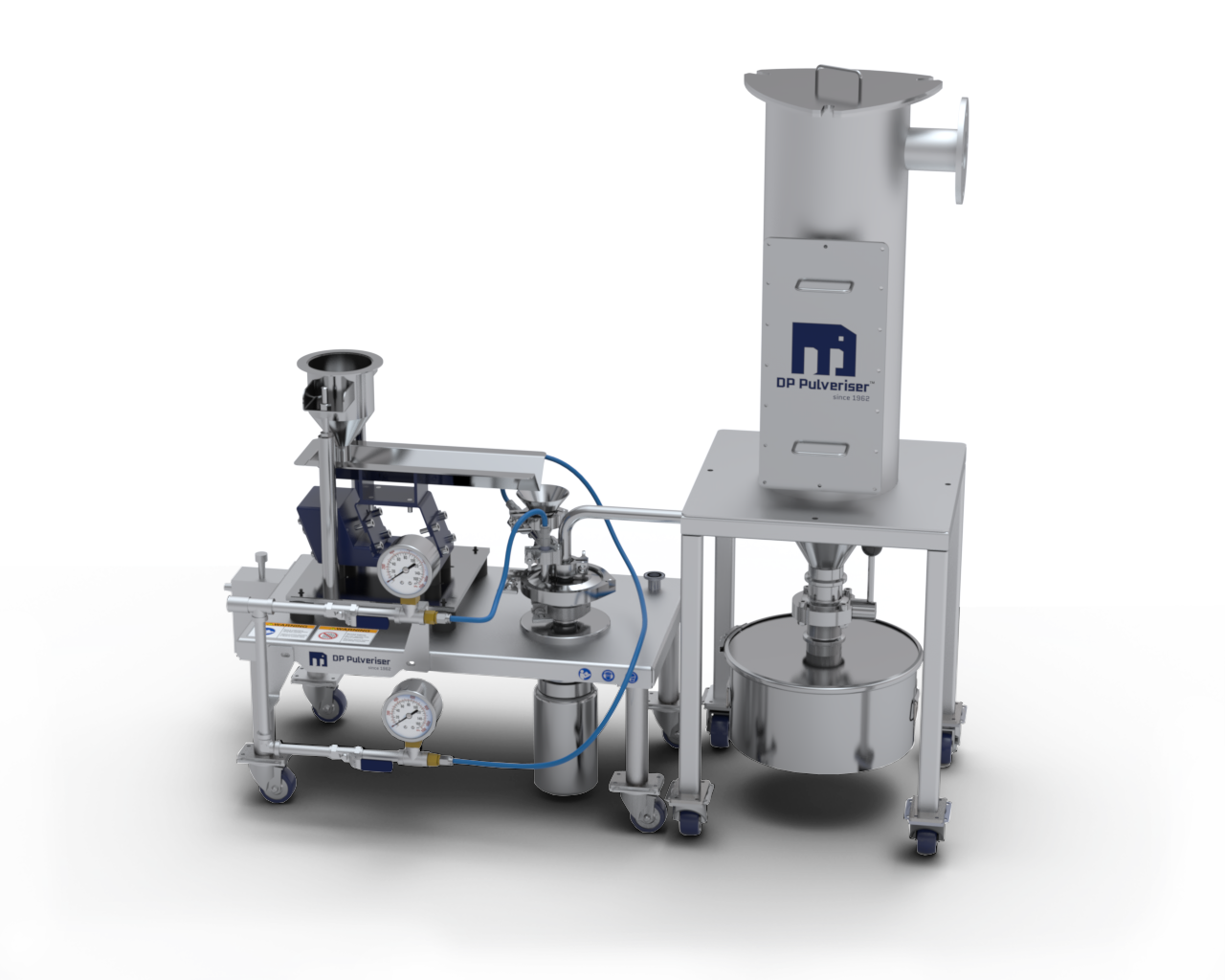
Our jet mills utilise high-velocity compressed air or inert gases to accelerate particles to supersonic speeds, creating particle-on-particle collisions that reduce materials to extremely fine particle sizes without mechanical grinding media.
Not Sure Which System You Need? Speak With Jet Mills Specialist.

A jet mill is an advanced particle size reduction system that uses compressed gas energy rather than rotating mechanical components to grind materials.
Unlike hammer mills, pin mills, turbo mills, or ball mills, jet mills rely on high-velocity gas streams to create intense particle-to-particle impact forces. As particles collide within the grinding chamber, they fracture into progressively smaller sizes until they reach the desired micron range.
This process enables manufacturers to achieve particle sizes as fine as:
The absence of grinding media makes jet milling particularly attractive for contamination-sensitive industries.
The jet milling process begins by feeding material into a grinding chamber where multiple high-pressure gas nozzles generate powerful vortex flows.
These gas streams accelerate particles to extremely high velocities.
As particles collide with one another:
This continuous process produces highly uniform particle size distributions with exceptional repeatability.
Jet mills routinely achieve particle sizes below 10 microns, with certain applications achieving sub-micron performance.
Because there are no hammers, pins, balls, or grinding discs contacting the product, contamination risks are dramatically reduced.
This is especially important for:
Integrated classification systems allow operators to maintain tight particle size distributions and consistent product quality.
Many materials degrade when exposed to heat.
Jet milling generates significantly lower product temperatures compared to many mechanical milling technologies, making it ideal for:
Particle-on-particle grinding ensures minimal metallic contamination and superior product integrity.
Jet mills are widely used throughout Europe’s pharmaceutical industry for micronisation of:
The ability to achieve precise particle sizes directly influences bioavailability, dissolution rates, and therapeutic performance.
Europe’s rapidly expanding battery manufacturing sector increasingly relies on jet milling technology for:
Particle size consistency is critical for battery performance, energy density, and manufacturing efficiency.
Applications include:
Jet mills are frequently specified for:
High-performance materials often require ultra-fine particle sizes for optimal performance.
Applications include:
Fluidised bed jet mills represent the most advanced and widely adopted jet milling technology.
Benefits include:
Spiral jet mills provide exceptional performance for:
Opposed jet systems utilise direct particle acceleration paths for maximum impact energy and ultra-fine particle production.
Hammer mills excel at coarse grinding and high throughput.
Jet mills excel at micronisation and contamination-sensitive applications.
Pin mills are effective for medium-fine grinding.
Jet mills achieve substantially finer particle sizes with superior particle size control.
Ball mills often require longer processing times and may introduce contamination from grinding media.
Jet mills provide cleaner processing and tighter particle size control.
Air classifier mills offer excellent versatility.
Jet mills are preferred when ultra-fine particle sizes below 20 microns are required.
Selecting the correct jet mill requires evaluation of:
Systems may range from laboratory units processing grams per hour to production systems processing several tonnes per hour.
Manufacturers may choose:
Inert gas systems are commonly utilised for explosive or oxidation-sensitive materials.
For pharmaceutical and nutraceutical applications, systems may be engineered to meet:
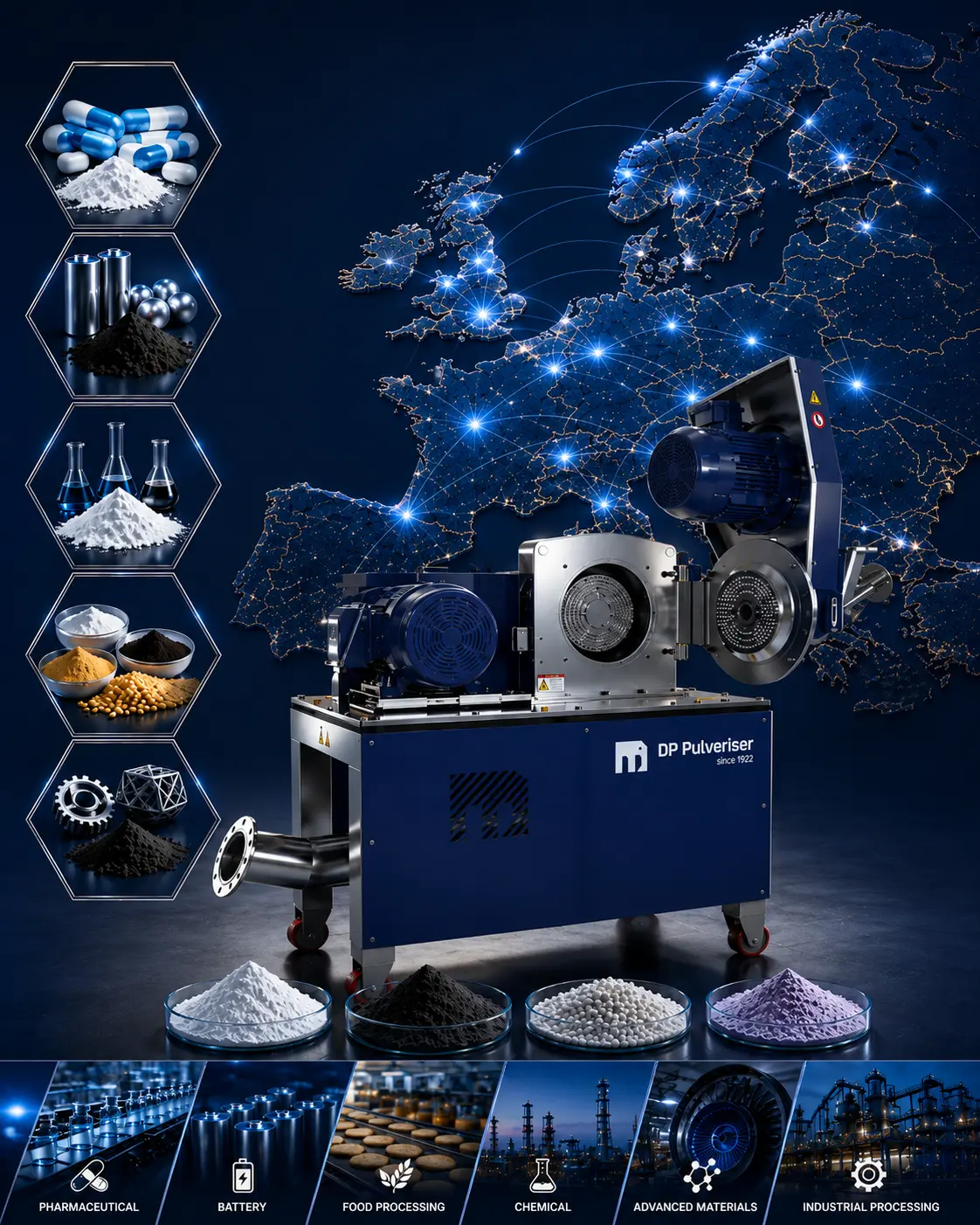
DP Pulveriser supplies jet milling solutions throughout:
Our Jet Milling Systems support manufacturers operating in pharmaceutical processing, battery materials production, advanced ceramics, specialty chemicals, pigments, minerals processing, food ingredients, and other applications requiring precise particle size control and ultra-fine grinding.
DP Pulveriser UK supplies advanced jet mill systems throughout the United Kingdom, Ireland, Germany, France, Italy, Spain, the Netherlands, Belgium, Scandinavia, Eastern Europe, and the wider European market.
Contact our team to discuss your material, target particle size, throughput requirements, and process objectives.
Engineered for precision grinding, dynamic classification, and consistent powder processing performance.
Precision particle reduction for consistent powder performance.
Explore Fine GrindingUltra-fine particle engineering for advanced powder applications.
Explore MicronizationControlled milling for accurate particle size distribution.
Explore Particle Size ReductionIntegrated powder handling for reliable material processing.
Explore Powder Processing
DP Pulveriser combines advanced engineering, process expertise, and application knowledge to deliver jet milling solutions tailored to specific manufacturing requirements.
Our capabilities include:
Whether you require micronisation of pharmaceutical ingredients, battery materials, pigments, advanced ceramics, specialty chemicals, or food ingredients, our engineering team can develop a customised solution optimised for your application.
Not Sure Which System You Need? Speak With an Engineer
A practical guide to particle size reduction equipment, covering mill types, material behaviour, ...
What is particle size reduction? Learn how milling changes powder performance, throughput, consis...