DP Pulveriser UK - Innovating the Future of Size Reduction
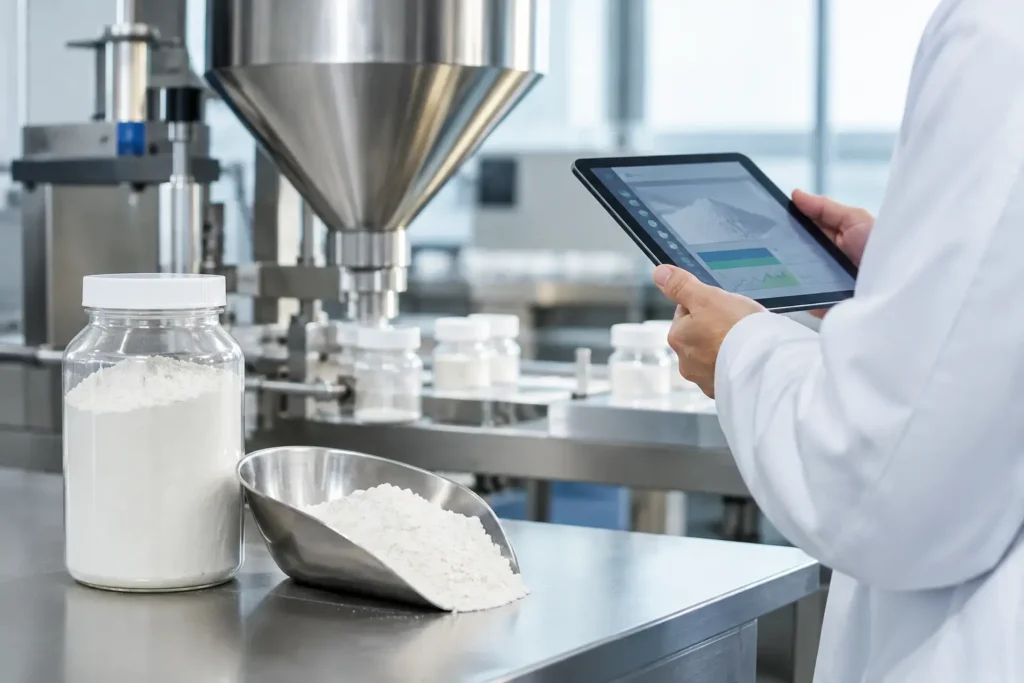
A powder batch can change long before it reaches the mill. A new raw-material supplier, a small moisture variation, an altered screen condition or an incorrect transfer route can all affect the finished product. Powder traceability gives manufacturers the evidence to identify where that change occurred, contain its impact and prevent it recurring.
For regulated and performance-critical production, traceability is not simply a record of lot numbers. It is the controlled connection between incoming material, process conditions, equipment status, in-process checks, packaging and final dispatch. When designed into the processing line, it protects product quality without creating unnecessary administrative burden on the production team.
What powder traceability needs to capture
Effective traceability follows material through the entire process, rather than beginning at final packing. The level of detail will depend on the application, risk profile and regulatory requirements, but the objective remains consistent: a manufacturer should be able to trace a finished batch backwards to its component materials and processing history, then trace any raw-material lot forwards to every affected product batch.
For powder processing operations, that record commonly starts with supplier approval, goods-in inspection, certificates of analysis and assigned material lots. It should then establish where material is stored, how it is identified, when it is released for production and whether it has been subject to sampling, quarantine or rework controls.
The production record must add the information that turns basic stock control into meaningful process traceability. This includes the equipment line used, campaign or batch number, operator confirmation, start and finish times, key milling or classification settings, sieve or screen specification, and the results of agreed quality checks. For applications involving blends, it must also preserve the identity and proportion of each constituent material.
A final record should connect the released product to packaging materials, pack dates, retained samples, quality disposition and customer shipment details. If a deviation is identified months later, this structure allows the manufacturer to isolate affected stock with confidence rather than placing a wider volume of material on hold.
Why powder processing creates specific traceability risks
Powders are mobile, easily dispersed and often handled in shared equipment. Those characteristics make them efficient to process at scale, but they also increase the risk of mix-ups, cross-contamination and loss of batch identity.
Material may pass through bulk bags, drums, vacuum conveying lines, hoppers, rotary valves, mills, classifiers, mixers, intermediate containers and filling stations. Each transfer is a point at which identification can be lost unless the system and operating procedure make the correct route clear. Manual decanting and temporary storage require particular discipline, especially where multiple grades have similar appearance.
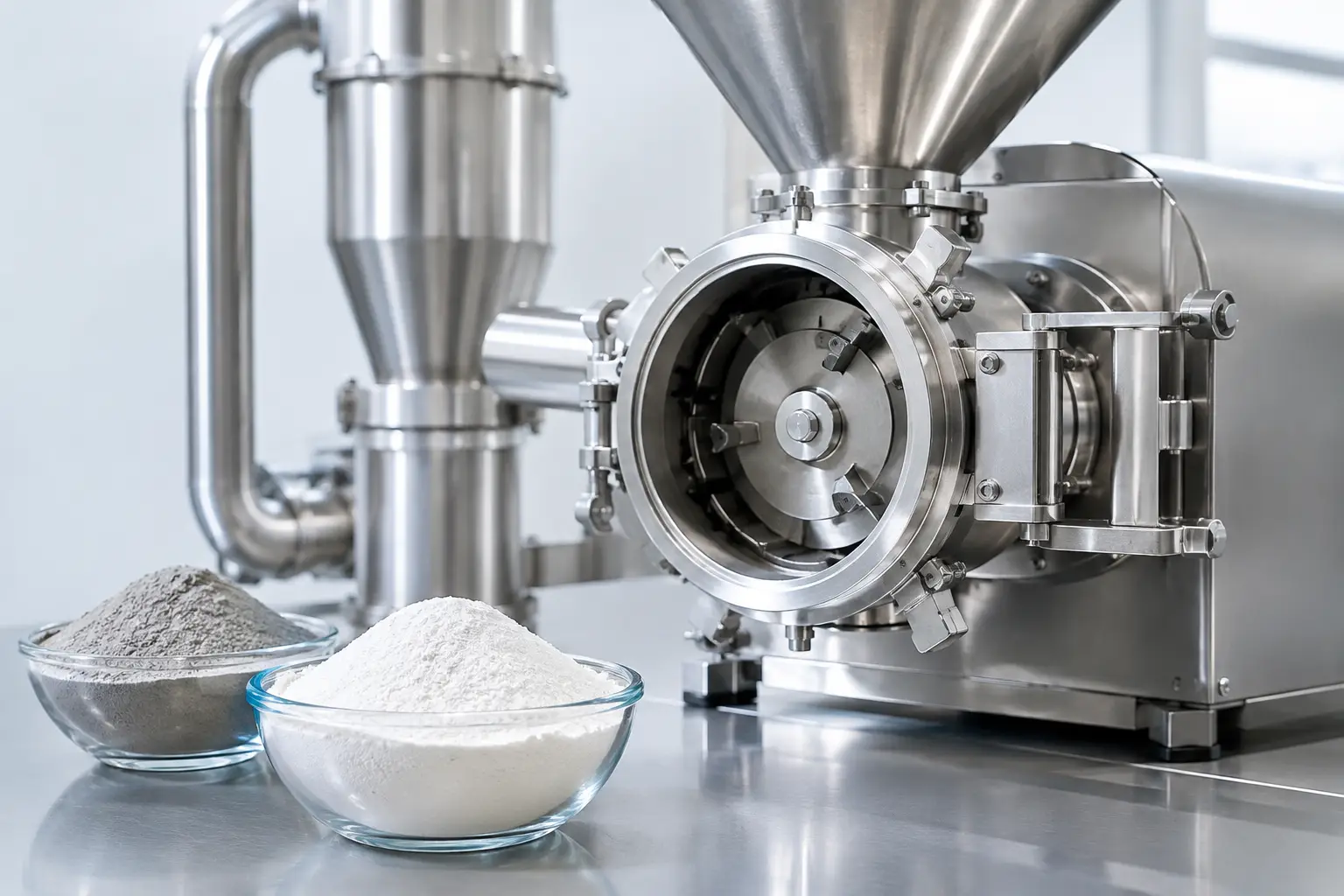
Particle size reduction adds another dimension. Two batches from the same incoming lot may perform differently if they were processed through different mill configurations or under different operating conditions. Rotor speed, grinding pressure, feed rate, air flow, classifier settings and product temperature can all influence particle size distribution, flowability, density and downstream behaviour.
That does not mean every machine parameter must be recorded at maximum resolution. Excessive data can obscure the variables that matter. The better approach is to identify critical process parameters during development and record those that have a demonstrated relationship with product quality, safety or compliance.
Traceability and contamination control
Traceability is closely linked to line clearance and cleaning verification. A batch record can confirm which mill was used, but it should also establish that the equipment was released after cleaning, that the previous product was suitable for the planned campaign sequence and that any necessary inspection was completed.
This is particularly relevant for food ingredients, nutraceuticals, pharmaceuticals, pigments and battery materials, where carryover can create quality, safety or performance issues. In some cases, dedicated contact parts or segregated processing lines may be the most appropriate engineering decision. In others, validated cleaning, controlled campaign planning and documented release procedures provide the required assurance. The correct solution depends on material hazards, cleaning difficulty, production volume and the consequence of contamination.
Build traceability into the line design
Reliable traceability is easier to achieve when it is considered during equipment selection and line layout. Retrofitting labels and paper checks onto a complex process can improve control, but it cannot fully compensate for poorly defined material flow.
A well-engineered powder line should minimise ambiguous hand-offs. Clearly identified charge points, enclosed conveying routes, controlled discharge arrangements and sensible buffer storage all help maintain batch integrity. Where practical, each container and transfer point should have a defined identity that follows the material through production.
Automation can strengthen control further. Barcode or RFID scanning can verify that the correct material is charged to the correct batch. Recipe management can restrict unauthorised changes to operating setpoints. Integrated control systems can collect equipment status, alarms and process data automatically, reducing the reliance on manual transcription.
However, automation is not a substitute for sound process design. A scanning system cannot prevent a mix-up if two materials can physically be tipped into the same unlabelled hopper. Similarly, recording a setpoint does not prove that a mill is producing to specification if the process has not been validated and monitored. Engineering, procedures and data controls must work together.
Define the critical data before collecting it
The most useful traceability systems are designed around decisions the business may need to make. If a customer query, out-of-specification result or supplier notification occurs, what must the technical team establish quickly? The answer should define the data structure.
For many operations, the critical questions are straightforward: Which raw-material lots were used? Which equipment processed the batch? What were the approved operating conditions? Who released the line and product? Which quality results apply? Where is the affected material now?
Additional detail may be required for high-specification materials. Battery powders may need strong control of environmental conditions, metallic contamination risk and classification performance. Pharmaceutical production may require electronic records, audit trails and tightly managed change control. Food and agricultural applications may place greater emphasis on allergen segregation, provenance and supplier certification.
The principle is to capture sufficient evidence to support rapid investigation and release decisions while keeping the record usable on the shop floor. Operators should not need to navigate a complicated system to complete routine work correctly. Clear workflows, sensible screen layouts and defined exception handling are as important as the database behind them.
Use traceability to improve process performance
The immediate value of powder traceability is often associated with recall readiness and compliance. Its wider value lies in process improvement. When quality results are connected to raw-material characteristics and machine settings, manufacturers can identify trends that would otherwise remain hidden.
For example, a recurring shift in particle size distribution may correlate with a particular feedstock moisture range, worn classifier components or a change in mill feed rate. An increase in rejected batches may reveal that material has been stored for too long before processing. Variation in bulk density may point to inconsistent mixing time or pneumatic conveying conditions.
This information enables production and engineering teams to move from reacting to failures towards controlling variation. It also supports more accurate scale-up. Data from laboratory and pilot trials can be compared with commercial production runs, helping establish the operating window required to maintain target product performance at higher throughput.
DP Pulverizer UK supports this approach through application-specific milling, classification, mixing and powder handling systems that can be configured around the material, required particle size and production control strategy. The objective is not simply to install individual machines, but to create a processing line where material flow, process data and product quality remain connected.
Avoid the common weak points
Traceability programmes often fail at the interfaces between systems and teams. Goods-in may use one identification method, production another and warehouse dispatch a third. The resulting gaps are usually exposed during an investigation, when records must be reconciled manually under time pressure.
Another weak point is rework. Rework material needs a clear status, defined maximum inclusion rate and traceable link to both the source batch and the new batch receiving it. Treating it as ordinary raw material can distort the manufacturing history and complicate any future containment action.
Change control also matters. A new supplier, revised mill component, updated recipe or altered cleaning method may affect product characteristics. Traceability records should make it clear when the change took effect and which batches were produced before and after implementation.
Finally, review the system against realistic scenarios. Select a finished batch and test whether the team can identify all source materials, process records and customers within an agreed period. Then start with an incoming lot and trace it forward through stock, work in progress and dispatch. A traceability system is only proven when it works under pressure.
The strongest powder traceability programmes make the correct action the easiest action at every stage of production. When material identity, process control and equipment design are aligned, the result is more than a better audit trail: it is a more predictable, efficient and defensible manufacturing operation.