DP Pulveriser UK - Innovating the Future of Size Reduction
A useful ribbon blender review should begin with the material, not the machine catalogue. A ribbon blender can provide highly consistent batch mixing for free-flowing powders, granules and dry blends, but its performance depends on bulk density, particle size distribution, fill level, ingredient ratio and the process duty around it. For production teams handling demanding formulations, the right question is not whether ribbon blending works. It is whether the blender has been engineered for the required blend uniformity, hygiene standard, batch cycle and operating environment.
What a ribbon blender does well
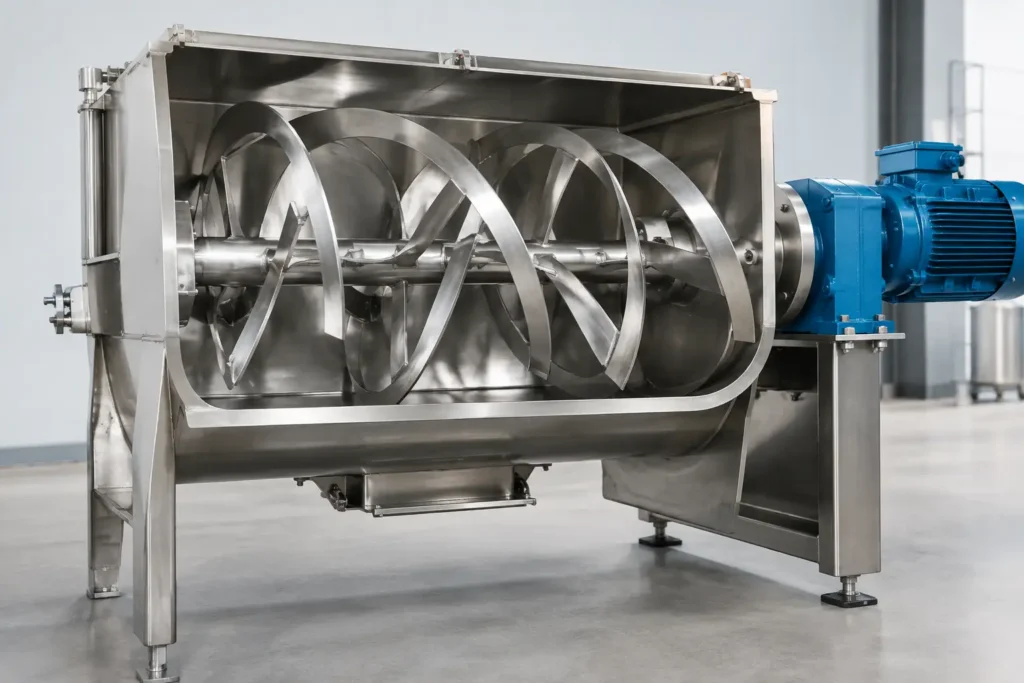
A ribbon blender uses inner and outer helical ribbons rotating on a common shaft within a horizontal U-shaped trough. The opposing ribbon flights move material in different axial directions while lifting and folding it through the batch. This creates a controlled convective mixing action that is particularly effective for dry powders and granular materials with reasonably compatible flow characteristics.
In the right application, the design offers a strong balance of throughput, repeatability and energy efficiency. It is widely used for food ingredients, nutraceutical premixes, agricultural products, mineral compounds, pigments, polymer additives and chemical formulations. A properly specified machine can process substantial batch volumes with relatively short mixing times, making it a practical choice where batch production remains preferable to continuous processing.
The principal attraction is not simply speed. It is the ability to produce repeatable mixing across successive batches when fill volume, recipe sequence and operating parameters are controlled. That repeatability supports product quality, reduces rework and gives production managers a more predictable basis for scheduling downstream milling, conveying, packing or further processing.
Ribbon blender review: where performance is won or lost
A mixer may appear straightforward, yet small engineering decisions have a material effect on blend quality and long-term reliability. Reviewing a ribbon blender properly means looking beyond nominal vessel volume and motor power.
Material behaviour determines suitability
Ribbon blenders are best suited to dry, free-flowing materials. They can handle many cohesive powders, but very sticky, high-fat, wet or paste-like products may build up on the ribbons and trough walls. In those cases, a paddle mixer, ploughshare mixer or another high-intensity configuration may be more appropriate.
Density differences also need careful assessment. When a fine, low-density component is mixed with a much denser granular ingredient, segregation can occur during charging, mixing, discharge or conveying. The blender may achieve an acceptable result at the end of the mixing cycle but lose uniformity before the material reaches the next process stage. Equipment selection therefore has to consider the whole material path, including bag discharge, vacuum transfer, screw conveying and intermediate storage.
Particle size matters for the same reason. Ingredients with closely matched particle size and density generally blend more readily. Where ratios are low, such as micronutrients, flavours, colours or active ingredients added at fractions of a percentage, the process may require pre-blending, controlled addition points or a dedicated intensifier system. Sampling plans should prove homogeneity rather than relying on visual assessment.
Batch fill level is not a minor setting
Most ribbon blenders perform best within a defined working capacity rather than when filled to the top. Underfilling reduces material interaction with the ribbons. Overfilling restricts the circulation needed for efficient folding and can increase cycle time. The usable batch volume must be matched to the normal production batch, not merely the largest batch that can physically fit in the trough.
This has direct implications for scale-up. A pilot unit may give excellent results with a particular fill ratio and mixing time, while a larger production vessel behaves differently because of geometry, ribbon clearance, shaft speed and ingredient addition method. Process development should establish a scale-up basis using representative material, target batch size and realistic production sequencing.
Discharge design affects both yield and cleaning
The discharge valve is a critical part of the machine. A poorly designed outlet can retain product, slow batch changeover and create a point where segregation occurs. Full-width bomb-bay doors or carefully engineered flush-mounted valves can improve discharge efficiency for many dry products, while the correct seal arrangement helps prevent leakage and product ingress into mechanical areas.
For high-value formulations, retained material is not just a housekeeping concern. It affects yield and traceability. For allergen-controlled, pharmaceutical or highly coloured products, it can also introduce cross-contamination risk. The blender should be specified with cleanability in mind from the outset, including access doors, internal surface finish, shaft seal design, drainability where wet cleaning is used, and the time required for validated cleaning between campaigns.
Engineering features worth assessing
The mechanical specification should reflect the actual duty cycle rather than a generic equipment description. For routine industrial service, assess the gearbox service factor, bearing arrangement, shaft deflection, ribbon construction, weld quality and the availability of replacement wear components. These details influence uptime far more than cosmetic finish.
The internal clearances between ribbon, trough and end walls deserve particular attention. Tighter clearances can reduce stagnant regions and improve material turnover, but they also demand accurate fabrication and consideration of any abrasive solids in the product. Mineral powders, glass-filled compounds and certain battery materials can cause significant wear. In such cases, material selection, replaceable liners or hard-facing may offer a lower total cost of ownership than a standard stainless steel construction.
The choice of contact material should follow the product and cleaning regime. Food, nutraceutical and pharmaceutical applications commonly require stainless steel with an appropriate internal finish, while corrosive chemical products may need higher-alloy materials. Carbon steel can be suitable for some industrial minerals and agricultural blends, provided contamination, corrosion and clean-down requirements are understood.
A variable speed drive is often valuable because it enables the mixing profile to be refined during commissioning and adjusted for recipe variation. However, more speed is not automatically better. Excessive tip speed can degrade friable particles, generate heat, alter particle size distribution or introduce unwanted aeration. The objective is the minimum energy input needed to meet the required blend uniformity within the available cycle time.
Containment, safety and compliance
A ribbon blender must be reviewed as part of a safe powder processing system. Fine powders may present dust exposure, explosion or cross-contamination hazards. The equipment arrangement should account for dust extraction, sealed charging, controlled venting, earthing, pressure relief where required and suitable hazardous-area components when the dust risk assessment calls for them.
Operator access also needs discipline. Interlocked guards, emergency stops and lockout provisions are essential around rotating shafts, drive assemblies and access covers. If manual ingredient addition is part of the process, the charging height, bag handling method and exposure controls should be designed around the operator rather than treated as an afterthought.
For regulated production, documentation can be as significant as mechanical performance. Fabrication records, material certificates, surface-finish specifications, weld procedures, factory acceptance testing and, where appropriate, commissioning support all contribute to a defensible installation. Pharmaceutical and food producers may require further support for qualification, cleaning validation and traceable change control.
The practical limits of ribbon mixing
Ribbon blenders are versatile, but they are not universal mixers. They are less suitable where very fast dispersion of minor liquid additions is required, where agglomerates must be broken down aggressively, or where the product behaves as a paste. A liquid spray system can distribute small binder or flavour additions, yet the achievable result depends on spray pattern, dosage rate, droplet size and the powder’s absorption characteristics.
Similarly, a ribbon blender should not be expected to correct upstream material variability. Inconsistent milling can produce wide particle size distributions, poor flow and variable bulk density that make uniform blending harder to achieve. If the process requires precise particle size reduction before mixing, the milling and classification stage should be engineered alongside the mixer. This is where an integrated powder processing approach can remove bottlenecks that a standalone blender cannot solve.
Selecting a blender for production rather than a datasheet
The strongest equipment specification is built from trials and measurable acceptance criteria. Define the blend uniformity target, sample locations, allowable mixing time, maximum retained product, batch size range, cleaning method and expected annual operating hours. Include the actual recipe sequence and any constraints imposed by upstream milling or downstream packaging.
A reputable supplier should be able to assess the application at laboratory or pilot scale before finalising a production design. The value of this work is not limited to choosing vessel volume. It establishes mixing time, ingredient order, fill level, speed range, discharge behaviour and any need for intensifier choppers or liquid addition. DP Pulverizer UK applies this process-led approach across mixing, milling, classification and material handling systems so that individual machines perform as one production line.
Procurement teams should also examine service access and spares strategy. A low purchase price can become expensive if seal replacement requires extended downtime, bearings are difficult to access or specialist components have long lead times. The more useful comparison is lifecycle cost: energy use, cleaning time, maintenance intervals, product losses and the financial impact of unplanned stoppages.
The right ribbon blender is rarely the largest or highest-powered option. It is the unit that gives the required blend quality with a repeatable cycle, straightforward cleaning and a design margin suited to the real material. Before committing to a specification, test the recipe under representative conditions and let the measured result set the engineering standard.