DP Pulveriser UK - Innovating the Future of Size Reduction
A mixer that performs well in trials can become a production bottleneck the moment volumes rise, product variants increase, or tighter uniformity targets are introduced. That is why batch mixing vs continuous mixing is not a theoretical comparison for process teams. It is a practical engineering decision that affects blend quality, throughput, traceability, cleaning time, labour demand and total operating cost.
For powder processors, the right answer depends less on preference and more on the interaction between material behaviour, production strategy and downstream requirements. Free-flowing materials with stable feed characteristics may suit continuous operation extremely well. Formulations that vary often, require strict lot segregation, or involve difficult-to-handle ingredients may still favour batch processing. The decision should be made around process realities, not around a general assumption that one format is more advanced than the other.
Batch mixing vs continuous mixing in production
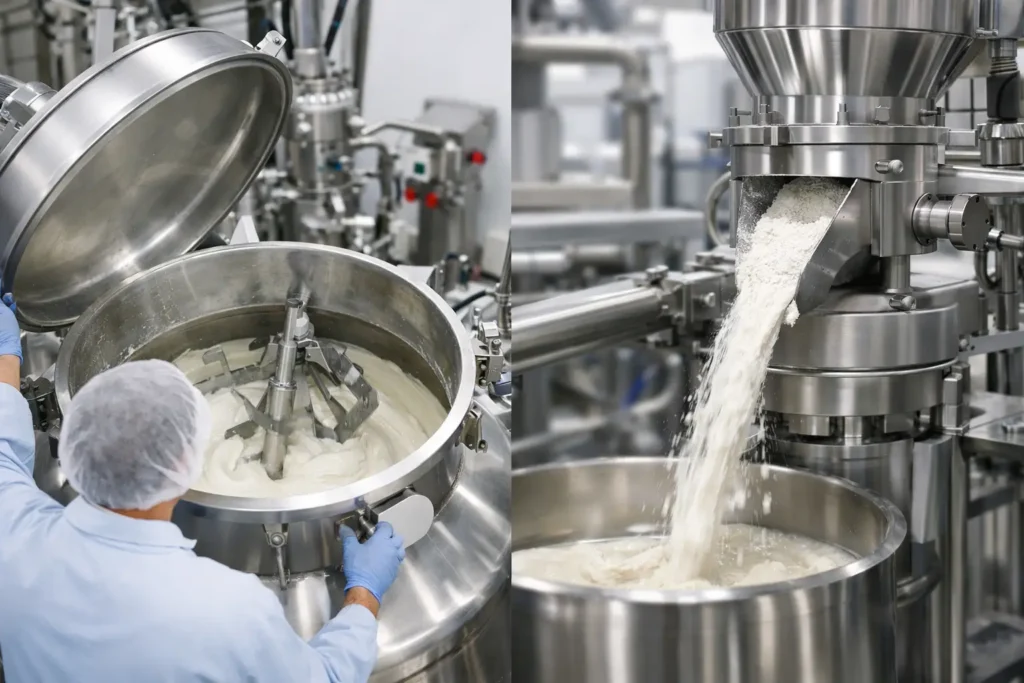
At a high level, batch mixing handles a defined quantity of material in discrete lots. Ingredients are charged, mixed for a set period, then discharged before the next cycle begins. This gives operators a clear start and finish point for each production run and creates a direct relationship between a physical batch and a quality record.
Continuous mixing works differently. Raw materials are fed into the mixer at controlled rates, the material moves through the machine continuously, and mixed product exits without stopping the process between lots. Rather than controlling a single vessel residence time in the traditional sense, the process depends on stable feed rates, mixer design, residence time distribution and reliable process control.
Neither method is automatically superior. Batch mixing often provides simplicity, flexibility and strong traceability. Continuous mixing can deliver higher throughput, more consistent output over long campaigns and better use of floor space and labour. The technical fit depends on what the plant needs the process to do every shift, every day.
Where batch mixing performs best
Batch systems remain common across pharmaceuticals, food, speciality chemicals and performance materials for good reason. They are well suited to operations where recipes change regularly, production volumes are moderate, and quality release is tied to identifiable lots.
A batch process gives operators and quality teams strong control over ingredient addition and mixing time. If a formulation includes low-dose actives, colourants, functional additives or fragile components, a defined cycle can be easier to validate and monitor. It also supports segregation of products where cross-contamination risk must be tightly managed.
From a practical standpoint, batch mixing can be easier to integrate into facilities already organised around weighed ingredients, intermediate bulk containers and lot-based documentation. Scale-up from development to production can also feel more intuitive because the process follows a familiar sequence – charge, mix, sample, discharge.
That said, batch systems carry unavoidable downtime. Charging, discharging, cleaning and waiting for analytical release all reduce effective throughput. If the plant is running long campaigns of the same product, those pauses can become a major cost driver. Variability between batches can also appear if fill levels, raw material properties or operator practices shift over time.
Where continuous mixing gains an advantage
Continuous mixing is often attractive when the goal is steady, high-output production with fewer interruptions. For manufacturers processing large volumes of the same formulation, the ability to maintain a stable process rather than repeatedly restarting one can improve both efficiency and consistency.
The strongest case for continuous operation usually appears where upstream and downstream equipment are also continuous. If milling, feeding, conveying, drying, granulating or packing are designed for uninterrupted flow, a continuous mixer can help remove transfer points and idle time between stages. That has implications not only for throughput, but also for containment, dust control and plant layout.
Continuous systems can also reduce the footprint required for a given output. Instead of relying on large vessels to process one lot at a time, a smaller mixer operating continuously may achieve the same or higher production rate. Labour demands may fall as well, particularly where automated feeding and control systems reduce manual intervention.
The trade-off is that continuous mixing places much greater emphasis on feed accuracy and process stability. If ingredient feeders drift, bulk density changes significantly, or powder flow becomes erratic, blend quality can move out of specification quickly. In batch processing, problems may be isolated to one lot. In continuous processing, deviations can affect a larger volume before they are detected unless process monitoring is strong.
The real deciding factors
The most useful way to assess batch mixing vs continuous mixing is to look beyond mixer type and focus on the behaviour of the whole process.
Material characteristics come first. Powders with poor flow, broad particle size distribution, cohesion, electrostatic tendency or high sensitivity to moisture can behave very differently under continuous feeding than they do in a batch vessel. If the feed system cannot present each ingredient reliably, the mixer itself cannot compensate for unstable input conditions.
Formulation complexity is equally important. A simple blend of free-flowing powders is a very different duty from a recipe containing micro-ingredients, liquid additions or ingredients with sharply different densities. As formulation complexity increases, the need for controlled residence time, precise dosing and predictable dispersion also increases.
Production strategy matters just as much as powder behaviour. Plants making a small number of products in long campaigns often benefit most from continuous processing. Sites handling frequent changeovers, seasonal recipes or customer-specific formulations may find that batch systems remain more practical and economical.
Quality requirements can shift the balance in either direction. In regulated environments, batch processing offers straightforward lot definition and familiar validation pathways. Continuous processing, however, can support excellent quality performance when supported by the right feeder accuracy, instrumentation and control philosophy. The choice is not simply about compliance. It is about how compliance is achieved and maintained.
Scale-up, control and operating cost
Scale-up is one of the areas where assumptions can become expensive. A batch mixer that works in a pilot vessel may not behave identically in a production-sized machine, particularly where fill level, shear profile or discharge behaviour changes. Continuous systems also require careful scale-up, but they can offer a more direct path when the key variables – feed rate, residence time and specific energy input – are well characterised.
Operating cost should be judged across the full process, not only the purchase price of the mixer. Batch systems may involve lower initial complexity, but they can consume more labour time, more cleaning hours and more floor space for equivalent output. Continuous systems may require a higher level of integration and controls, yet they often improve utilisation and lower unit cost over sustained production.
Energy performance depends on the application. In some powder processes, continuous operation reduces repeated start-stop losses and improves overall efficiency. In others, the difference is marginal and the larger savings come from better material handling, more consistent feeding or reduced rework.
Hygiene, containment and changeover
For food, nutraceutical, pharmaceutical and high-value chemical applications, cleaning strategy is often as important as mixing performance. Batch mixers can be easier to isolate, inspect and validate between lots, especially where washdown or manual verification is required. That makes them attractive for short runs and allergen-sensitive or multi-product environments.
Continuous systems can perform very well in contained or hygienic production, but changeover planning becomes critical. If the line is expected to run many products each week, the benefit of continuous output can be eroded by stoppages for clean-down and line clearance. If it is dedicated to a narrow product family, the economics often improve considerably.
This is where system design matters. Feeders, transfer equipment, discharge points and dust control all influence how cleanable and maintainable the installation will be. The best mixing solution is rarely just a mixer. It is an engineered process line built around the realities of the product and the site.
Choosing the right route for your plant
A sound decision starts with a few direct questions. Is production constrained by throughput, by changeover time, or by inconsistent blend quality? Are formulations stable enough for continuous feeding? Does the site need lot-by-lot traceability, or would defined time-based or mass-based traceability be acceptable? Is the process likely to stay within one product family, or will frequent recipe changes remain part of the business model?
Those questions usually reveal whether the priority is flexibility or sustained output. Batch mixing is often the right answer where control, segregation and recipe agility lead the specification. Continuous mixing is often the stronger option where high volumes, integrated flow and lower unit cost are the main targets.
For many manufacturers, the next step is not choosing one concept in isolation but testing the material properly. Trials at laboratory and pilot scale can show how a powder blend responds to residence time, feeder variability, shear level and discharge behaviour before capital is committed. For processors moving from development to full production, that engineering work is where performance gains are secured and scale-up risk is reduced.
The best plants do not ask which mixing method is fashionable. They ask which one will hold specification, support growth and run reliably under real production conditions. That is the question worth answering before any equipment order is placed.