DP Pulveriser UK - Innovating the Future of Size Reduction
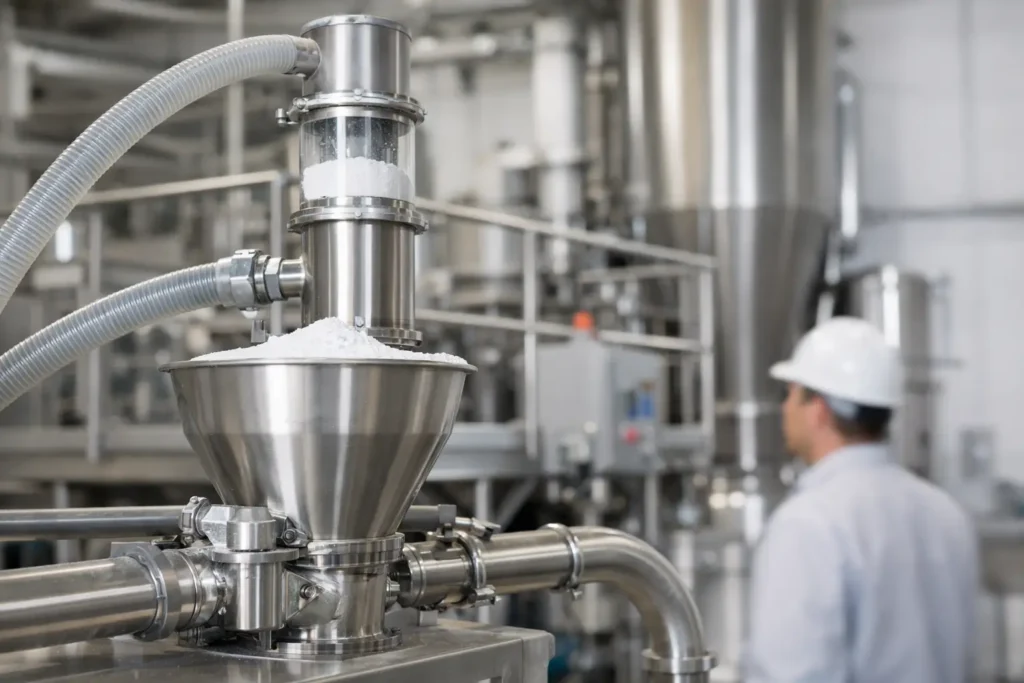
A conveying line can be the source of a production bottleneck long before operators see a blocked pipe or a failed blower. Poorly controlled transfer can segregate a blend, damage fragile particles, introduce contamination or consume disproportionate energy. This powder conveying system design guide sets out the engineering decisions that determine whether a system delivers stable throughput, clean operation and consistent product quality.
Start with the powder, not the conveyor
Powders do not behave as a single material class. A free-flowing mineral, cohesive pharmaceutical excipient, aeratable pigment and hygroscopic food ingredient may share a nominal particle size, yet require entirely different handling conditions. System design must therefore begin with measured material behaviour rather than assumed bulk density or a supplier data sheet alone.
Particle size distribution is central, but it is only one input. Engineers should assess bulk and tapped density, moisture content, particle shape, flow function, permeability, compressibility, abrasiveness and sensitivity to shear or impact. Electrostatic behaviour, temperature sensitivity and dust explosibility also influence the equipment specification. For fine powders, a small change in moisture or the proportion of fines can materially alter conveying performance.
The process duty matters equally. Define the required mass flow rate, operating hours, batch size, transfer distance, vertical lift, receiving-vessel pressure and whether the line must feed a mill, classifier, mixer, reactor, packing machine or storage silo. A system designed for intermittent bag-dump transfer has different control and cleaning requirements from one supplying a continuous high-throughput milling line.
Where a process is being scaled from laboratory or pilot operation, representative trials are particularly valuable. The behaviour of a few kilograms in a short test line does not always predict performance through a full production route with longer pipe runs, multiple bends and larger receivers.
Choose the conveying method around the duty
The principal choice is usually between mechanical conveying and pneumatic conveying. Neither is universally better. The correct selection depends on product characteristics, layout constraints, hygiene requirements, distance, capacity and the desired degree of containment.
Mechanical systems such as screw conveyors, flexible screws, bucket elevators and belt conveyors can be efficient for short, accessible routes and products that tolerate contact with moving components. They can offer predictable metering and lower energy use for suitable duties. However, internal surfaces, bearings and transfer points must be considered carefully where contamination control, rapid cleaning or highly abrasive material is involved.
Pneumatic conveying is often preferred when a plant requires enclosed transfer between process stages, flexible routing or dust-controlled handling. It can transport powders horizontally and vertically through relatively compact pipework, reducing manual intervention and open transfer points. The trade-off is that compressed air or blower energy, wear, product degradation and receiver filtration must all be engineered into the design.
Dilute phase versus dense phase
Dilute-phase pneumatic conveying carries particles at relatively high air velocity. It suits many free-flowing, non-fragile powders and offers straightforward operation across long distances. Yet high velocity can increase pipe wear with abrasive products and generate attrition, heat or fines where particle integrity is critical.
Dense-phase conveying moves material at lower velocities and higher solids loading, typically in slugs or dunes. It can reduce degradation and abrasion, making it attractive for fragile granules, abrasive minerals and materials where dust generation must be limited. It also demands more precise control of air pressure, pipeline conditions and feed behaviour. A dense-phase system will not compensate for a poorly designed inlet or an inconsistent feed source.
Vacuum conveying is useful for contained, lower-capacity transfer, especially from bag tipping stations, IBCs or small process vessels. Pressure conveying can achieve higher capacities and longer routes. In some plants, a combined approach gives the best result: vacuum collection from local points followed by pressure transfer to a central destination.
Design the system as a controlled process route
A conveyor is not simply a pipe, screw or blower. Its performance is defined by the interfaces before and after it. Material must enter the system consistently, travel without unwanted separation or blockage, then discharge into a receiver that can separate conveying air efficiently and feed the next stage at the required rate.
The feed arrangement is a frequent source of instability. Hopper geometry, outlet size, agitation, fluidisation and feeder selection must be matched to the powder’s flow properties. A rotary valve may provide an effective airlock for a free-flowing product, but it can smear, compact or bridge cohesive materials. Screw feeders provide controlled dosing, while pressure vessels may be required for high-pressure dense-phase duties. The feeder should be selected as part of the conveying calculation, not added after the pipeline has been specified.
Pipeline routing deserves the same attention. Keep runs as short and direct as practical, while allowing access for inspection and maintenance. Excess bends add pressure loss and wear. Bend radius, orientation and construction material should reflect both the powder and conveying regime. Abrasive applications may need hardened bends or replaceable wear sections; sensitive powders may need gentler routing to protect particle form.
At the receiving end, filter area, media selection and cleaning method determine whether air separation remains stable. Inadequate filtration raises pressure drop, reduces capacity and increases the risk of dust escape. The receiver must also accommodate the material’s bulk density, batch volume, discharge rate and any requirement for weighing, sampling or downstream dosing.
Protect product quality throughout transfer
Conveying can alter the product just as certainly as milling or mixing. Fine powders may agglomerate under moisture exposure, segregate because of velocity changes, or accumulate electrostatic charge. Friable materials can break down at feeders, bends and high-impact discharge points. For applications with tight particle size control, these effects can shift final product performance.
The design response depends on the mechanism. Reducing pneumatic velocity may limit attrition, while a different feeder can reduce compaction. A polished stainless-steel contact surface may support hygiene and cleanability, but highly adhesive material may still require vibratory assistance, air pads or a different hopper angle. For food, pharmaceutical and nutraceutical production, hygienic design also includes drainability, crevice control, suitable seals and validated cleaning arrangements where required.
Contamination control should be considered across the complete route. This includes foreign-body protection, magnet placement, sieve integration, gasket selection and the management of product retained in dead zones. Where multiple formulations share a line, the time and effectiveness of changeover can carry more operational value than the lowest initial equipment price.
Build safety and compliance into the specification
Fine powders can create hazardous atmospheres, and dust exposure presents occupational and housekeeping risks even where explosion potential is low. A conveying design should be supported by a formal dust hazard assessment and aligned with applicable UK requirements, including DSEAR and ATEX obligations where relevant.
The required safeguards depend on the dust’s test data and the installed environment. They may include earthing and bonding, explosion venting, suppression, isolation valves, flame-free venting, pressure-resistant construction or an inerting strategy. These measures must work as a coordinated system. Installing an explosion vent on a receiver, for example, does not by itself protect connected pipework or upstream equipment.
Containment also matters for operator protection and product recovery. Closed transfer, effective filtration and correctly designed connections reduce fugitive dust. For potent, sensitising or high-value materials, the target containment level may determine the entire equipment architecture, from bag discharge to final packing.
Size for real operating conditions, not peak figures alone
Capacity calculations should include material variability, start-up conditions, line purging, filter loading and realistic utilisation. Specifying a system only for an ideal peak rate often produces a line that operates close to its limit, leaving little tolerance for a denser batch, a change in ambient humidity or gradual filter resistance.
Energy use should be evaluated over the expected operating profile. Pneumatic systems can be highly effective, but air generation is energy intensive. Correctly sized blowers, variable-speed control, leak prevention and stable conveying velocity can reduce consumption without sacrificing reliability. Mechanical conveying may use less power for a short route, but access, cleaning labour and transfer-point dust extraction can change the total cost comparison.
Instrumentation turns a conveying line into a controllable process asset. Pressure transmitters, airflow measurement, vessel level detection, rotary-valve monitoring and load cells can identify a developing blockage or feed inconsistency before production stops. In critical applications, trend data also supports preventative maintenance and repeatable batch performance.
A practical powder conveying system design guide for procurement
Procurement decisions are strongest when suppliers are asked to demonstrate the basis of their design. The proposal should state the powder assumptions, guaranteed operating duty, conveying mode, air source, expected pressure range, wear strategy, filtration arrangement, controls scope and safety provisions. It should also identify exclusions clearly, particularly for upstream feed equipment and downstream receiving interfaces.
Assess maintainability alongside performance. Ask how filters are accessed, how bends are replaced, how the system is cleaned, where product can accumulate and which critical spares are required. A lower-cost line that needs frequent intervention can quickly lose its advantage through downtime, labour and rejected product.
For integrated processing plants, the conveying route should be engineered with the mill, classifier, mixer and packing stages as one system. DP Pulveriser UK applies this whole-process approach to help manufacturers protect particle size, product uniformity and throughput from raw material intake through to final discharge.
The most effective conveying system is rarely the one with the highest air velocity or the largest motor. It is the one that matches the actual powder, process duty and plant operating discipline – and continues to do so when production conditions are less than ideal.