DP Pulveriser UK - Innovating the Future of Size Reduction
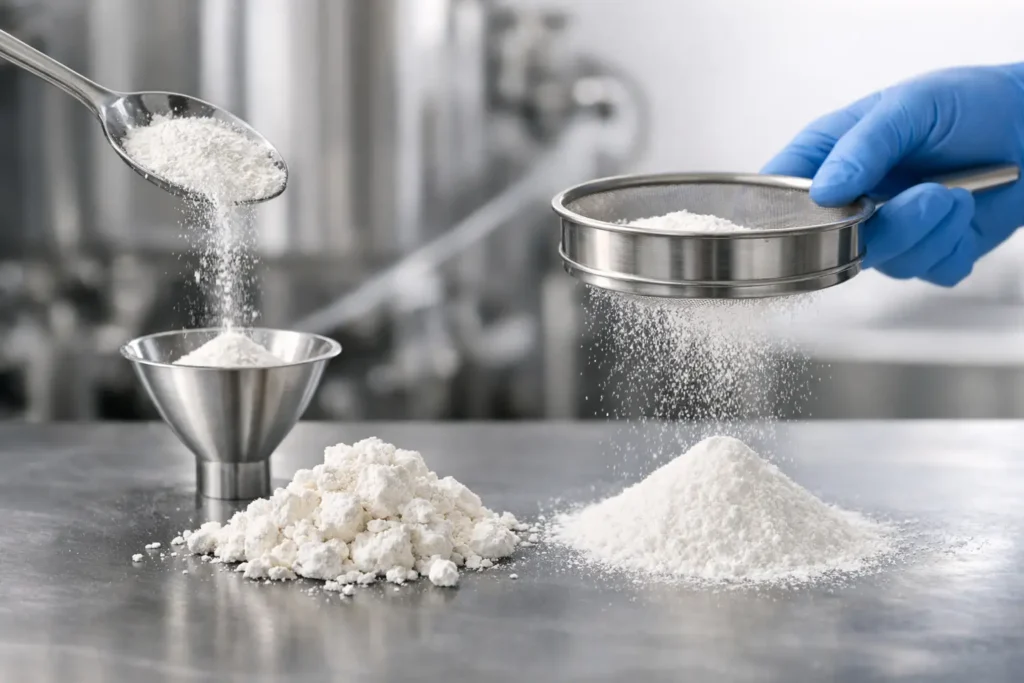
Powder agglomeration rarely starts as a dramatic failure. It usually shows up as inconsistent feed into the mill, poor classifier performance, blocked transfer lines, variable blend uniformity, or a finished product that will not meet specification batch after batch. For manufacturers asking how to reduce powder agglomeration, the right answer is rarely a single equipment change. In most production environments, agglomeration is the result of how material properties, process conditions and system design interact.
That matters because agglomerates do more than affect appearance. They alter bulk density, reduce flowability, distort particle size distribution, create dosing inconsistency and introduce avoidable energy loss. In regulated and performance-critical sectors, even modest agglomeration can compromise throughput, repeatability and downstream handling.
How to reduce powder agglomeration at source
The most effective way to control agglomeration is to identify where it begins. In some applications, particles bind because of residual moisture. In others, electrostatic charge, elevated temperature, fat or oil content, softening points, or excessive fine generation are the primary drivers. If the mechanism is not understood, corrective action tends to be trial and error.
A good starting point is the material itself. Hygroscopic powders, ultrafine products, cohesive actives, fatty food ingredients and certain chemical intermediates all have a natural tendency to form clusters. The same is true of materials with irregular particle shape or broad particle size distribution, where smaller particles fill voids between larger ones and increase interparticle attraction. If the product is already predisposed to agglomerate, the process window must be tighter.
Moisture control is often the first variable to review. Powders can pick up moisture from ambient air, from upstream wet processing, or from poorly controlled storage. Even small changes in relative humidity can shift a free-flowing powder into a cohesive one. Where moisture is a known issue, enclosed conveying, dehumidified air, insulated transfer points and tighter storage controls can make a measurable difference. In some lines, pre-drying or temperature conditioning is necessary before size reduction or classification.
Temperature is closely related. Heat generated during milling, blending or pneumatic conveying can soften sensitive materials and encourage particles to stick together. This is common in heat-sensitive pharmaceuticals, sugar-based products, polymers and certain nutraceutical ingredients. In these cases, reducing tip speed, adjusting residence time, using air-assisted cooling or moving to cryogenic milling can reduce agglomeration while protecting product integrity.
Process conditions that increase agglomeration
Many powder systems unintentionally create the conditions that promote agglomeration. High-energy impact can be useful for particle size reduction, but if the process generates too many fines or too much heat, it can also increase cohesion. Likewise, excessive recirculation in a poorly balanced system can repeatedly stress the same material until agglomerates form.
Feed consistency is a common weak point. If the mill or classifier receives an uneven feed, the process becomes unstable. Some particles are over-processed, others are under-processed, and the overall distribution broadens. That broader distribution often increases the proportion of fines, which then adhere to larger particles. Controlled feeding with the right dosing and conveying arrangement is often more valuable than operators expect.
Airflow management also deserves attention. In air classifier mills, jet mills and pneumatic systems, the relationship between air volume, pressure and classification point has a direct effect on whether particles separate cleanly or begin to cluster. If velocity drops in dead zones, powder can settle and compact. If airflow is too turbulent in the wrong area, soft materials may collide and bind. The solution is not simply more air. It is the correct air profile through the system.
Residence time matters for the same reason. Powders that remain too long in a grinding chamber or mixer are more exposed to heat build-up, repeated collision and attrition. Shorter, better-controlled residence times often improve both particle shape and flow performance. There is a trade-off, of course. Reducing residence time too far may limit size reduction or blending effectiveness, so optimisation should be based on trials rather than assumption.
Equipment selection and system design
If the goal is how to reduce powder agglomeration on a lasting basis, equipment choice must reflect the application, not just the target throughput. Different milling technologies produce very different stress profiles. A hammer mill may be suitable for one friable product but too aggressive for a heat-sensitive or cohesive powder. A pin mill can deliver tighter reduction in many applications, but only if heat generation and feed rate are managed properly. Jet milling may be the better route for fine, high-value materials where contamination and thermal stress must be minimised.
Classification is equally important. If the system cannot remove oversize efficiently or control the fine fraction accurately, agglomeration often reappears downstream as a handling issue. Integrated milling and classification systems tend to perform better where particle size distribution is critical, because they reduce reprocessing and stabilise the output.
Mixer design should not be overlooked. In some plants, agglomeration is blamed on milling when it is actually developing during blending or post-processing. High-shear mixing can break soft lumps, but it can also generate heat and compact certain powders if used for too long. Gentler mixing may preserve flowability, though it may not achieve the same dispersion of low-dose ingredients. The right approach depends on whether the process needs deagglomeration, homogeneity, or both.
Material transfer is another frequent cause. Long pneumatic conveying runs, poorly designed bends, product hold-up points and unstable discharge from hoppers all contribute to compaction and lump formation. Reliable powder handling depends on consistent flow paths, correct line sizing and hopper geometry designed for the material’s actual flow characteristics, not generic assumptions.
Practical actions to reduce powder agglomeration
In production terms, the best improvements are usually targeted rather than dramatic. Tightening environmental control, stabilising feed rate, reducing local heat generation and refining classification often deliver better results than replacing an entire line.
Start with measurement. Review moisture content, inlet air condition, product temperature, particle size distribution and bulk density across multiple batches. If possible, compare material behaviour at several points in the process rather than only testing the final product. Agglomeration often begins upstream of where it becomes visible.
Then assess where mechanical energy is being introduced. Milling speed, rotor configuration, screen selection, classifier settings and conveying velocity all affect whether particles remain discrete or begin to adhere. In many cases, reducing intensity slightly while improving control produces a better result than pushing for maximum instantaneous throughput.
Where a powder is especially difficult, application trials are worth the time. Laboratory and pilot testing can show whether the real issue is moisture sensitivity, excessive fines, thermal softening or poor system balance. That prevents costly over-specification and helps establish a scalable process window before capital is committed. For manufacturers moving from development to commercial production, this step is often where long-term reliability is won or lost.
It is also sensible to review whether deagglomeration should happen inline or as a separate step. Some products respond well to integrated milling and classification. Others benefit from a dedicated conditioning stage before blending, filling or packaging. The most efficient answer depends on the powder’s mechanical behaviour and the required end specification.
When the problem is not just the powder
Agglomeration is sometimes treated as a product issue when it is actually a systems issue. Inadequate extraction, inconsistent utilities, poor storage conditions, interrupted production schedules and operator workarounds can all undermine an otherwise capable process. If the same material runs well on one line but not another, the difference is usually in system control rather than the powder itself.
That is why engineered process integration matters. Milling, classification, mixing, conveying and containment cannot be assessed in isolation when the objective is consistent powder performance. A line designed around the application will usually outperform a collection of individually competent machines that do not share the same process logic. This is where a specialist partner such as DP Pulveriser UK can add value – not only through machine supply, but through application-led system design that improves product quality, efficiency and total cost of ownership.
Powder agglomeration can rarely be eliminated in every material, but it can be reduced to a controlled, predictable level with the right combination of process understanding and equipment design. The most reliable plants are not the ones that force difficult powders through generic systems. They are the ones that engineer around material behaviour from the start.