DP Pulveriser UK - Innovating the Future of Size Reduction
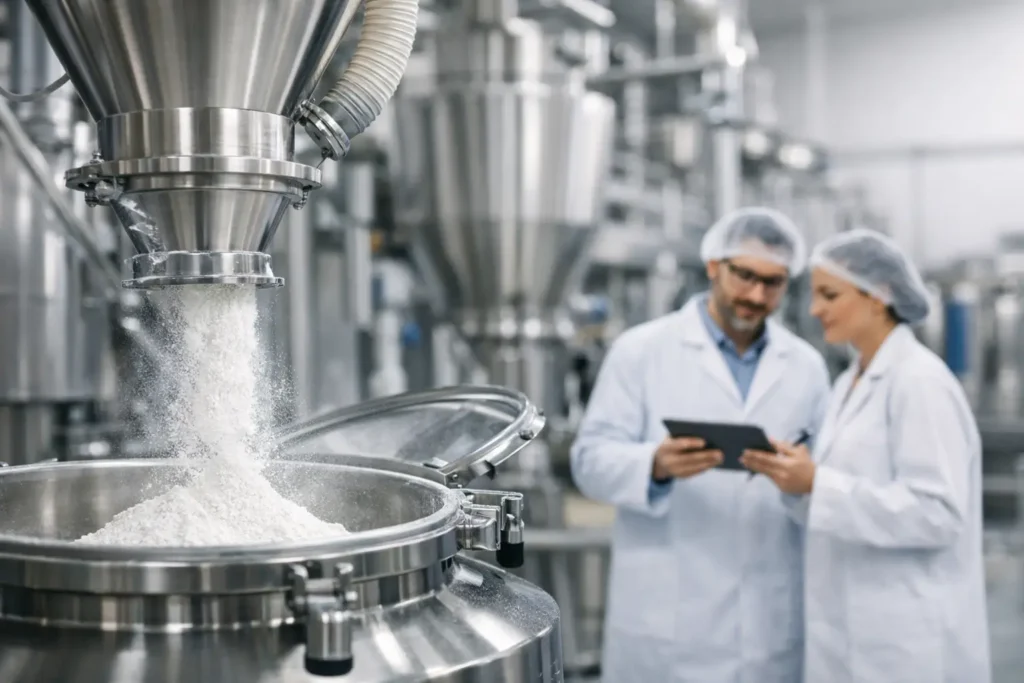
A mill can achieve precise particle size reduction, yet the production line may still lose capacity through poor feeding, dust escape, segregation or unreliable transfer. Powder handling system integration addresses the interfaces around the processing equipment: how material arrives, moves, is contained, measured, discharged and controlled. For manufacturers operating at commercial scale, these interfaces often determine whether a process delivers repeatable product quality or recurring production disruption.
Why powder handling must be engineered as a system
Powders do not behave like liquids. Their flow characteristics change with particle size, moisture content, bulk density, temperature, electrostatic charge and storage time. A material that discharges consistently during a laboratory trial can bridge in a production hopper, generate excessive fines in a pneumatic line or compact in a screw feeder.
This is why selecting a conveyor, filter or hopper in isolation creates risk. The feeder must supply the mill at a stable rate. The mill discharge must suit the classifier, collection method and downstream mixer. The conveying velocity must transfer material without unnecessary attrition, blockage or excessive energy use. Controls must respond to real process conditions rather than simply run each item of equipment independently.
An integrated approach defines these relationships before manufacture. It turns a collection of machines into a controlled processing line with known operating limits, traceable material flow and a clear path to scale-up.
Start with material behaviour, not equipment preference
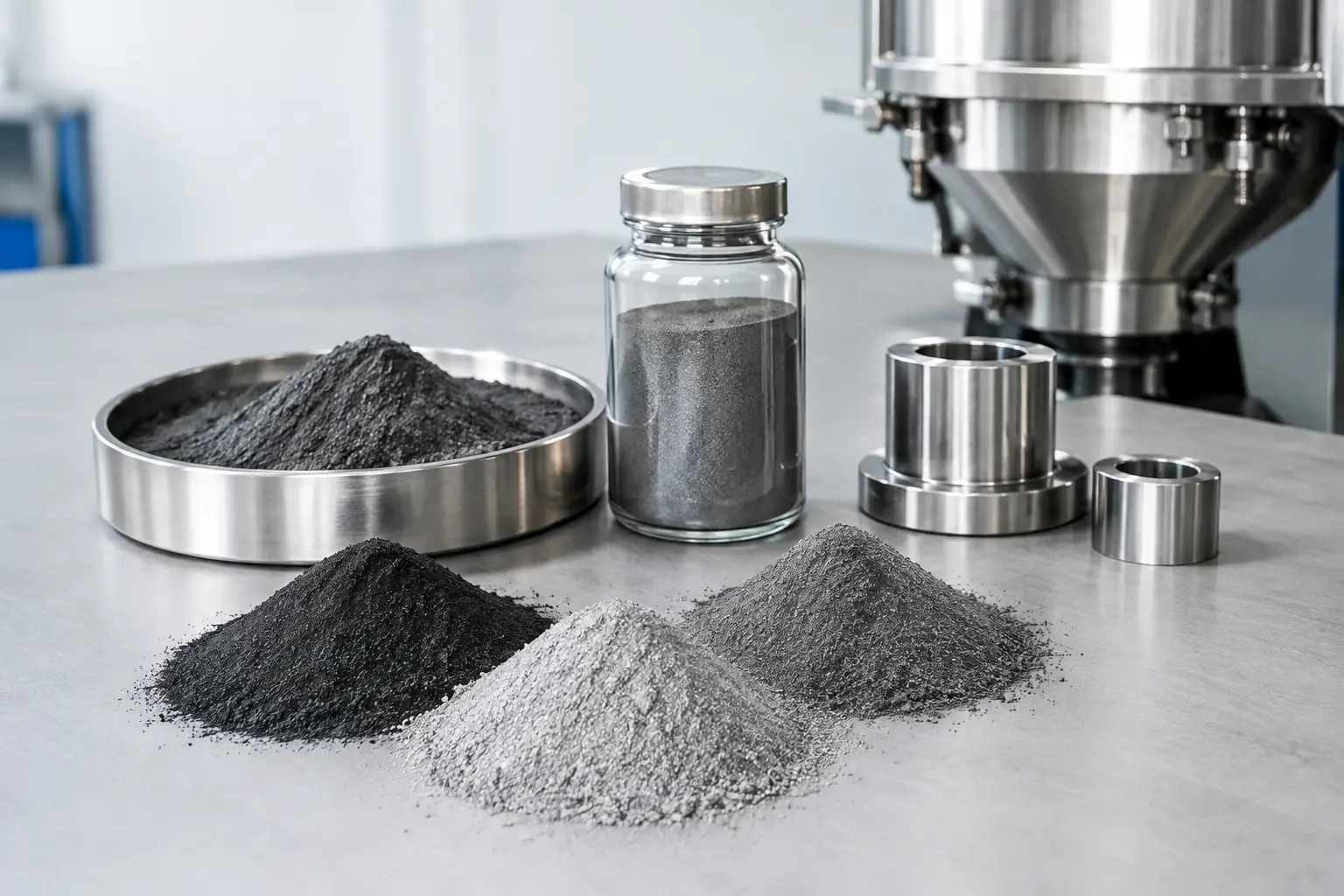
The most effective projects begin with a detailed material assessment. Particle size distribution is central, but it is not the only variable. Engineers should establish bulk and tapped density, angle of repose, moisture sensitivity, flow function, friability, dustiness, explosibility and any tendency to agglomerate or segregate.
For example, a free-flowing mineral powder may suit dense-phase pneumatic conveying, while a low-density, friable food ingredient could require carefully designed dilute-phase transfer at controlled velocity. A hygroscopic pharmaceutical ingredient may need a sealed system with conditioned air and minimal residence time. Battery and pigment materials may demand strict containment, low contamination risk and highly repeatable batch control.
Material testing also identifies where a process needs flexibility. A system handling several grades may require interchangeable contact parts, adjustable feeder geometry or recipe-driven control settings. Designing for the most challenging material from the outset can avoid costly modifications once production has started.
Define the duty cycle accurately
Throughput should be defined as more than a target kilograms-per-hour figure. The required rate, batch size, operating hours, cleaning frequency, product changeovers and allowable downtime all influence equipment selection. A system sized for its theoretical maximum can perform poorly when asked to operate steadily at a much lower rate.
Equally, the line must accommodate upstream and downstream realities. Delivery container sizes, manual handling limits, buffer storage, packaging speeds and cleaning windows all affect the practical capacity of the installation.
Build a continuous process path
A well-designed powder handling line follows the material from receipt to final discharge. The objective is to remove unnecessary transfers, minimise product degradation and maintain consistent conditions at each critical point.
Raw material may enter through sacks, drums, intermediate bulk containers or bulk storage. At this stage, the design must consider dust extraction, operator ergonomics, foreign-body control and the need for de-lumping or screening. Controlled feeding is then used to deliver a stable mass flow into milling, classification, mixing or another processing stage.
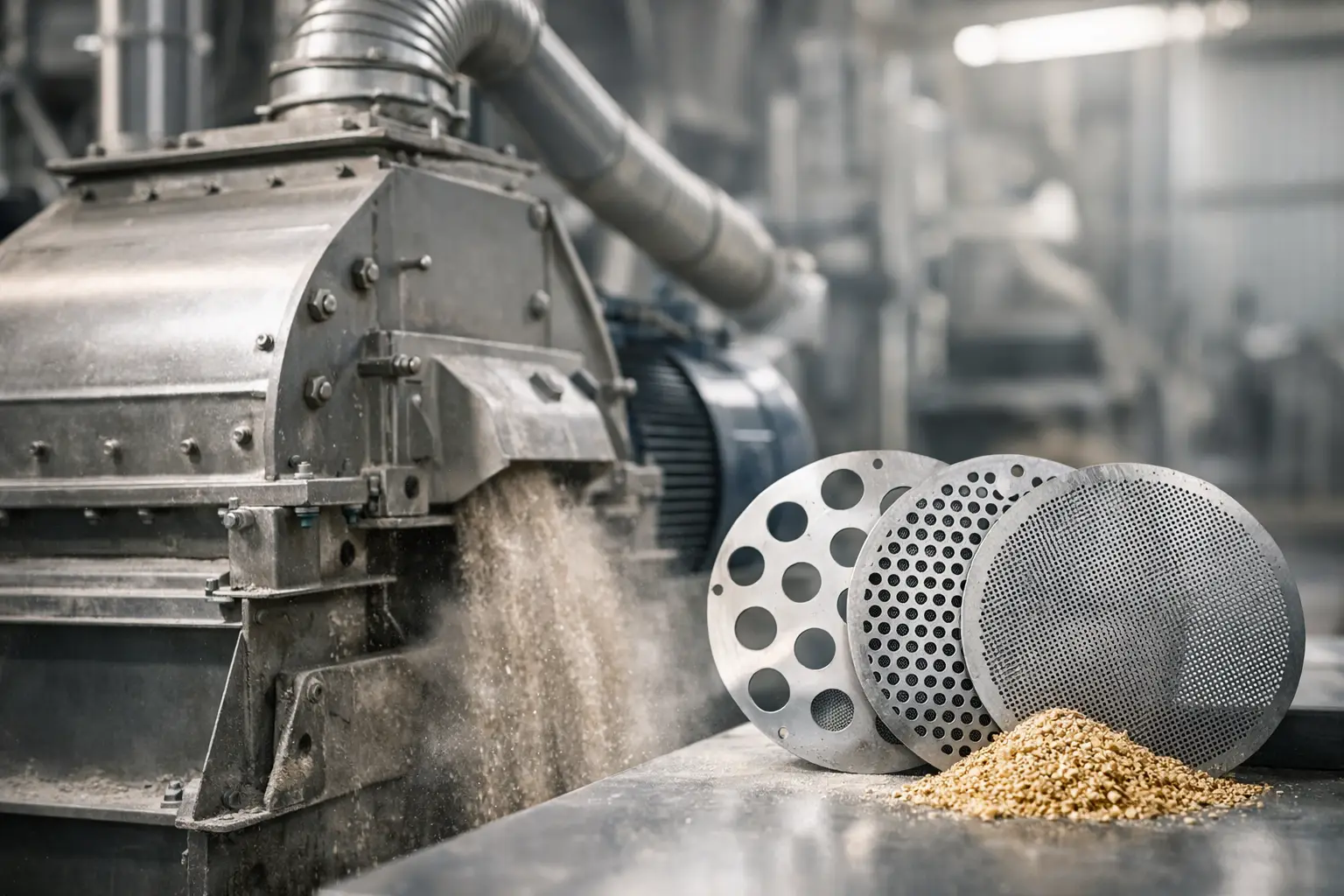
After size reduction, collection and transfer require particular attention. Fine material can overload filters, settle in poorly designed ductwork or separate by particle size during handling. Cyclones, bag filters, rotary valves, screw conveyors and pneumatic conveying equipment must therefore be selected as a connected arrangement. The pressure balance across the system matters as much as the nominal performance of any single component.
Where a process includes mixing, the transfer arrangement should preserve the intended formulation. Long conveying distances, high transport speeds and repeated drops can encourage segregation. In some applications, locating the mixer close to the milling or dosing stage reduces both handling complexity and variability.
Choose conveying technology around the process risk
Mechanical and pneumatic conveying both have a place in powder processing. The correct choice depends on distance, elevation, material sensitivity, hygiene requirements and the degree of containment required.
Screw conveyors provide controlled transfer over short distances and can be effective for measured discharge beneath hoppers or filters. Their limitations include wear with abrasive powders, potential product build-up and the possibility of material damage where the product is fragile. Rotary valves are often essential for pressure isolation and metered discharge, but their clearances, speed and wear characteristics must match the product.
Pneumatic conveying offers enclosed transfer across more complex plant layouts. Dilute-phase systems can be practical for many materials but may increase particle attrition and energy demand. Dense-phase conveying can reduce velocity and wear, although it requires careful control of pressure, line design and material flow behaviour. It is not automatically the best choice for every powder.
Vacuum conveying is particularly useful where containment, flexible routing and controlled collection are priorities. However, filter loading, receiver sizing and discharge reliability must be engineered for the duty. A conveying method that appears compact on a layout drawing may create avoidable interruptions if cleaning, filter replacement or product changeover has not been considered.
Containment, hygiene and safety are design inputs
For regulated and performance-critical production, containment cannot be added as an afterthought. The required level depends on the material, operator exposure limits, housekeeping standards and the consequences of cross-contamination. Enclosed loading stations, sealed transfer connections, local extraction and correctly specified filtration can reduce fugitive dust while improving product recovery.
Food, nutraceutical and pharmaceutical applications may require hygienic construction, polished contact surfaces, cleanable design and documented material traceability. Chemical, mineral and metal processing may place greater emphasis on abrasion resistance, corrosion resistance and service access. The same line can require different engineering decisions depending on the process environment.
Dust explosion risk must also be assessed where combustible powders are present. The assessment should inform equipment zoning, earthing, venting, isolation, suppression and control philosophy. A safe system is one in which these measures work together with the material flow design, rather than acting as separate additions.
Controls turn equipment into a production system
Mechanical integration alone does not ensure stable output. Control architecture links feeders, mills, classifiers, conveyors, collection equipment and safety devices into a coordinated operating sequence.
A gravimetric feeder can maintain a defined feed rate as hopper weight changes. Differential pressure monitoring can identify filter loading before flow is restricted. Level sensors can prevent a receiver from overfilling or a downstream machine from running empty. Variable-speed drives allow conveying and feeding performance to be adjusted without compromising the wider process.
For lines with multiple products, recipe control reduces reliance on manual settings. Operating parameters such as feed rate, classifier speed, air volume and transfer time can be recorded against a batch. This supports consistency, fault finding and process validation, particularly where particle size and blend uniformity are critical quality attributes.
The control system should also make maintenance practical. Clear alarm priorities, accessible diagnostics and sensible interlocks help operators identify whether a stoppage originates from poor material flow, a blocked filter, an empty hopper or a downstream constraint.
Design for cleaning, maintenance and scale-up
The lowest-cost installation is rarely the lowest-cost system to operate. Access for inspection, cleaning and replacement of wear parts affects availability throughout the equipment life. This is especially relevant for abrasive products, sticky materials and plants with frequent changeovers.
Good engineering provides access doors where they are needed, avoids dead zones that retain material and positions valves, filters and sensors so they can be serviced safely. It also considers how equipment will be lifted, isolated and cleaned within the available production area.
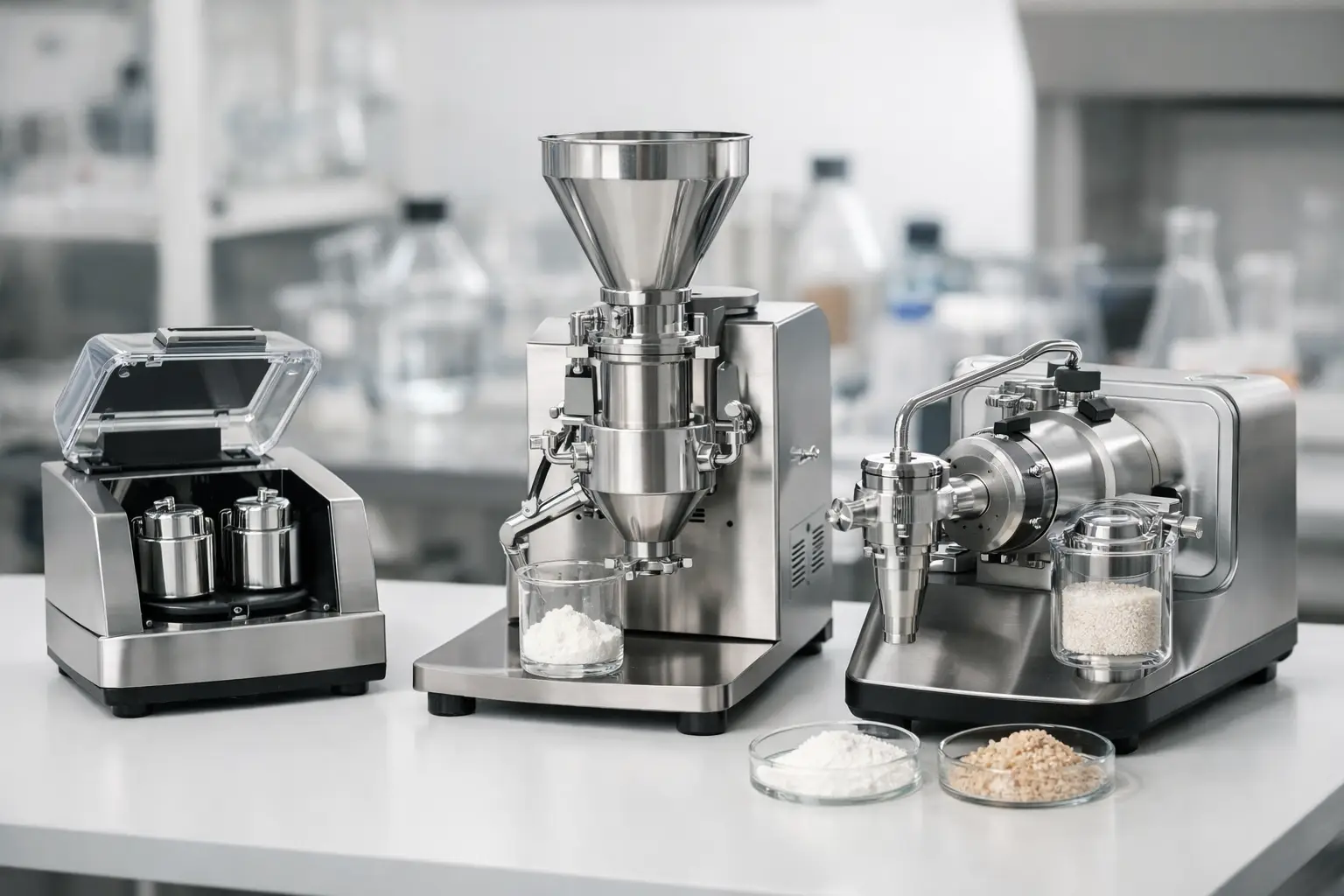
Scale-up should be planned from the first trials. Laboratory and pilot work can establish milling performance and material behaviour, but industrial capacity introduces longer transfer distances, larger storage volumes and different residence times. A process partner able to connect testing with full-scale equipment design can reduce uncertainty between development and production.
A practical integration brief
Before requesting a system proposal, manufacturers should provide representative material samples and define the required throughput range, particle size target, batch or continuous operation, available utilities, cleaning requirements and site constraints. Information on existing upstream and downstream equipment is equally valuable.
The strongest proposals will address more than equipment dimensions and motor ratings. They will explain the material route, containment strategy, controls, maintenance access, safety measures and expected operating assumptions. They should also identify where further testing is required rather than masking uncertainty with oversized equipment.
DP Pulveriser UK engineers complete powder processing systems around the actual application, from controlled feeding and milling through classification, collection, conveying and discharge. The objective is not simply to move powder between machines. It is to create a dependable process that protects product quality and supports the production targets that matter on site.
The most useful next step is to map the current material path and identify every point where flow, containment or control is lost. Those details provide the engineering foundation for a powder handling system that performs reliably long after installation.