DP Pulveriser UK - Innovating the Future of Size Reduction
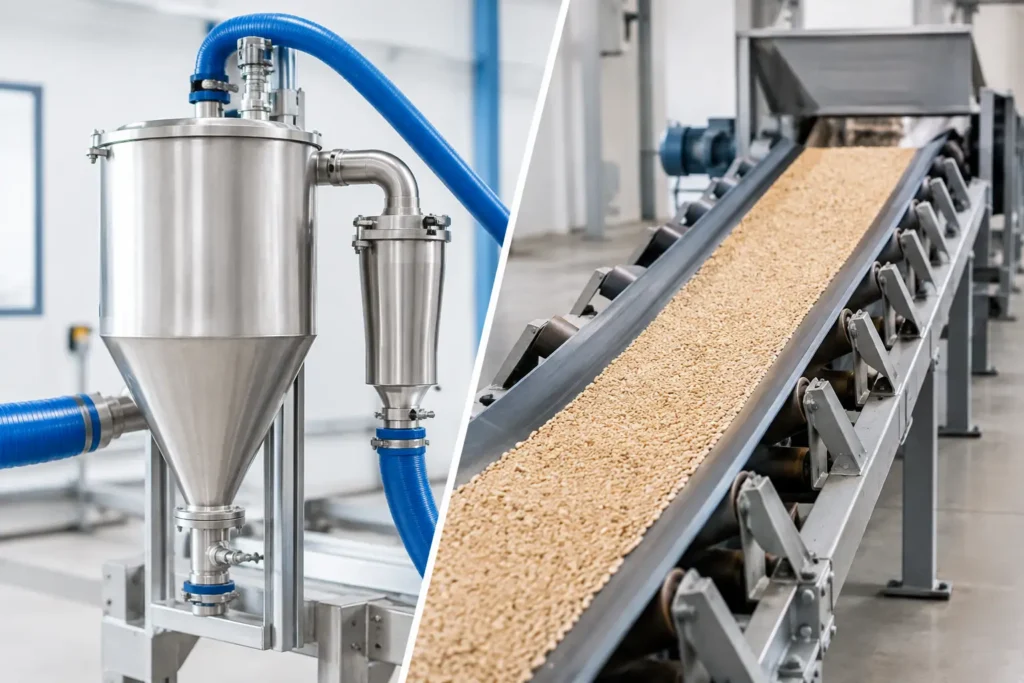
A conveying system can protect a carefully controlled powder specification or undermine it between processing stages. The decision between pneumatic versus mechanical conveying affects more than how material moves from a mill to a blender, hopper or pack-off line. It influences segregation, dust containment, product recovery, energy demand, cleaning time, maintenance access and the practical layout of the plant.
For high-value, fine or sensitive powders, the correct choice is rarely determined by a single performance figure. The material’s behaviour, required route, duty cycle and hygiene or containment obligations must be considered as one process design problem.
What separates pneumatic and mechanical conveying?
Pneumatic conveying moves powder through enclosed pipework using a controlled air or gas stream. A pressure system pushes material through the line, while a vacuum system draws it towards a receiver. The system may operate in dilute phase, where particles are suspended at relatively high gas velocity, or dense phase, where plugs or dunes of material travel at lower velocity.
Mechanical conveying uses a moving mechanical element to transfer material. Common options include screw conveyors, flexible screws, belt conveyors, drag chain conveyors, bucket elevators and vibratory feeders. Each has a defined place in powder handling, from short, controlled transfers beneath a mill to vertical elevation and high-capacity bulk movement.
The distinction matters because air-based transfer and mechanically driven transfer impose different forces on the material. A fine pharmaceutical excipient, abrasive mineral powder and free-flowing food ingredient may all travel successfully by either method in principle, but their performance, maintenance profile and total operating cost can differ substantially.
Pneumatic versus mechanical conveying: key decision factors
Route, footprint and plant integration
Pneumatic systems are particularly effective where a line must travel vertically, around obstructions or across a complex production area. Pipework can be routed overhead, reducing floor-level congestion and allowing mills, classifiers, mixers and filling stations to be arranged around the process rather than constrained by a straight transfer path.
Mechanical conveyors are often the simpler and more economical choice for short, direct routes. A screw conveyor beneath a discharge point can provide predictable transfer without the blower, filtration and air separation equipment required by a pneumatic system. Where equipment sits close together and access is straightforward, this simplicity can be a material advantage.
Long pneumatic routes are not automatically preferable. Every bend, elevation change and restriction increases pressure loss and can raise particle impact, line wear or the risk of blockage. The route should be engineered, not merely fitted into available space.
Powder characteristics and product quality
Particle size distribution, bulk density, moisture content, flowability, friability and abrasiveness all influence the selection. Fine, dry powders with a tendency to become airborne can benefit from fully enclosed pneumatic transfer. A correctly designed system limits dust escape and can deliver product directly into a sealed receiving vessel.
However, high-velocity dilute-phase conveying may cause attrition in brittle granules, crystals or agglomerates. It can also generate fines, change bulk density or contribute to segregation where particle sizes and densities vary widely. Dense-phase pneumatic conveying may reduce impact velocity, but it requires more careful control of pressure, air volume and feed conditions.
Mechanical conveying can be gentler for certain materials, particularly when speeds are low and the conveyor is correctly matched to the duty. Yet a screw may compact cohesive powder, smear heat-sensitive products or create local shear. A drag chain can handle heavier materials effectively, but may introduce degradation or carry-over depending on design and operating speed.
Material trials are valuable where product quality is critical. The objective is not simply to prove that powder will convey, but to verify post-transfer particle size, moisture, temperature, bulk density and flow properties against the required specification.
Throughput and control
Mechanical conveyors can offer consistent metering for short distances, especially when paired with a controlled feeder. This is useful when a milling or mixing process requires a stable, measured feed rate. They are also well suited to continuous, high-tonnage duties where the product route is direct and the installation can accommodate the equipment.
Pneumatic conveying provides considerable flexibility across multiple pickup and discharge points. It can support batch transfers, centralised material collection and distribution to several process vessels. Vacuum conveying is often used for controlled charging, where the system transfers a defined batch before releasing it into the receiver.
Neither technology should be sized from a nominal hourly rate alone. Peak rate, batch size, line length, operating hours, receiver capacity and upstream/downstream equipment availability all affect the required duty. An oversized pneumatic system wastes energy; an undersized mechanical conveyor becomes a production bottleneck.
Containment, hygiene and cleaning
Enclosed transfer is a major reason to specify pneumatic conveying in pharmaceutical, nutraceutical, food, battery-material and speciality chemical applications. When correctly sealed and filtered, the system helps control dust exposure, reduce product loss and support cleaner working areas. Vacuum systems are also inherently advantageous where any leak should draw air inward rather than release powder outward.
Mechanical equipment can also be enclosed, but seals, covers, shaft penetrations and discharge interfaces demand careful attention. For applications requiring frequent product changeovers, cleanability must be assessed at the same level as throughput. Consider access to contact parts, disassembly time, retained material, wash-down compatibility and validation requirements.
There is no universal cleanliness winner. A pneumatic line can retain material in bends, filters and receivers if it is poorly designed. A mechanical conveyor with accessible, polished contact surfaces may be faster to inspect and clean for a short dedicated transfer. The correct answer depends on the product family and the changeover regime.
Energy, wear and maintenance
Pneumatic conveying generally requires more energy than an equivalent short mechanical transfer because blowers or vacuum pumps must move both air and product. Filter condition, air leakage, pipe diameter and system pressure all affect power consumption. Energy performance therefore depends on disciplined design and maintenance rather than the conveying principle alone.
Mechanical systems often have lower installed power for direct horizontal movement. Their maintenance needs are more visible: bearings, seals, screws, chains and gearboxes require scheduled inspection. Abrasive powders can accelerate wear, particularly at loading zones and on screws or drag flights.
Pneumatic systems remove many moving parts from the transfer line, but wear is concentrated at bends, diverter valves and high-velocity impact points. Abrasive mineral, pigment or metal powders may require specialised bend geometry and wear-resistant materials. Blockages also need a practical recovery plan, particularly in dense-phase systems handling variable or cohesive material.
Selecting the right conveying method
The most effective specification begins with the process, not a preferred machine type. Define the powder’s tested properties, the required transfer rate, batch frequency, route geometry, allowable product change, containment target and available utilities. Then assess the interfaces: mill discharge, classifier, mixer, storage hopper, dust collection and packing equipment must operate as a coordinated system.
A practical selection often follows these broad patterns:
- Pneumatic conveying suits enclosed transfers over longer or more complex routes, multi-point distribution, controlled vessel charging and applications where dust containment is central to the design.
- Mechanical conveying suits short, straightforward routes, continuous high-capacity movement, stable metering duties and installations where low energy use and straightforward maintenance take priority.
- Hybrid systems are frequently the strongest solution. For example, a screw feeder may regulate discharge from a mill or hopper into a pneumatic line, combining feed control with flexible enclosed transport.
- Dense-phase pneumatic systems deserve consideration for fragile, abrasive or high-bulk-density powders, but only after proving that the material can form and maintain stable plugs under the intended conditions.
Engineering the system around the process
Conveying performance is determined by details that are easy to overlook during early equipment selection. Pickup design must prevent inconsistent feed or excess air ingress. Pipe diameter and bends must balance velocity, wear and the risk of deposition. Receiver filters need sufficient area and an effective cleaning method. Mechanical conveyors need suitable clearances, drives and access arrangements for the actual powder, not a generic bulk-solid assumption.
Safety assessment must also be integrated from the outset. Where combustible dust is present, the conveying method, earthing strategy, isolation requirements, pressure relief provisions and zoning approach must be evaluated for the complete installation. Similarly, products susceptible to heat gain, moisture pickup or cross-contamination need controls designed into the conveying route rather than added after commissioning.
For projects progressing from pilot work to full production, scale-up data is especially valuable. A laboratory milling result is only part of the answer if conveying alters the final particle size distribution or creates unacceptable losses. DP Pulverizer UK can evaluate milling, classification and powder transfer as connected stages, helping ensure the handling system supports the quality achieved in the mill.
The best conveying choice is the one that preserves product specification while meeting the real operating duty with manageable energy use, maintenance and cleaning. Start with representative material testing and a clearly defined process route. That work gives the production team a system designed to perform reliably long after installation.