DP Pulveriser UK - Innovating the Future of Size Reduction
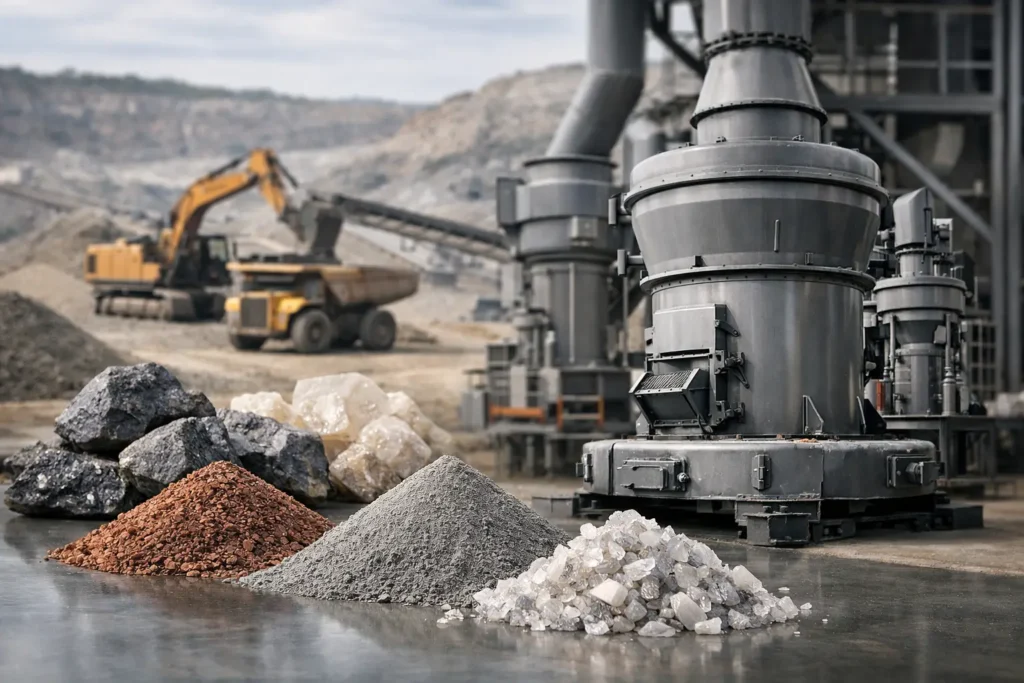
Abrasive mineral processing quickly exposes the limits of general-purpose equipment. The best mills for abrasive minerals are selected not only for target particle size, but also for wear rate, contamination risk, energy demand, classification accuracy and the practicality of maintenance in a production environment. A mill that produces the required fineness on day one can become an expensive choice if liners, beaters or classifiers require frequent replacement.
Quartz, silica, alumina, zircon, garnet, feldspar, talc blends and mineral fillers all behave differently in a grinding circuit. Their hardness, friability, feed size, moisture level and required product specification determine the most suitable milling principle. The right solution is therefore application-specific, often combining controlled feeding, milling, air classification, dust extraction and product handling into one engineered process line.
What makes abrasive minerals difficult to mill?
Mineral hardness is only part of the engineering challenge. Materials with high silica content, for example, can rapidly erode contact surfaces. A highly abrasive feed can shorten the service life of conventional steel components, introduce metallic contamination and create variation in the final particle size distribution as internal geometries wear.
The required fineness matters just as much. Coarse mineral reduction is generally achievable using impact-based equipment, but producing a narrow fine powder distribution requires precise control of residence time and classification. As particles become finer, surface area rises, flow behaviour changes and the risk of heat build-up, agglomeration or over-grinding increases.
A well-designed system assesses the complete duty: feed material size and moisture, throughput, target d50 and top size, permissible contamination, bulk density, product temperature, available utilities and maintenance access. These details dictate whether the process should use mechanical impact, particle-on-particle collision, integrated classification or staged reduction.
Best mills for abrasive minerals by application
There is no single mill that is best across every abrasive mineral duty. The most effective choice depends on whether the priority is coarse reduction, fine classification, contamination control, high capacity or a particularly tight particle size specification.
Jet mills for ultra-fine, low-contamination powders
Jet mills are often the preferred option for ultra-fine abrasive minerals where avoiding mechanical grinding contact is a primary concern. Compressed air or inert gas accelerates particles into high-velocity collisions. Size reduction occurs largely through particle-on-particle impact rather than through conventional grinding media or high-speed metal tooling.
This makes jet milling particularly suitable for fine silica, alumina, ceramic raw materials, mineral pigments and speciality fillers where product purity and narrow sizing are critical. An integrated dynamic classifier can control the upper particle size limit, returning oversize material to the grinding zone while collecting the fine fraction.
The trade-off is energy consumption. Compressed-air milling can require more energy than mechanical milling, particularly at higher production rates. It is most economically justified where the target is very fine powder, contamination limits are demanding or a sharp particle size cut adds significant product value. For abrasive minerals, wear-resistant liners and classifier components remain relevant, although the absence of conventional grinding media reduces several common contamination pathways.
Air classifier mills for controlled fine grinding
An air classifier mill combines impact grinding with an internal air classifier. Material enters the grinding chamber, is reduced by the rotating impact assembly and then passes into the classification zone. Fine particles exit with the process air, while oversize particles are rejected for further milling.
For many mineral filler and pigment applications, this design provides an effective balance between throughput, fineness and control. It is particularly useful when the product requires a consistent fine powder rather than the extreme fineness commonly associated with jet milling. The classifier speed, air volume and rotor configuration can be adjusted to influence the final cut point and particle size distribution.
Wear protection is central to reliable operation. Depending on the mineral and purity requirement, contact components may use hardened alloys, ceramic linings or other wear-resistant materials. A process engineer should consider not only the initial liner cost but also replacement interval, accessibility and the effect of progressive wear on product quality. In sustained production, these factors have a direct effect on total cost of ownership.
Turbo mills for high-throughput mineral processing
Turbo mills use high-speed impact and controlled airflow to achieve efficient reduction of dry, friable mineral materials. They can be a strong option for applications requiring high throughput and a fine-to-medium powder specification, especially where the feed is already suitably pre-crushed.
Their practical advantages include continuous operation, compact process integration and the ability to work with external classification where a tighter cut is needed. For minerals that are abrasive but not excessively hard, a turbo mill can offer an efficient production route when equipped with appropriate wear-resistant internals.
However, a turbo mill is not automatically the correct choice for ultra-fine or contamination-sensitive duties. High tip speeds increase the potential for wear, so material trials should establish expected component life and verify that the generated particle shape and size distribution meet the end-use requirement. This is especially relevant for coatings, ceramics and battery-related materials, where powder consistency can affect downstream performance.
Hammer mills for pre-grinding and coarse reduction
Hammer mills are widely used for initial reduction of mineral feedstock before fine grinding or classification. They apply repeated impact using swinging or fixed hammers, making them effective for breaking down lumps and reducing relatively coarse material to a manageable feed size.
In abrasive mineral service, hammer mills are best viewed as a pre-grinding stage rather than a universal final-sizing solution. They are valuable where raw feed arrives in variable lumps or requires a controlled, consistent size for downstream jet mills, air classifier mills or other fine-grinding equipment.
The main consideration is wear. Hammers, screens, liners and discharge components must be selected for the mineral’s abrasiveness and desired operating life. Replaceable wear parts, sensible inspection access and a reliable feed arrangement reduce unplanned stoppages. Screen selection also matters: too fine a screen can restrict throughput and increase energy use, while too coarse a screen can overload the next process stage.
Pin and universal mills for moderate abrasive duties
Pin mills and universal mills can process certain mineral powders efficiently where the material is moderately abrasive, the particle size target is not ultra-fine and flexibility is valuable. Their impact-based configurations can suit laboratory development, pilot-scale work and production duties involving mineral blends or lower-hardness materials.
They should be selected cautiously for high-silica or highly abrasive products. Direct contact between the product and rotating components can result in accelerated wear compared with fluid-energy systems. Yet they may still be the right engineering choice where throughput requirements are moderate, a broader particle size distribution is acceptable and quick changeover supports multiple products.
Engineering priorities beyond the mill itself
The mill is only one part of the result. Abrasive mineral plants benefit from a controlled feed system that avoids surges, an appropriate dust collection arrangement, reliable pneumatic conveying and a classifier matched to the required cut point. Poorly controlled feeding can destabilise mill load and broaden the particle size distribution, even when the machine itself is correctly specified.
Material construction deserves close attention. Hardfaced steel may be suitable for some coarse duties, while ceramic, tungsten carbide or specialised wear-resistant liners may be justified for demanding fine mineral applications. The right option depends on the mineral, acceptable contamination level, service interval and cost of downtime. More expensive protection can be the lower-cost decision when it preserves consistent production and reduces planned maintenance frequency.
Laboratory and pilot trials are equally valuable. They reveal whether the mineral fractures cleanly, produces excessive fines, retains moisture, coats internal surfaces or changes behaviour at production scale. Trials also provide evidence for capacity estimates, energy demand, wear expectations and the suitability of a closed-loop classification circuit.
How to select a mineral milling system
Start with the product specification rather than the equipment category. Define the feed size range, required throughput, target particle size distribution, maximum oversize, contamination limits and final application. A mineral filler for plastics may need a different particle shape and top-size control from a ceramic powder or a coating-grade pigment.
Next, consider the operating economics. Jet mills may provide the finest and cleanest result, while air classifier mills often offer a more balanced route to controlled fine powders. Turbo mills can suit high-capacity duties, and hammer mills provide dependable pre-grinding where feed preparation is required. The best answer can be a two-stage system rather than one mill asked to perform every function.
Finally, specify for maintenance as seriously as you specify for output. Wear component design, inspection intervals, spare-part availability, containment, cleaning access and control integration all influence availability over the life of the plant. DP Pulveriser UK engineers milling and classification systems around these real production constraints, from development-scale trials through to complete turnkey processing lines.
A successful abrasive mineral installation is one where particle size, product purity and maintenance planning are designed together. Establish the duty with representative material, validate it under realistic operating conditions and select the mill around the process you need to run for years, not simply the test result you need to achieve once.