DP Pulveriser UK - Innovating the Future of Size Reduction
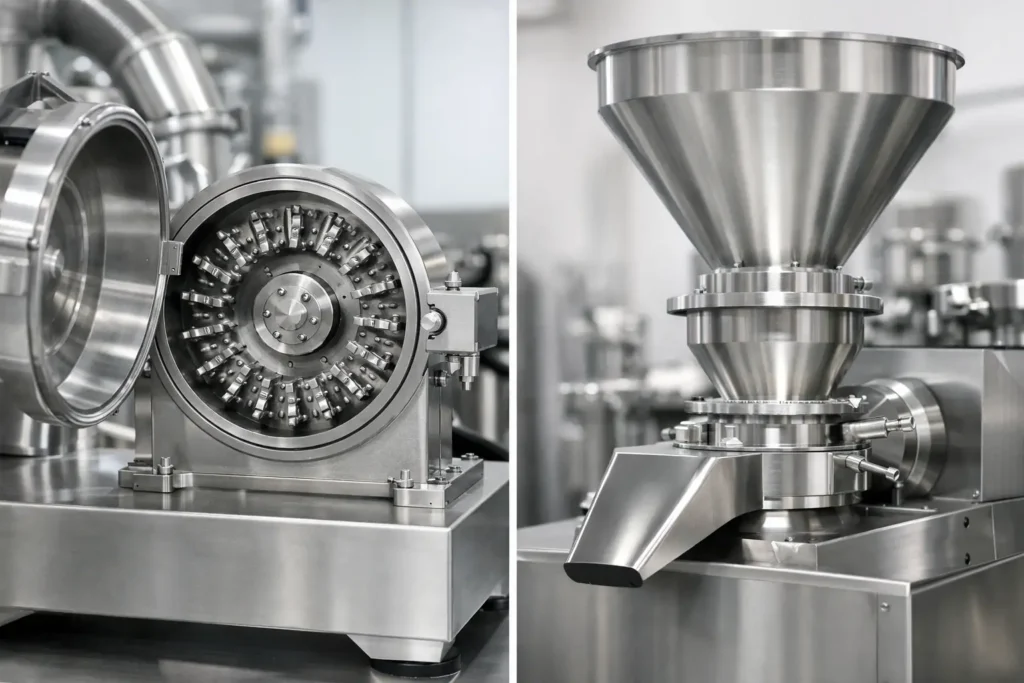
A pin mill vs cone mill decision is rarely resolved by comparing headline capacity alone. Both machines can improve powder consistency, break down agglomerates and prepare materials for downstream blending, packing or further processing. Their grinding mechanisms, however, produce very different outcomes for particle size distribution, heat exposure, throughput and product handling.
For process engineers and production teams, the correct choice starts with the material and the specification. A free-flowing crystalline ingredient, a friable pharmaceutical intermediate and a sticky hygroscopic powder may all require size reduction, but they will not necessarily perform well in the same mill.
Pin Mill vs Cone Mill: The Fundamental Difference
A pin mill reduces particle size primarily through high-speed impact. Material enters the grinding chamber and is accelerated against pins mounted on one or two rotating discs. The repeated impacts and collisions break particles down quickly, making the machine well suited to applications requiring a relatively fine, tightly controlled powder.
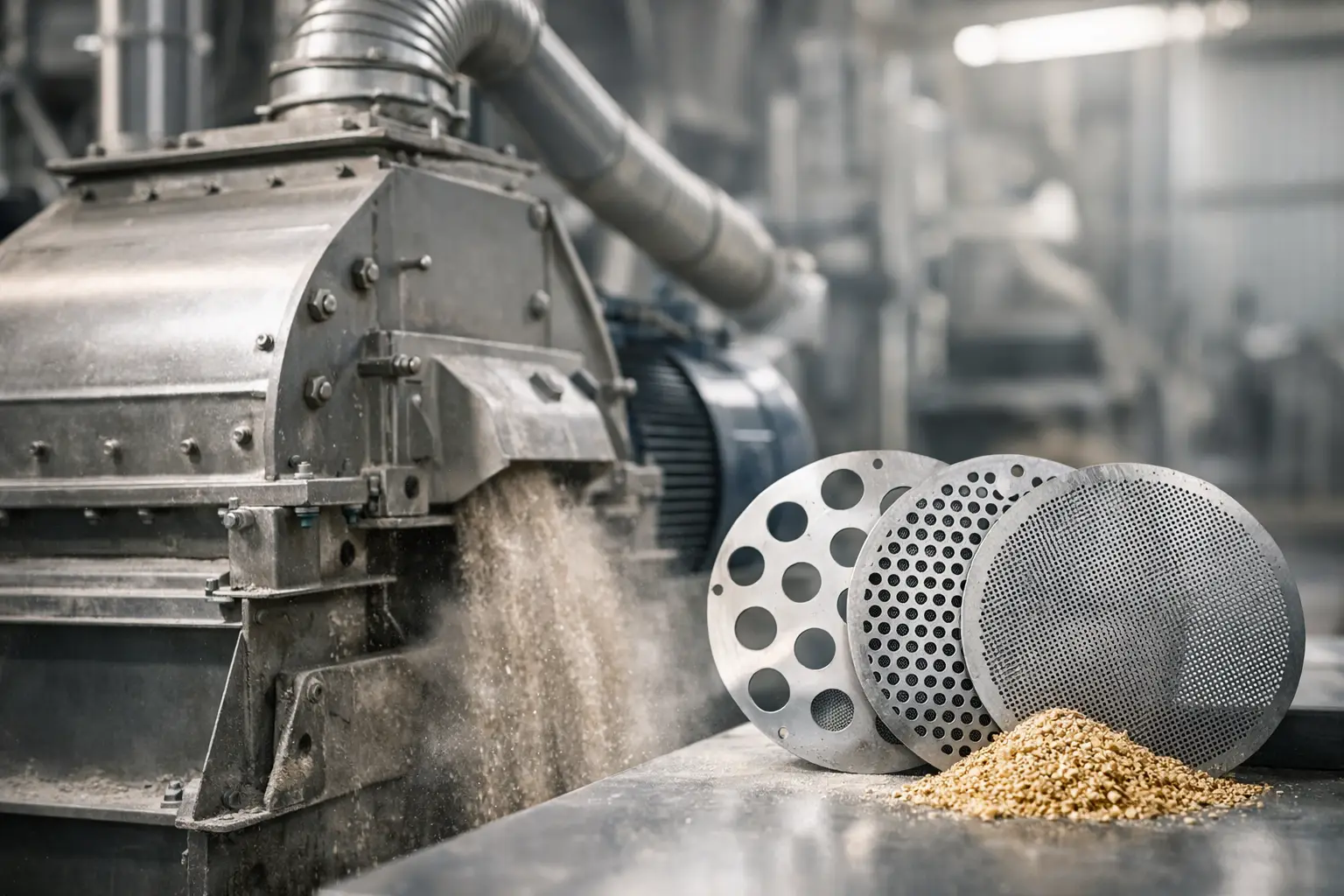
A cone mill, also known as a conical screen mill or conical mill, works by gentle size reduction and deagglomeration. Product is fed into a conical chamber, where an impeller or rotor moves it against a perforated screen. Material exits once it is small enough to pass through the selected aperture. Rather than relying on intensive impact, the cone mill applies controlled shear and compression.
This difference is central to equipment selection. A pin mill is generally chosen when real particle size reduction is needed. A cone mill is more often selected to remove lumps, condition material for consistent flow, calibrate granules or reclaim oversized product without generating an excessive fine fraction.
When a Pin Mill Is the Better Fit
Pin mills are effective where a process needs high-energy milling with a fine output. They are commonly specified for food ingredients, chemicals, pigments, minerals, nutraceuticals and selected pharmaceutical materials. Depending on the product characteristics and mill configuration, they can achieve fine powders with a narrower particle size distribution than a cone mill would normally produce.
The high peripheral speed of the pins creates strong impact forces. This can make a pin mill especially valuable for brittle, crystalline or dry materials that fracture cleanly under impact. Sugar, salt, spices, polymers, chemical powders and certain mineral products are typical examples, although each application must be verified through trials.
Pin milling can also support higher throughput in continuous operations where the feed is stable and the material flows freely. Screen selection, rotor speed, pin geometry, air management and feed control all influence the final result. A machine that performs well on a laboratory batch may need a different configuration to maintain the same specification at production scale.
The trade-off is energy input. High-speed impact creates heat, and that heat can affect low-melting, thermally sensitive or fat-containing materials. It may also lead to screen blinding, build-up or reduced efficiency when processing sticky products. Where temperature is a critical quality attribute, cooling, controlled air flow or cryogenic milling may be required instead of a standard ambient pin mill arrangement.
Pin mill performance considerations
A pin mill should be assessed against the target particle size, acceptable fines content and permitted product temperature. The feed material must also be dry enough and sufficiently free-flowing to enter the grinding zone consistently. Large or variable feed particles can create fluctuating load, inconsistent results and unnecessary wear.
Wear is another practical factor. Abrasive minerals, ceramic powders and some battery materials may require wear-resistant internals and careful material selection. The lowest purchase price is not necessarily the lowest operating cost if pins, liners or other high-wear components require frequent replacement.
When a Cone Mill Is the Better Fit
Cone mills excel where product integrity matters more than aggressive micronisation. Their controlled, lower-energy action makes them a strong option for deagglomerating powders, sizing granules, breaking soft lumps and improving flow before tabletting, encapsulation, blending or filling.
This is particularly relevant in pharmaceutical and nutraceutical production, where a consistent granule size can improve blend uniformity and downstream dosing. In food processing, cone milling can condition powders and dried ingredients without the level of mechanical stress associated with impact milling. It is also widely used for reclaiming off-spec agglomerates and processing material after drying.
The screen is a primary control point. Altering aperture size, screen thickness, open area and impeller design can change the output and throughput significantly. Rotor speed is equally important: higher speed may increase capacity and break-down, but it can also generate more fines. This makes cone mills adaptable, but only when the operating window has been developed for the specific material.
A cone mill is not typically the best answer when a major reduction from coarse feed to a fine powder is required. It can produce controlled sizing, but it does not offer the same high-impact grinding mechanism as a pin mill. Attempting to use a cone mill for a duty beyond its intended reduction range can restrict throughput, increase recirculation and still fail to meet the particle size specification.
Cone mill performance considerations
Cone mills are often favoured for applications that demand straightforward cleaning, contained processing and repeatable product handling. Sanitary construction, quick-release screens and validated cleaning arrangements can be particularly valuable in regulated production environments.
The material still determines success. Highly elastic, oily or damp products may smear across the screen rather than pass through it. Fibrous materials can also be challenging. In these cases, screen selection, impeller profile and feed method require close attention, and another milling technology may be more appropriate.
Particle Size, Fines and Product Quality
The most useful question is not simply, “Which mill produces the smallest particles?” It is, “What particle size distribution will improve the next stage of the process?” A very fine powder may enhance dissolution or appearance, but it can also reduce flowability, increase dust generation and create segregation issues during blending.
Pin mills tend to generate a finer product and can create a greater proportion of fines if speed or residence time is excessive. Cone mills generally produce a more controlled calibrated output, with less intensive size reduction. For granulated products that need predictable flow into a tablet press or filling line, this is often the preferred result.
Quality should be assessed using representative samples, not a single sieve result. Consider D10, D50 and D90 values where relevant, as well as bulk density, moisture, flow behaviour, temperature and the amount of oversize or fines. A milling trial should also review whether the material changes over a full production run as equipment warms up or feed conditions vary.
Throughput, Integration and Total Cost
Throughput claims only have value when they are tied to a material, feed specification and target output. A pin mill may offer substantial continuous capacity for suitable dry products, while a cone mill may provide better process reliability for controlled deagglomeration and batch-to-batch consistency. Neither is universally faster.
Integration is equally important. The mill must work with upstream feeding and downstream collection, conveying, classification or packaging equipment. Poor feed control can undermine even a well-selected machine. For fine pin-milled powders, dust collection and air handling may be central to performance. For cone-milled granules, the priority may be gravity transfer, containment and avoiding segregation.
Total cost of ownership includes energy consumption, wear parts, cleaning time, operator intervention, changeover frequency and lost production during maintenance. A lower-energy cone mill may be commercially attractive for a simple conditioning duty. A pin mill may justify its higher energy demand when it removes the need for a separate fine-grinding stage or consistently meets a demanding particle size target.
Selecting the Right Mill Through Trials
A structured trial is the most reliable way to select between these technologies. Start with the incoming particle size, moisture level, bulk density, hardness, heat sensitivity and required production rate. Then define the output specification in terms that reflect product performance, rather than an arbitrary mesh size alone.
Test both the best-case result and the realistic operating range. This means evaluating start-up, steady-state running, temperature rise, cleaning requirements and material variability. It also means confirming that the selected configuration can scale from development work to commercial production without compromising quality or throughput.
For complex applications, the mill should be specified as part of the wider powder handling system. DP Pulveriser UK engineers milling, classification and conveying solutions around the actual process duty, helping manufacturers avoid the cost of solving a narrow milling problem while creating a downstream handling problem.
The most productive choice is the one that delivers the required powder behaviour consistently at scale. Whether that points to the fine-impact action of a pin mill or the controlled conditioning of a cone mill, the decision should be proven with your material, your specification and your production conditions.