DP Pulveriser UK - Innovating the Future of Size Reduction
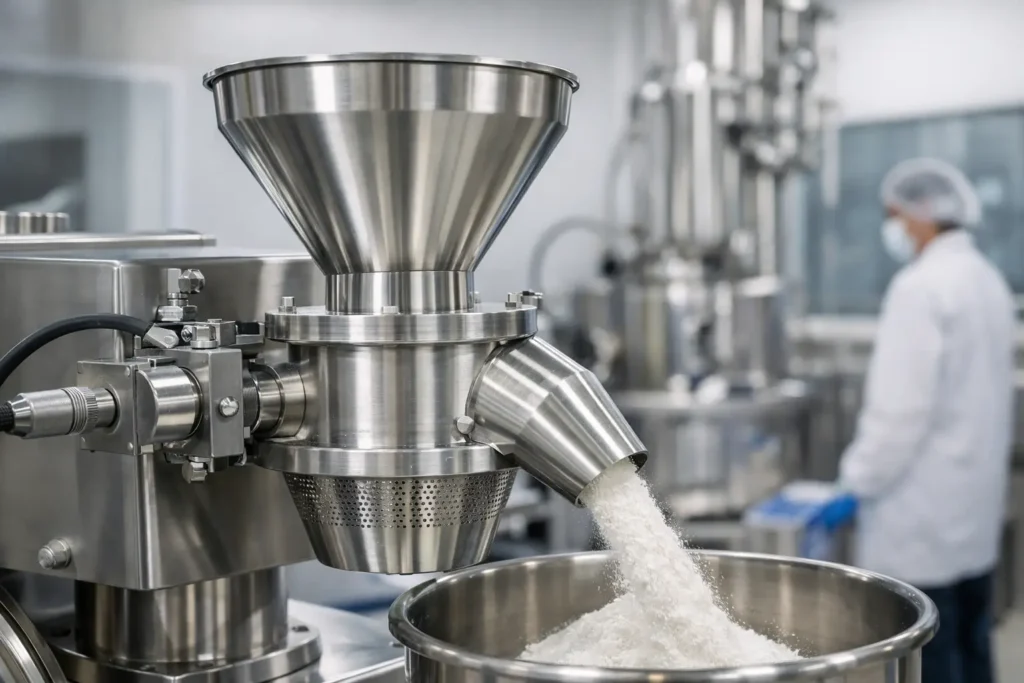
A cone mill for pharmaceutical powders is rarely selected on headline throughput alone. In practice, the right choice comes down to how consistently it can deliver the target particle size distribution, how gently it handles friable materials, and how well it fits within a validated production environment. For pharmaceutical manufacturers, those details affect blend uniformity, downstream flow, tablet compression, capsule filling and, ultimately, batch repeatability.
Why a cone mill for pharmaceutical powders is widely used
Cone mills are established in pharmaceutical processing because they offer controlled deagglomeration and sizing without the higher impact forces associated with more aggressive milling technologies. That matters when a formulation needs improved flow and uniformity, but cannot tolerate excessive fines generation, heat build-up or unnecessary particle damage.
In many plants, the cone mill sits between upstream blending or drying and downstream compression, encapsulation or granulation stages. Its role may be simple on paper – break soft agglomerates and deliver a more consistent powder – but the process effect is significant. A narrow, predictable output can improve feeder performance, reduce segregation risk and support more stable production rates.
That does not mean a cone mill is always the right answer. If the application requires substantial particle size reduction from a hard feed material, a pin mill, hammer mill or jet mill may be more appropriate. The value of a cone mill lies in controlled, efficient sizing where product integrity and process consistency are priorities.
How the process works
A cone mill typically uses an impeller to move powder through a conical screen. As the material passes through the apertures, oversized agglomerates are reduced and the final product exits with a more defined size profile. The process is mechanically straightforward, but performance depends heavily on the relationship between the impeller design, screen type, rotational speed and the behaviour of the powder itself.
For pharmaceutical applications, this simplicity is an advantage. A well-engineered cone mill is easier to validate, easier to clean and easier to integrate into contained systems than many alternative mills. It can also be configured for batch or continuous processing, depending on the line design and production objective.
What matters most is not just whether the machine can mill the powder, but whether it can do so repeatedly across batches, operators and scale. In regulated manufacturing, repeatability is the commercial requirement.
Key selection criteria
Particle size and product behaviour
The first question is not machine size. It is material behaviour. Pharmaceutical powders vary widely in density, friability, moisture sensitivity, electrostatic tendency and agglomeration pattern. A cone mill that performs well on one product may be unsuitable for another if the feed behaves differently under shear.
For dry granules, the objective is often to remove oversize and improve uniformity before compression. For cohesive API blends or excipient systems, the aim may be to improve flow while limiting fines. In both cases, the screen aperture and impeller configuration are central to performance. Smaller apertures can tighten size distribution, but they may also reduce throughput or increase heat generation if the product resists passage.
This is where testing matters. Application-specific trials provide a clearer view of achievable output, yield and particle size distribution than any nominal equipment specification.
Throughput and line integration
A cone mill should be sized for realistic plant conditions rather than idealised capacity figures. Peak demand, batch size, feeder arrangement, transfer method and available headroom all affect practical performance. In pharmaceutical production, line integration is often as important as the mill itself.
For example, a machine that meets the target kilograms per hour may still create an operational bottleneck if it complicates charging, discharge, containment or cleaning changeovers. Likewise, oversizing the mill can be inefficient if the process spends most of its time operating well below the intended range.
The better approach is to assess the cone mill as part of the full process route. Feed consistency, material transfer and downstream equipment response should all be considered together.
Heat, fines and product integrity
Not every powder responds well to mechanical stress. Some formulations are highly friable and can generate excessive fines if the impeller speed is too high or the screen geometry is poorly matched to the product. Others are heat sensitive and may degrade if residence time increases under restricted flow conditions.
A cone mill is often chosen because it can be gentler than other size reduction technologies, but gentle is relative. The actual outcome depends on the setup. It is often possible to reduce fines generation by adjusting speed, selecting a different screen profile or using a more suitable impeller design. Those variables should be evaluated early, particularly for high-value or performance-critical products.
GMP design and cleanability
Hygienic construction
For pharmaceutical environments, mill selection must align with GMP expectations. Product contact surfaces, weld quality, crevice-free construction and material certification all influence suitability. The machine should support thorough cleaning, straightforward inspection and minimal retention.
In practical terms, operators and quality teams will look for easy access to screens and impellers, repeatable assembly, and surfaces that do not trap powder. A design that is awkward to strip down may still run well, but it will carry a higher operational burden over time.
Containment and operator safety
Potent compounds and dust-sensitive products introduce another layer of complexity. In these cases, the cone mill may need to operate within a contained system using split butterfly valves, isolators, gloveboxes or integrated transfer arrangements. Dust control is not only a housekeeping issue. It affects product loss, operator exposure and compliance.
For ATEX-sensitive environments or solvent-related processes, the broader system design must also be reviewed carefully. Mill selection should never be separated from the plant’s safety basis.
Scale-up from development to production
One of the most common mistakes in powder processing is assuming that a successful laboratory result will transfer directly to commercial production. With cone milling, scale-up is generally more straightforward than with some high-energy technologies, but it still requires engineering discipline.
Changes in screen area, impeller tip speed, feed presentation and bulk density can all influence the result at larger scale. A development programme should therefore look beyond target particle size and examine throughput stability, fines generation and cleaning practicality under realistic operating conditions.
For manufacturers moving from pilot trials to full production, equipment suppliers that can support development, scale-up and system integration add practical value. That is especially true where the cone mill forms part of a wider line including mixing, conveying, feeding or containment equipment. DP Pulveriser UK works in exactly this space, where machine selection is tied to process performance rather than treated as an isolated purchase.
Where a cone mill fits – and where it does not
A cone mill for pharmaceutical powders is particularly effective for sizing dry granules, breaking soft agglomerates, improving powder flow and preparing material for downstream dosing or compaction. It is often the preferred option where the process needs controlled conditioning rather than aggressive comminution.
There are, however, limits. If the feed includes hard crystalline materials requiring substantial size reduction, a cone mill may struggle to deliver the required result efficiently. If the product specification demands very fine micron-level output, another technology is usually more suitable. And if the formulation is extremely sticky or moisture-laden, screen blinding may become the dominant issue unless the process is specifically engineered around it.
The best equipment decisions are made by matching the mechanism to the material. That sounds obvious, but it is where many capital purchases succeed or fail.
Questions worth asking before purchase
Technical buyers should look beyond standard datasheets. Ask how the mill performs on comparable pharmaceutical products. Ask what screen and impeller combinations are available, how the machine is cleaned, how parts are changed, and what level of validation support can be provided. Ask whether the mill has been designed for contained handling if the application requires it.
It is also worth challenging claimed throughput figures. Capacity without consistency is not useful in a regulated process. The more relevant measure is stable, repeatable output at the required particle size, with acceptable yield and manageable cleaning time.
Support after installation also matters. Spare parts availability, commissioning quality and process troubleshooting all affect the real cost of ownership. In pharmaceutical production, downtime has a way of becoming more expensive than the original equipment saving.
A cone mill is not a complicated concept, but selecting the right one for pharmaceutical powders is an engineering decision rather than a catalogue exercise. When the machine is properly matched to the formulation, process and compliance requirement, it becomes a quiet but essential part of a reliable manufacturing line. That is usually the best kind of equipment investment – one that keeps the process stable, the product consistent and the production team out of trouble.