DP Pulveriser UK - Innovating the Future of Size Reduction
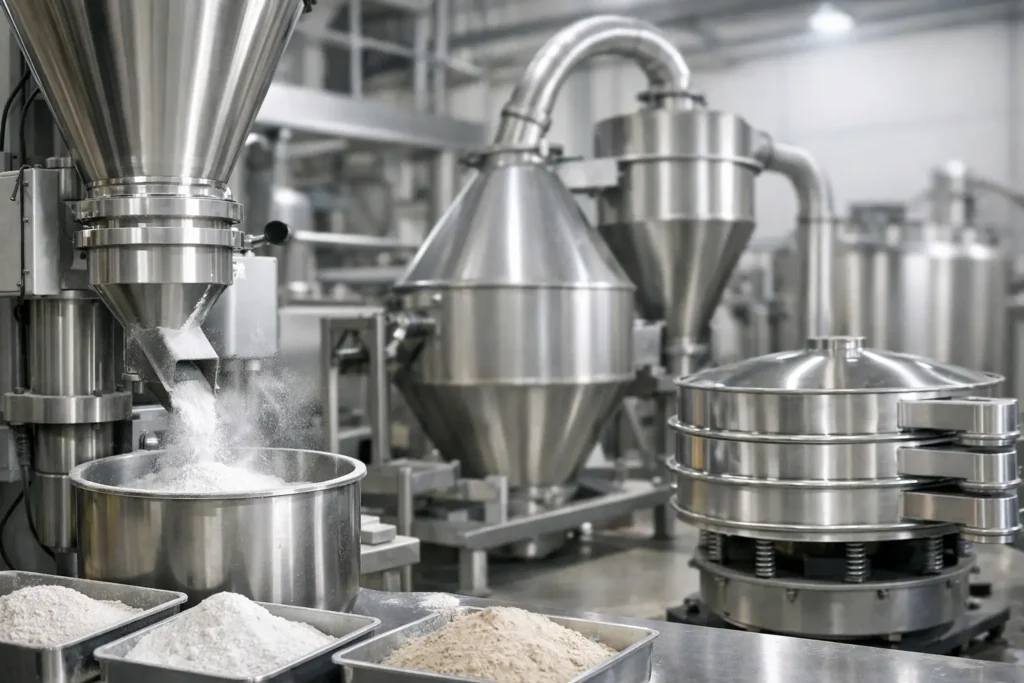
A line that runs well at pilot scale can still fail under production load. Throughput rises, heat builds, particle size drifts, segregation appears in transfer, and a material that looked straightforward in the lab starts behaving very differently. That is why an industrial powder processing equipment guide needs to begin with process reality rather than machine brochures. In powder processing, equipment selection is inseparable from the material, the target specification, the required capacity, and the way the full system operates from feed to final pack-out.
What an industrial powder processing equipment guide should cover
For industrial manufacturers, the real question is not simply which mill or mixer to buy. It is how to achieve precise particle size reduction, stable product quality, safe handling, and commercially viable throughput with the lowest practical operating cost. A suitable solution often combines milling, classification, feeding, conveying, mixing, dust control, and containment into one engineered process.
The correct equipment choice depends on several variables at once. Material hardness, friability, fat or oil content, heat sensitivity, moisture level, bulk density, abrasiveness, explosibility, and contamination risk all influence the process route. So do downstream requirements. If a product must meet a narrow top size, preserve active ingredients, improve dissolution, disperse evenly in a blend, or feed consistently into a tablet press or coating line, the specification has to drive the equipment selection.
Choosing mills for particle size reduction
Milling is usually the core operation, but different mill types solve different problems. Treating them as interchangeable often leads to underperformance.
Jet mills for micron and contamination-sensitive applications
Jet mills are typically selected where very fine particle size is required, often in applications that demand tight control and low contamination. Because size reduction occurs through particle-to-particle impact in a high-velocity gas stream, there is no conventional grinding media. That makes jet milling particularly attractive for pharmaceuticals, battery materials, advanced chemicals, and other high-value powders where purity matters.
The trade-off is energy demand and throughput. Jet mills can deliver excellent fineness and narrow distributions, but they are not automatically the most economical option for every duty. If the target does not require micron-scale performance, another mill technology may provide lower total cost of ownership.
Pin mills and universal mills for flexible fine grinding
Pin mills and universal mills are widely used for a broad range of powders where controlled fine grinding is needed without the complexity of a jet mill. They suit many food, chemical, mineral, and agricultural products, especially where the feed is free-flowing and the specification is demanding but not extreme.
Their appeal lies in flexibility. They can often handle changing products and different production campaigns with relatively efficient operation. The limiting factors are usually heat generation, wear in abrasive duties, and sensitivity to sticky or fibrous materials.
Hammer mills and cone mills for controlled reduction
Hammer mills remain a practical choice for many coarse to medium grinding applications, particularly where throughput is high and the feed is less delicate. They are used across sectors for de-agglomeration, pre-grinding, and size reduction of bulk materials. Cone mills, by contrast, are often chosen where a more uniform, gentle reduction is needed, especially for conditioned powders and granules.
The distinction matters. Hammer mills are productive and straightforward, but they are not always ideal for tight particle size distributions. Cone mills can offer better control for certain products, though they may not achieve the same throughput or fineness as impact-based systems.
Turbo mills and air classifier mills for tighter distributions
Where finer output and better control over oversize are required, turbo mills and air classifier mills become more relevant. An air classifier mill combines grinding and classification in a single system, allowing fine particles to exit while coarse material remains in the grinding zone until it reaches the target size.
That integrated approach is valuable when product consistency is critical. It reduces reliance on secondary screening and can improve process efficiency. Even so, performance still depends on feed consistency, air handling, and correct rotor and classifier settings. A well-designed machine cannot compensate for an unstable upstream process.
Cryogenic milling for heat-sensitive materials
Some products simply do not mill well at ambient temperature. Polymers may smear, spices may lose volatile compounds, and heat-sensitive actives can degrade. Cryogenic milling addresses this by cooling the material, often with liquid nitrogen, so it becomes brittle enough to process efficiently.
This route can transform difficult applications, but it comes with infrastructure and running cost implications. It is usually justified when standard milling compromises product quality, throughput, or cleanability to an unacceptable degree.
Classification is not an afterthought
In many powder plants, classification determines whether the line truly meets specification. A mill may reduce average particle size, but if oversize remains high or the distribution is too broad, downstream performance suffers. That can affect blend uniformity, dissolution, reactivity, surface finish, or packing density depending on the product.
Standalone air classifiers and integrated classifier mills allow tighter cut points and better control over final output. They are especially useful when the process demands a narrow particle size distribution rather than simple reduction. For manufacturers working in regulated or performance-critical sectors, that distinction is commercially significant.
Classification also affects yield. Rejecting too much useful material increases recirculation loads and energy consumption. Accepting too much coarse fraction may reduce product quality. The right balance has to be engineered around the actual specification rather than nominal machine capability.
Mixing, handling and conveying complete the process
Powder quality can be lost after milling just as easily as during it. A well-ground product can segregate in hoppers, compact in transfer, absorb moisture, or pick up contamination if the handling system is poorly designed. That is why an effective industrial powder processing equipment guide cannot stop at size reduction.
Mixers must match the bulk behaviour of the powder and the purpose of the blend. Is the goal simple homogenisation, incorporation of minor ingredients, coating of particles, or densification? Different duties place different demands on shear, residence time, discharge performance, and cleanability.
Conveying and feeding systems need the same attention. Pneumatic transfer may support hygiene and plant layout flexibility, but it can generate attrition or segregation in fragile materials. Mechanical conveying may be gentler in some cases, though footprint and containment must be considered. Poor feed consistency into a mill or classifier will undermine the entire line, no matter how advanced the main equipment may be.
System design matters more than standalone machine selection
This is where many capital projects go wrong. Equipment is purchased item by item, often from different suppliers, with limited process integration. On paper, every machine appears suitable. In operation, the interfaces create the problems – unstable feed rates, mismatched capacities, dust escape, excessive recirculation, difficult cleaning, or poor access for maintenance.
An engineered system approach usually delivers better results. That means evaluating the complete process from raw material intake through milling, classification, blending, conveying, collection, and controls. It also means sizing ancillaries correctly. Fans, filters, feeders, valves, instrumentation, and automation strategy can have as much influence on line performance as the mill itself.
For manufacturers scaling from laboratory work to production, this point is especially important. A process that behaves well on a small platform does not scale in a linear fashion. Residence time, thermal load, air volume, and product flow patterns all change. The strongest outcomes typically come from application-specific engineering supported by pilot validation and a clear scale-up path.
Key evaluation criteria for buyers
Technical teams usually begin with particle size and throughput, but those are only part of the decision. Wear resistance, contamination control, hygiene requirements, clean-in-place or washdown needs, noise, dust containment, ATEX considerations, and maintenance access all affect suitability.
Energy performance should be reviewed in context. The lowest installed power does not always produce the lowest operating cost if yield is poor, recirculation is high, or downtime is frequent. Equally, a premium machine may justify its capital cost if it improves consistency, reduces waste, and supports faster changeovers.
Procurement teams should also test supplier capability beyond the equipment data sheet. Can the partner support trials, customise the design, integrate the line, and provide commissioning and aftersales support? In sectors where uptime and compliance matter, that capability is not a nice extra. It is part of the asset value.
A practical route to the right solution
The most reliable way to specify powder processing equipment is to start with the end requirement and work backwards. Define the target particle size distribution, throughput, material behaviour, contamination limits, and cleaning standard. Then assess which process route can deliver that result consistently at scale.
From there, shortlist equipment by application fit rather than popularity. A jet mill may be the correct answer for one product and a costly mistake for another. A hammer mill may look economical until excess fines or broad distribution create downstream losses. It depends on the duty, and good engineering should make those trade-offs visible before purchase.
For manufacturers investing in new capacity or upgrading an underperforming line, the strongest results come from process-led equipment selection. That is the principle behind advanced powder systems developed by specialist partners such as DP Pulveriser UK: not selling an isolated machine, but engineering a production-ready solution that holds specification, supports scale, and performs reliably where it matters most – on the plant floor.
The right powder processing line should do more than meet today’s output target. It should give your operation room to tighten quality, improve efficiency, and adapt with confidence as product and market demands change.