DP Pulveriser UK - Innovating the Future of Size Reduction
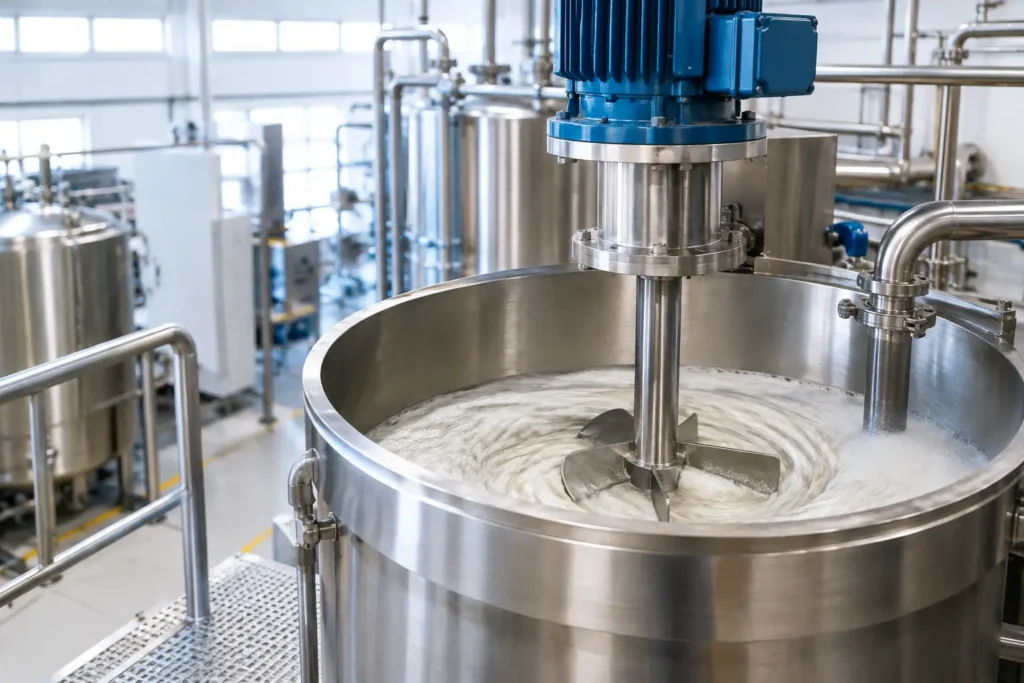
A mixer that produces an acceptable blend in a short development trial can create costly variability once it is connected to industrial-scale feeding, conveying, milling and packing equipment. The difference is rarely the mixer alone. Particle size distribution, bulk density, ingredient addition sequence, fill level and discharge behaviour all affect the result. This industrial mixing technology guide sets out the engineering considerations that matter when specifying a system for repeatable powder processing.
What industrial mixing must achieve
Industrial mixing is not simply the movement of material inside a vessel. The objective is to create the required degree of uniformity within a defined process time, without damaging particles, generating excessive heat, causing segregation or compromising cleanability. For powders, granules, pastes and dry blends, the acceptable result must be defined before equipment is selected.
That definition may include blend uniformity, particle coating coverage, moisture distribution, colour consistency, batch-to-batch repeatability or the controlled dispersion of a minor ingredient. In pharmaceuticals and nutraceuticals, content uniformity and containment may lead the specification. In food production, allergen control, hygienic design and gentle handling are often decisive. For minerals, chemicals, coatings or battery materials, throughput, abrasion resistance, dust control and protection from contamination can carry greater weight.
The required mixing mechanism depends on the material. Free-flowing powders may blend effectively through vessel rotation and controlled diffusion. Cohesive powders often need more positive agitation to break agglomerates and distribute fine additions. Materials with a wide range of particle sizes, densities or shapes are more likely to segregate, particularly during transfer and discharge. A mixer should therefore be assessed as part of the complete process, not as an isolated machine.
Industrial mixing technology guide: start with the material
A technically sound mixer selection begins with representative material data. Generic descriptions such as “fine powder” or “difficult blend” are not sufficient for engineering a dependable production line. The behaviour of the powder changes with moisture, temperature, storage time, particle size and the proportion of fine material.
Key properties include bulk density, particle size distribution, angle of repose, flowability, friability, moisture sensitivity and electrostatic behaviour. It is also necessary to understand whether the formulation contains a low-dose active, a lubricant, fibres, pigments, liquid additions or ingredients that may form agglomerates. The more dissimilar the components, the greater the risk that an apparently uniform blend will separate during downstream handling.
Particle size reduction can be closely linked to mixing performance. Milling an ingredient before blending may improve dispersion by reducing agglomerates and narrowing the particle size range. Equally, over-milling can increase cohesion, dust generation and electrostatic charge. Where a formulation demands precise particle size control, milling, classification and mixing should be designed as connected stages with defined transfer conditions.
Consider the addition sequence
The order in which ingredients enter the mixer can be as influential as mixer type. A minor component may require pre-blending with a carrier before it is introduced to the main batch. Liquids may need atomised addition at a controlled rate to avoid wet spots and large agglomerates. Sensitive ingredients may be added late in the cycle to limit shear exposure.
Automated weighing and recipe control improve repeatability, but they do not correct poor formulation behaviour. The equipment must still provide suitable access points, distribution across the powder bed and sufficient mixing time for every addition stage.
Match mixer design to the duty
There is no universal industrial mixer. Each design provides a different balance of mixing intensity, batch capacity, cleaning access, energy use and discharge characteristics.
Ribbon and paddle mixers are widely used for batch blending of dry powders and granular materials. Their horizontal agitators generate convective movement and can provide effective blending at practical production volumes. Paddle designs are generally better suited to fragile particles or applications where lower shear is preferred, while ribbon configurations can provide more intensive movement for cohesive materials. The final choice depends on material response, not simply the nominal speed of the machine.
Ploughshare and high-intensity mixers use faster mechanical action to create a fluidised mixing zone. They are suited to demanding powder blends, rapid dispersion and processes involving liquid addition or agglomerate breakdown. That higher intensity can be beneficial, but it may also increase wear, heat generation and particle attrition. Abrasive mineral products and fragile food particulates require particularly careful assessment.
Tumble mixers, including V-blenders and double-cone designs, offer gentle blending for free-flowing powders. They can be effective where low shear and easy cleaning are priorities. However, they may be less suitable for cohesive materials, short cycle requirements or blends with low-level ingredients that need positive dispersion.
Conical screw mixers combine gentle vessel rotation with a vertical orbiting screw. They are often specified for materials with different bulk densities or for products that need low energy input. Their broad operating range can be useful in multi-product facilities, although the achievable result still depends on fill level, formulation and discharge arrangement.
Continuous mixers are appropriate where production demand, upstream dosing accuracy and downstream packaging capacity support a steady-state process. They can reduce batch handling and improve line efficiency, but their control philosophy is more demanding. Loss-in-weight feeders, refill strategies, residence time distribution and online monitoring must be engineered together.
Scale-up is a process development task
Scale-up should not rely on a simple increase in vessel volume. Geometric proportions, agitator tip speed, fill ratio and material bed depth can all change between laboratory, pilot and production equipment. A formula that mixes in five minutes at small scale may require a different cycle time, speed or addition method at commercial scale.
Practical trials using representative materials remain the most reliable way to establish the operating window. These trials should evaluate more than blend samples taken at the end of the cycle. Testing should include samples from multiple locations, material retained in the mixer, discharge behaviour and samples after conveying. A blend that passes inside the vessel but segregates in an intermediate hopper has not solved the production problem.
The operating window should define acceptable batch size, mixing time, agitator speed, ingredient sequence and any liquid addition settings. It should also identify the point at which over-mixing begins to create separation, attrition or undesirable temperature rise. This evidence gives production teams a controlled basis for validation and routine operation.
Design the interfaces around the mixer
A high-performance mixer cannot compensate for poorly controlled feeding or discharge. Ingredients entering at inconsistent rates can form local concentration zones. Pneumatic conveying may alter particle size or separate fines from coarse fractions. Long drop heights and high transfer velocities can increase dust generation and segregation.
The mixer should be integrated with suitable storage, dosing, conveying and discharge equipment. Hopper geometry, valve design and the position of extraction points affect mass flow and cleanout. For hygroscopic, hazardous or high-value products, sealed transfer systems may be needed to protect operators, prevent atmospheric moisture uptake and minimise product loss.
Containment requirements should be established early. This includes dust-tight construction, local extraction, filter selection, access door sealing and safe handling of collected fines. Where combustible dust is present, the process requires a formal assessment of explosion risk, including potential ignition sources, pressure relief and isolation measures. The appropriate design will depend on the material’s tested explosion characteristics and the site’s wider safety strategy.
Specify for cleaning, maintenance and reliability
Cleaning time is production time. In multi-product plants, poor access and retained material can become a larger cost than the mixing cycle itself. The vessel interior should minimise crevices, dead zones and inaccessible surfaces. Tool-free or efficiently removable components can reduce changeover time, provided they maintain reliable sealing and correct reassembly.
Material of construction must suit the product and cleaning method. Stainless steel may be appropriate for hygienic and corrosive duties, while wear-resistant linings or hardened contact parts may be justified for abrasive minerals and pigments. Surface finish, gasket materials and shaft seal design should be selected for the process rather than treated as standard options.
Maintenance planning also matters. Bearings, gearboxes, drive systems and seals should be accessible for inspection, with condition monitoring where the duty is critical. Variable-speed drives can help optimise mixing intensity across formulations, but only when operating parameters are controlled and documented. Lower energy consumption is valuable, yet the lowest-power mixer is not automatically the lowest-cost solution if it extends batch time or creates quality losses.
Build control into the system
Repeatable output depends on repeatable inputs. Modern mixing systems can record recipe selection, ingredient weights, mixing time, speed, temperature and discharge status. These records support traceability, fault investigation and continuous process improvement, particularly in regulated manufacturing.
For higher-value or tightly specified products, process monitoring may include power draw, torque, temperature, moisture or near-infrared analysis. Such data can indicate changes in material behaviour before they become a batch failure. Monitoring should be selected for a clear operational purpose, however. Collecting large volumes of data without defined control limits does not improve process capability.
A better basis for investment
The strongest equipment specification is built around measurable product and process requirements: blend quality, capacity, cleaning time, containment, integration, safety and lifetime operating cost. Price should be evaluated against those requirements, including the cost of rejected batches, extended changeovers, maintenance downtime and lost throughput.
For manufacturers moving from development to commercial output, an engineering partner that can assess milling, classification, mixing and powder transfer together reduces avoidable risk. DP Pulverizer UK applies this process-led approach to build mixing systems and full turnkey lines around the behaviour of the material, not a catalogue assumption.
A well-engineered mixing installation gives operators a repeatable process rather than a narrow set of conditions that only works on a good day. That is the practical foundation for higher throughput, consistent product quality and confident scale-up.