DP Pulveriser UK - Innovating the Future of Size Reduction
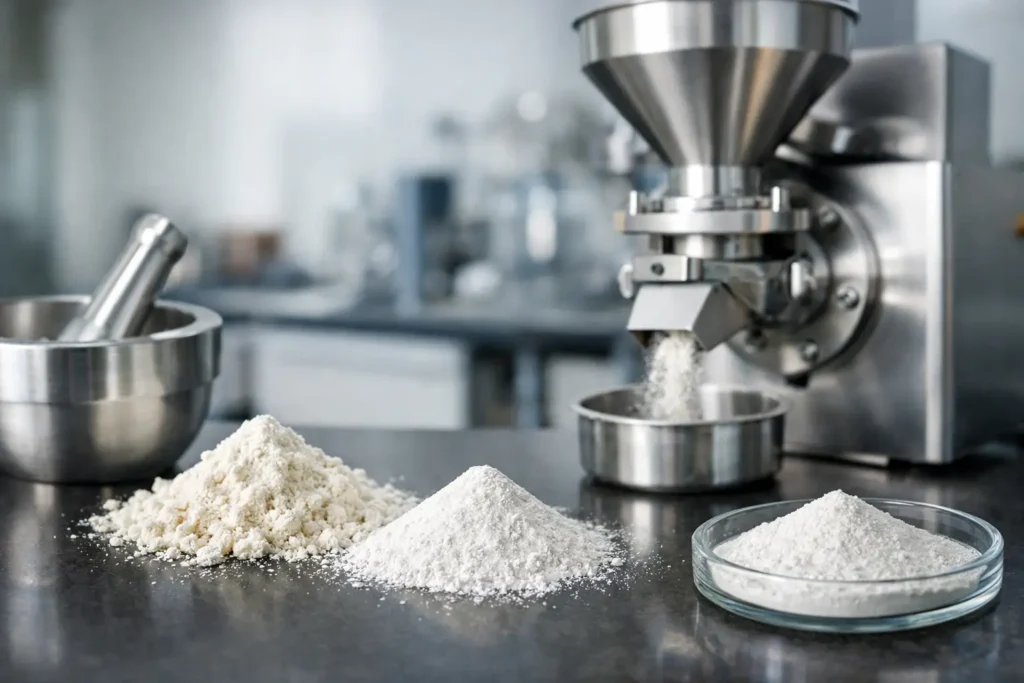
Particle size problems rarely start with the mill alone. In most production environments, the question of how to reduce particle size of powder is tied to a wider process issue – inconsistent feed, poor flow, excess heat, broad distribution, low yield, or difficult scale-up. The right answer depends on the material, the target specification, and the demands of the line around it.
For industrial manufacturers, particle size reduction is not simply about making powder finer. It is about achieving the required distribution, preserving product integrity, maintaining throughput, and doing so at a cost that makes operational sense. That is why successful size reduction begins with process understanding, not equipment selection in isolation.
How to reduce particle size of powder in production
At plant level, powder size reduction is governed by three interacting factors: material characteristics, milling technology, and system control. A brittle mineral behaves very differently from a fatty food ingredient, a heat-sensitive pharmaceutical intermediate, or an elastic polymer. Applying the wrong machine can lead to excessive fines, agglomeration, contamination, or unacceptable energy consumption.
The first step is defining the real target. In some applications, the goal is a top size limit. In others, it is a narrow D50 with minimal oversize and controlled fines. These are not the same requirement, and they do not favour the same process route. A hammer mill may be suitable for coarse to medium reduction, while a jet mill or air classifier mill may be needed where tighter micron-level control is essential.
Feed condition matters just as much. Moisture content, bulk density, hardness, friability, temperature sensitivity, and initial particle size all influence the reduction mechanism. Powders that cake, smear, or soften under heat often require a very different approach from free-flowing, brittle materials.
Match the mill to the material
Choosing the correct milling principle is the foundation of effective particle size reduction. Impact, attrition, compression, and shear each produce different outcomes, and many industrial applications use a combination of these forces rather than one alone.
Hammer mills and universal mills
For general-purpose size reduction, hammer mills and universal mills are often selected where moderate fineness, high throughput, and mechanical simplicity are priorities. They perform well on many dry, friable materials, but they are not always the best option for narrow particle size distributions. If the specification becomes tighter, downstream classification or a different mill type may be required.
Pin mills and turbo mills
Pin mills and turbo mills are effective where finer grinding and more controlled reduction are needed. They are commonly used for food ingredients, chemicals, and powders that respond well to impact-based comminution. Their performance depends heavily on rotor speed, feed rate, and the tendency of the material to heat during processing.
Cone mills
Cone mills are widely used when gentle deagglomeration, delumping, and controlled sizing are more important than aggressive micronisation. In pharmaceutical and nutraceutical environments, they are often preferred for uniform granule sizing and product conditioning. If the aim is very fine powder, however, a cone mill alone is unlikely to achieve the target.
Air classifier mills and jet mills
When the application demands finer particle sizes and tighter control, air classifier mills and jet mills become more relevant. An air classifier mill combines grinding and internal classification, allowing oversize particles to be returned for further reduction while acceptable particles exit the process. This supports narrower distribution and better control over fines.
Jet mills are particularly useful for very fine, contamination-sensitive, or heat-sensitive products because they use particle-on-particle impact rather than mechanical grinding media. That said, they generally require more energy and are not always the most economical choice for every throughput level.
Cryogenic milling
Some powders resist size reduction because they become elastic, sticky, or thermally unstable under ambient conditions. Cryogenic milling addresses this by embrittling the material at low temperature before or during grinding. This is often the right route for polymers, waxy products, spices, and other heat-sensitive materials where ambient milling causes smearing or loss of performance.
Process settings matter as much as the machine
Even the right mill will perform poorly if process variables are not controlled. In practice, many particle size issues are caused by unstable operating conditions rather than inadequate equipment design.
Rotor speed directly affects impact energy and residence time. Increasing speed may reduce particle size, but it can also increase heat generation, wear, and fines. Higher speed is not automatically better. The optimum setting is the one that meets specification without creating secondary problems.
Feed rate is another common source of inconsistency. If the mill is starved, energy use may rise without efficient throughput. If it is overfed, particles can pass through with insufficient residence time, leading to oversize material and broad distribution. Controlled, consistent feeding is essential, particularly for fine grinding applications.
Screen or classifier configuration also has a major effect. In screen-based mills, aperture size influences top size but can also alter throughput and heat build-up. In classifier-based systems, airflow, rotor speed, and cut-point settings determine the balance between yield and fineness. Tightening the cut-point may improve product quality, but often at the expense of throughput.
Why classification is often the difference
A common mistake is treating size reduction as a single-stage operation when the specification really demands classification. If product quality depends on a narrow particle size distribution, milling alone may not be enough.
Classification removes oversize particles and, in some systems, limits excessive fines. This improves consistency and can stabilise downstream performance in blending, conveying, compaction, coating, dissolution, or reaction kinetics. In many sectors, especially pharmaceuticals, battery materials, pigments, and advanced chemicals, classification is not optional – it is central to process capability.
Integrated milling and classification systems also support more efficient recirculation. Rather than over-grinding the entire batch to ensure compliance, the process can selectively return only the coarse fraction. This reduces wasted energy and helps preserve product functionality.
Material behaviour can change the answer
If a powder does not reduce as expected, the material itself is often the reason. Hardness is only one part of the picture. A soft but sticky product can be more difficult to process than a hard brittle one. Moisture, fat content, fibre structure, electrostatic behaviour, and thermal sensitivity all influence mill performance.
This is why lab and pilot trials are so valuable before committing to full-scale production. A process that works in principle can still fail commercially if it generates too much heat, creates handling problems, or cannot sustain the required tonnes per hour. Scale-up should be based on measured material response, not assumption.
For manufacturers planning expansion, the best systems are designed with this progression in mind – from test work to pilot validation to full production. That reduces risk and gives the production team confidence that the final installation will achieve the specified particle size at commercial throughput.
How to reduce particle size of powder without creating new problems
Reducing particle size can improve surface area, blend uniformity, reactivity, and product appearance. It can also create dust, segregation, flow issues, and explosion risk if the process is not properly engineered. Fine powders behave differently in storage, transport, and dosing. A successful solution considers the whole powder handling system, not just the grinder.
Dust control, containment, and ATEX considerations may all be relevant depending on the material. Wear protection and contamination control are equally important in high-purity and abrasive applications. In regulated sectors, cleanability, validation, and repeatability must be engineered into the system from the outset.
This is where an application-specific approach delivers the strongest outcome. The most effective installations combine the right mill, properly matched classification, controlled feeding, efficient conveying, and a layout that supports maintenance and process stability. For many manufacturers, that is the difference between a machine purchase and a reliable production solution.
DP Pulveriser UK supports this approach with engineered milling and powder processing systems designed around the application, the required particle size profile, and the realities of industrial production.
If you are assessing how to reduce particle size of powder, start with the specification, the material, and the operational constraints. Once those are clearly defined, the right process route becomes much easier to engineer – and far more likely to deliver consistent results on the factory floor.