DP Pulveriser UK - Innovating the Future of Size Reduction
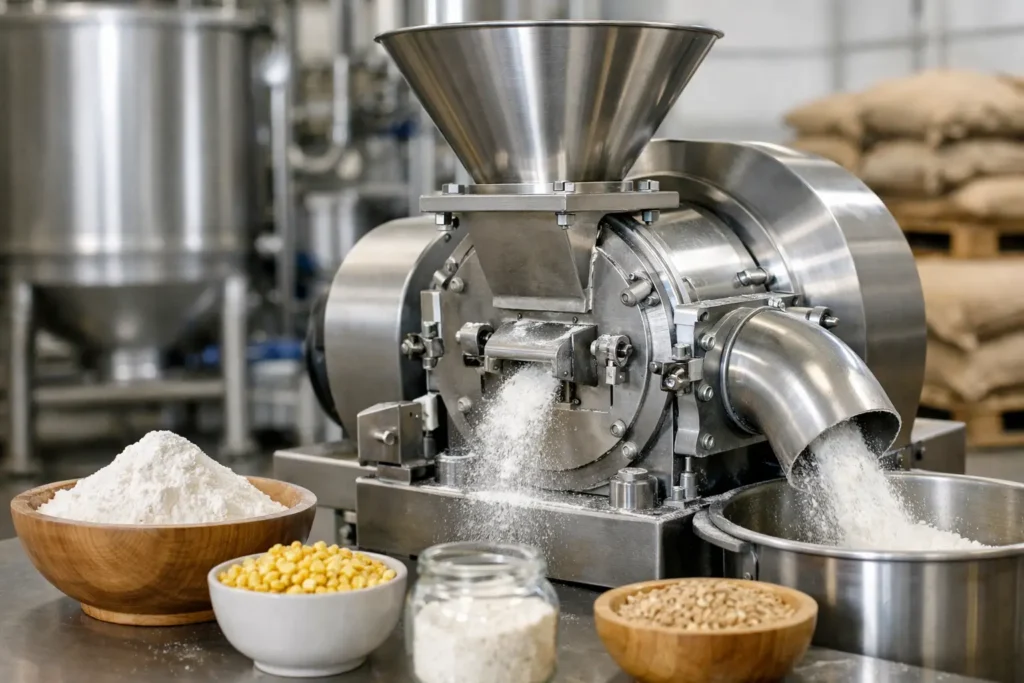
A hammer mill for food ingredients can solve one problem and create another if the specification is wrong. Many production teams start with a simple target – reduce particle size – but the real decision sits in the details: friability, oil content, moisture, temperature rise, hygienic design, throughput stability and the required particle size distribution. In food processing, those factors determine whether the mill supports a stable line or becomes a recurring source of waste, cleaning downtime and inconsistent product quality.
Where a hammer mill fits in food processing
Hammer mills are widely used across food manufacturing because they offer dependable size reduction for a broad range of dry and semi-dry materials. Spices, sugar, grains, pulses, dehydrated vegetables, animal feed ingredients and certain nutraceutical raw materials can all be reduced efficiently when the machine is matched correctly to the product.
The operating principle is straightforward. A rotor fitted with hammers impacts the incoming material at high speed, fracturing and reducing it until particles are small enough to pass through a screen. That simplicity is one of the main reasons hammer mills remain a practical choice in production environments. They are mechanically direct, scalable and capable of handling significant throughputs.
That said, a hammer mill is not automatically the best answer for every food application. If a product is highly heat sensitive, sticky, fibrous or needs very tight top-size control, another milling technology may perform better. The right question is not whether a hammer mill can grind the ingredient, but whether it can do so consistently, hygienically and at the required production rate.
What matters most when selecting a hammer mill for food ingredients
The correct machine specification starts with the ingredient itself. Hard crystalline sugar behaves very differently from oily spices or brittle cereal components. Even within one category, moisture variation from batch to batch can change mill performance noticeably.
Particle size and distribution
Most buyers begin with a target micron or mesh figure, but average size alone is not enough. Food manufacturers often need control over the full particle size distribution because oversized particles affect mouthfeel, blend uniformity and downstream mixing, while excessive fines can change flow properties, dust load and packing behaviour.
In a hammer mill, particle size is influenced by rotor speed, hammer design, screen aperture, feed rate and material characteristics. A smaller screen does not always mean a better result. It may increase residence time, create more fines and raise product temperature. In many food applications, the objective is not the smallest possible output but the most repeatable one.
Heat generation and product integrity
Impact milling generates heat. For many food ingredients, that is manageable. For others, it is a process risk. Spices can lose volatile compounds, sugars may soften, and fat-containing products can smear or blind the screen if temperature rises too far.
This is where engineering detail matters. Appropriate tip speed, controlled feed presentation and airflow management can reduce unnecessary heat build-up. In some cases, the answer is not to push one mill harder, but to design the system around the material so the equipment operates within a stable window. If flavour retention, colour stability or nutritional integrity are critical, the mill has to be selected with those outcomes in mind.
Throughput under real production conditions
Quoted capacity figures are often treated as fixed, but they are only meaningful when tied to a specific ingredient, feed size, moisture level and final specification. A hammer mill producing a coarse cereal grind may achieve very different throughput from the same machine reducing a dense spice blend to a much finer range.
Production teams should assess expected throughput against the actual duty, not a catalogue maximum. It is also worth considering whether the process needs headroom for future demand, recipe changes or seasonal raw material variation. A system that performs well in trials but runs at its limit on the plant floor can quickly become expensive to operate.
Hygiene, cleanability and food safety
For food plants, mechanical performance is only part of the decision. The hammer mill must also support hygienic operation and practical cleaning. Poor access, retained product zones and difficult internal geometry all increase contamination risk and extend changeover times.
Design features that affect sanitation
A food-grade hammer mill should be assessed for material contact surfaces, internal finish, ease of inspection and access for cleaning. Tool-less or simplified access can reduce downtime during product changeovers. Seals, bearings and shaft arrangements also deserve close attention because poorly protected components can compromise both hygiene and reliability.
If the line processes allergens or multiple product families, cleanability becomes commercially significant as well as operationally necessary. The cost of a mill is not just the purchase price. It includes cleaning labour, lost production during washdown or dry clean procedures, and the risk of off-spec material following changeover.
Dust control and containment
Food powders bring combustible dust considerations alongside hygiene requirements. A well-engineered hammer mill system should account for extraction, containment and safe powder handling, particularly when processing fine organic materials. Dust control also improves housekeeping and helps maintain a more stable plant environment.
This is rarely a standalone machine issue. The mill, feeder, discharge arrangement, filter system and downstream conveying all influence overall cleanliness and safety. Buyers who evaluate only the mill body often miss where the real operating issues begin.
Material behaviour changes everything
One of the most common specification errors is assuming that all dry food ingredients respond similarly to impact milling. They do not.
Free-flowing, brittle products are usually well suited to hammer milling. Crystalline and friable ingredients break readily and can be processed with predictable performance. Fibrous materials are more variable. They may resist clean fracture, generate irregular particles and create screen blockage if the mill geometry is not appropriate.
High-fat or oil-rich ingredients need particular caution. As temperature rises, these products can smear instead of fracture cleanly. That affects both throughput and particle size consistency. In some cases, pre-conditioning, lower temperature operation or an alternative mill type will be more effective. The same applies to hygroscopic ingredients where moisture uptake can change flow and screen performance.
This is why process development matters. Laboratory and pilot evaluation can expose issues that are not obvious from a raw material data sheet alone. For technically demanding applications, the best equipment choice is often made through testing rather than assumption.
The value of system integration
A hammer mill for food ingredients should be considered as part of a complete process, not as an isolated machine. Feed consistency, metal separation, aspiration, product collection and downstream transfer all affect mill performance.
An inconsistent feed can create fluctuating load, uneven particle size and unnecessary wear. Infeed design should present product to the grinding chamber in a controlled, repeatable way. Upstream magnets or protection devices may be required to prevent tramp metal damage. Downstream classification or screening may also be necessary where product quality demands tighter control than a hammer mill alone can provide.
For larger installations, integrated systems often deliver better economics than piecemeal equipment selection. Energy performance, operator intervention, maintenance planning and line reliability all improve when the process is engineered as a whole. That is particularly relevant for manufacturers scaling from pilot to commercial production, where a machine that worked acceptably in isolation may behave differently once connected to full plant utilities and handling systems.
Wear, maintenance and total cost of ownership
Hammer mills are proven industrial machines, but wear is unavoidable. Hammers, screens, liners and other high-contact components need monitoring and replacement at planned intervals. The operating cost depends heavily on the abrasiveness of the ingredient, the duty cycle and how efficiently wear parts can be changed.
A lower capital cost can be misleading if the machine requires frequent stoppages or if critical parts are difficult to access. For food manufacturers running demanding schedules, maintainability has direct value. Fast screen changes, dependable rotor balance and durable construction reduce both labour input and production disruption.
Energy consumption also deserves proper scrutiny. A mill that reaches the target size with less recirculation, lower heat generation and more stable throughput will often deliver a better whole-life result than a cheaper alternative. Engineering quality shows up over time in consistency, uptime and reduced intervention.
When a hammer mill is the right choice
A hammer mill is often a strong fit when the ingredient is dry, relatively brittle and suited to impact reduction, and when the process needs dependable throughput with practical maintenance. It can be an excellent option for bulk food ingredients where the goal is efficient reduction to a controlled, application-appropriate size range.
It becomes a weaker fit when the product is highly sticky, temperature sensitive, elastic or requires exceptionally narrow particle size distribution without downstream classification. In those cases, another milling technology may produce a better technical and commercial outcome.
For manufacturers comparing options, the best approach is to define the true process requirement clearly: feed characteristics, final specification, hygiene standards, expected throughput, cleaning regime and future scale. From there, equipment selection becomes an engineering decision rather than a guess.
DP Pulveriser UK supports that approach by focusing on application-specific milling systems rather than one-size-fits-all recommendations. For food producers working with demanding ingredients, that discipline matters. The right mill should not only reduce particle size. It should protect product quality, support plant efficiency and remain reliable under production pressure.
A well-chosen hammer mill earns its place by doing the same job, shift after shift, without forcing compromises elsewhere in the process.