DP Pulveriser UK - Innovating the Future of Size Reduction
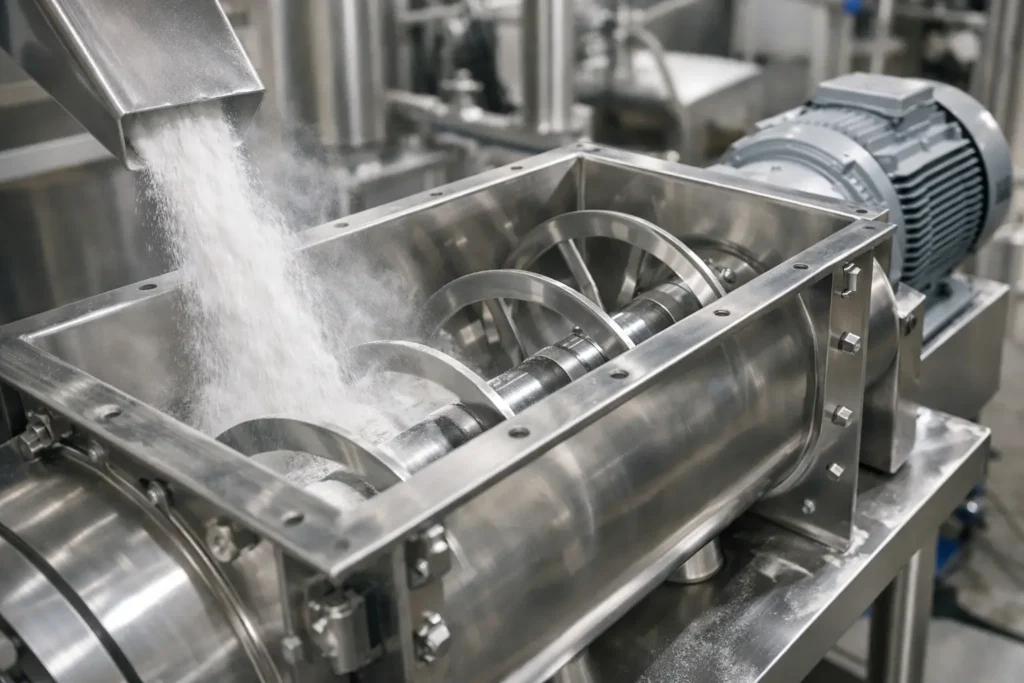
A ribbon blender can appear to be a straightforward horizontal mixer, yet its performance is determined by details that are easy to overlook: ribbon geometry, working volume, discharge design, powder behaviour and the accuracy of the drive system. For manufacturers comparing the best industrial ribbon blenders, the right decision is not about selecting the largest vessel or the highest motor rating. It is about achieving repeatable blend uniformity at the required production rate, without compromising cleanability, product integrity or operating cost.
Ribbon blenders remain a highly effective option for dry powders, granules and low-level liquid additions. They are widely specified across food, nutraceutical, chemical, mineral, agricultural and specialist materials production because they combine high batch capacity with a relatively efficient and accessible mechanical design. However, the same mixer will not suit every powder. A proper evaluation starts with the product, then works outward to the machine and the complete handling line.
What Defines the Best Industrial Ribbon Blenders?
The best industrial ribbon blenders are engineered around the movement of the material, rather than a generic vessel size. A double helical ribbon assembly creates both radial and axial circulation. The outer ribbon typically moves material from the ends towards the centre, while the inner ribbon returns it towards the ends. This counter-flow action continually redistributes the batch through the mixing zone.
For free-flowing powder blends, this mechanism can provide a highly consistent result in short cycle times. It is particularly useful where ingredients have similar bulk density and particle size, such as premixed food powders, dry chemical formulations, fertiliser blends and mineral compounds. The design also offers a large working capacity relative to its footprint, supporting efficient production where batch processing is preferred.
Performance changes when ingredients differ significantly in density, particle shape or particle size. Fine powders can agglomerate, coarse particles may segregate, and lightweight components can be displaced by denser material during filling or discharge. In these cases, a standard ribbon arrangement may still be suitable, but the ribbon pitch, tip clearance, rotational speed and loading sequence need to be assessed against the application. Blending trials are often the most reliable way to establish whether the specified equipment will meet a defined uniformity target.
Start With the Powder, Not the Mixer
A ribbon blender should be selected according to measurable powder properties and process conditions. Bulk density is only one part of the picture. Flowability, moisture content, cohesion, particle size distribution, friability and electrostatic behaviour all influence how material travels through the mixer.
A free-flowing powder may blend efficiently at a moderate ribbon speed and discharge cleanly through a flush-mounted valve. A cohesive or hygroscopic material may require higher torque, carefully controlled clearances and a vessel finish that reduces material retention. Where a formulation includes minor ingredients at a low inclusion rate, the method of addition is as relevant as the mixer itself. Adding a trace ingredient directly onto a static powder bed can create local concentration zones that require longer mixing and may still be difficult to eliminate.
Liquid addition deserves equal attention. A ribbon blender can disperse small quantities of oil, flavouring, binder or surfactant when the liquid is introduced through correctly positioned spray bars or atomising nozzles. Large droplets, poor spray coverage or injection at the wrong point in the cycle can produce wet agglomerates instead of an even coating. For higher liquid levels or materials that form pastes, another mixing technology may deliver a more dependable result.
Capacity, Fill Level and Throughput
A larger vessel does not automatically mean higher output. Ribbon blenders need adequate freeboard for the powder to circulate effectively. Operating too close to the vessel’s total volume restricts movement and can increase blend times. Running consistently underfilled can also reduce mixing efficiency, particularly when the ribbon geometry is designed for a specific working range.
Most industrial ribbon blenders are specified around a practical working volume rather than gross vessel capacity. The required batch mass is calculated from the product’s bulk density, then checked against the recommended fill level. This should account for likely density variation between deliveries, as powders can compact during storage, change with humidity or vary after milling and classification.
Throughput should be assessed as a complete batch cycle: loading, mixing, sampling, discharge and cleaning where required. A mixer with a five-minute blend time may have limited production value if manual loading takes twenty minutes or if its discharge valve retains material. Integrated conveying, automated ingredient dosing and a properly sized downstream hopper can make a greater difference to hourly output than simply increasing mixer speed.
Engineering Features That Affect Daily Performance
When comparing industrial ribbon blender designs, procurement teams should examine the components that govern reliability, cleaning time and product control. The following features deserve specification-level attention:
- Ribbon and shaft design: Ribbon thickness, pitch, clearance and weld quality affect material movement, torque demand and retained product. The shaft and support arrangement must be rated for the actual material load, including difficult start-up conditions.
- Drive and gearbox selection: A correctly sized geared drive should provide controlled low-speed mixing and sufficient starting torque. Variable-speed control can assist product development and allow recipes with different mixing requirements to run on one platform.
- Discharge valve configuration: A full-width bomb-bay, slide or butterfly valve may be appropriate depending on product flow, hygiene needs and the required discharge rate. The valve must minimise dead zones and allow dependable shut-off between batches.
- Construction and finish: Food, pharmaceutical and high-purity applications may require stainless steel contact surfaces, polished internal welds, sanitary seals and clean-in-place provisions. Abrasive minerals or pigments may call for wear-resistant materials instead.
- Safety and containment: Dust-tight covers, interlocked access points, extraction connections and guarding should be considered as part of the system. Where combustible dust is present, the equipment and installation must be assessed against DSEAR and relevant ATEX requirements.
The cost of these features should be evaluated against the application, not added indiscriminately. A highly polished, fully automated hygienic system is justified in a product-changeover-intensive nutraceutical plant. It may be unnecessary for a dedicated mineral blending line where wear life and service access are the priority.
Blend Quality Must Be Verified, Not Assumed
A visually uniform batch is not proof of homogeneity. For products with active ingredients, colour-critical formulations or narrow compositional tolerances, blend validation should use a documented sampling method and a relevant analytical test. Samples need to be taken from multiple positions and, where appropriate, at different stages of discharge. This reveals whether segregation occurs after mixing rather than within the vessel.
The sampling plan should reflect the actual production process. A blend can pass a sample test in the mixer but separate in a transfer screw, pneumatic conveying line or intermediate hopper. Particle size differences, density contrast and vibration during handling can all contribute. For this reason, the best industrial ribbon blender is often one component of an engineered powder processing system, with transfer equipment designed to preserve the blend it has created.
Mixing time also requires discipline. Overmixing is not always harmless. Some particulate products can segregate when exposed to extended movement, while fragile granules may break down. Establishing the minimum validated mixing time protects both product quality and production capacity.
When a Ribbon Blender Is Not the Right Choice
Ribbon blenders are versatile, but they are not a universal answer. Very cohesive powders, materials that require intensive deagglomeration, high liquid additions and difficult paste-like products may benefit from a ploughshare, paddle, high-shear or other specialised mixer. Fragile inclusions may need a gentler mixing action, while formulations with very small additions of potent ingredients can require a different batch strategy and higher containment.
The same applies where continuous processing is essential. A continuous mixer may offer better line integration for high-volume, stable formulations, although it demands accurate, consistent upstream dosing. Batch ribbon blending remains attractive when manufacturers need recipe flexibility, clear batch traceability and practical validation of individual lots.
Specify for the Full Process Life
A sound equipment specification should define more than vessel capacity and motor power. It should state the materials to be processed, batch range, target blend uniformity, allowable residual product, cleaning method, required discharge time, control philosophy, dust classification and any compliance requirements. It should also identify the upstream and downstream equipment that determines whether the mixer can operate at its intended rate.
For manufacturers scaling from trials into commercial production, application-specific testing reduces avoidable risk. DP Pulverizer UK applies this process-led approach across mixing, milling, classification and powder handling systems, helping match equipment design to material behaviour and production objectives.
The most productive next step is to send representative materials through a defined trial programme, measure blend quality at discharge and assess cleaning and handling under realistic conditions. That evidence will identify the ribbon blender configuration that supports consistent batches long after commissioning.