DP Pulveriser UK - Innovating the Future of Size Reduction
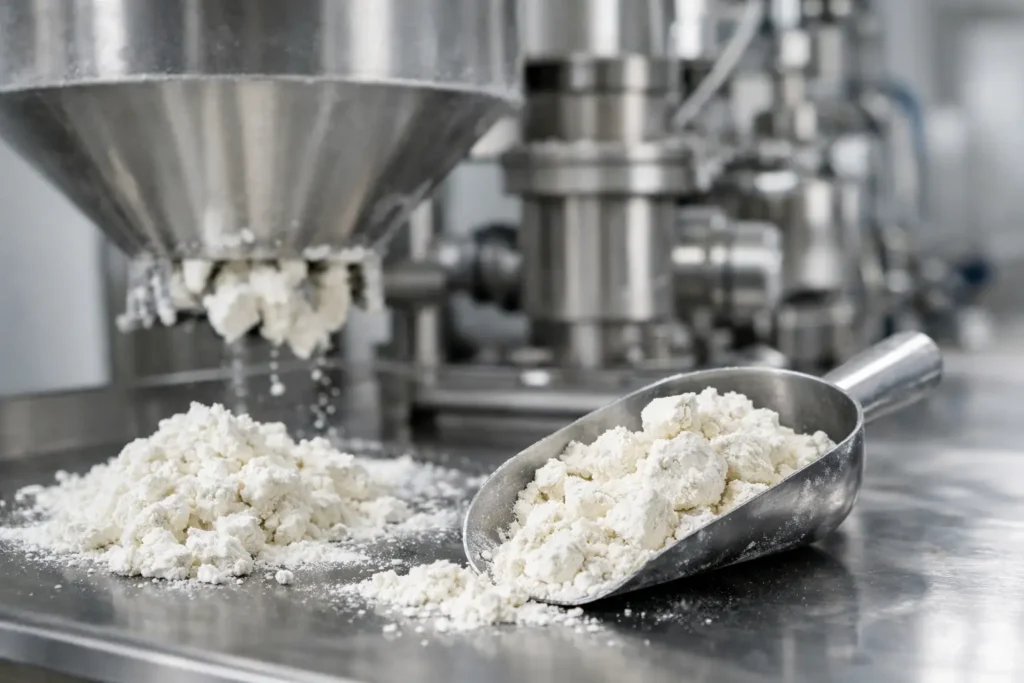
A hopper that discharged freely last week can become a production constraint without any change to the product specification. When powder bridges, forms lumps or compacts into a hard mass, the immediate problem is lost flow. The deeper issue is that powder caking causes often sit across the whole process: incoming material condition, milling profile, ambient humidity, conveying, storage time and equipment geometry.
For manufacturers working with food ingredients, chemicals, minerals, pharmaceuticals, coatings or battery materials, caking is more than a housekeeping concern. It can disrupt dosing accuracy, reduce classifier performance, create batch-to-batch variation and force unplanned cleaning or rework. Effective control starts by identifying the mechanism rather than treating every lump as the same fault.
What powder caking actually is
Caking occurs when individual particles form bonds strong enough to prevent the powder from returning to a free-flowing state under normal handling. A light, reversible agglomerate may break apart during conveying or screening. A cake does not. It may need mechanical force, milling or disposal before the material can be processed reliably.
The bond can be created by liquid bridges, dissolved and recrystallised solids, fat migration, chemical reaction, electrostatic attraction or physical consolidation under load. In practice, several mechanisms commonly operate at once. A hygroscopic food powder, for example, may absorb water vapour, develop liquid bridges at particle contact points and then compact under the weight of material in a silo.
Caking should also be separated from poor flow caused by particle shape. Very fine, irregular or highly cohesive powders can flow poorly even when no hard agglomerates have formed. Both conditions may produce bridging in a hopper, but they require different corrective action.
The main powder caking causes
Moisture uptake and humidity exposure
Moisture is the most frequent cause of powder caking. Many powders absorb water from the surrounding air until they reach an equilibrium moisture content. Once surface moisture increases, particles adhere through capillary liquid bridges. If soluble material is present, a small amount can dissolve at the contact point and then recrystallise as conditions change, creating a much stronger solid bridge.
The risk is not limited to visibly damp powder. Short exposure during transfer, poorly sealed IBCs, compressed-air leaks, washdown near filling equipment or humid ambient air can be sufficient for sensitive products. Materials such as salts, sugars, milk powders, fertilisers and certain pharmaceutical excipients may show a sharp reduction in flowability once a critical relative humidity is exceeded.
Water activity, sorption behaviour and the intended storage climate should therefore be considered together. A moisture specification alone does not always predict storage performance, particularly where temperature fluctuates.
Temperature cycling and condensation
Temperature changes can create local condensation even in a nominally dry production area. A cold powder entering a warmer room, or a warm vessel cooling overnight, can bring air near the dew point at the powder surface. This can cause localised wetting and caking around vessel walls, discharge valves and the upper surface of stored material.
Heat also changes the behaviour of some ingredients. Fat-containing powders may develop tackiness when temperatures approach the softening range of their fat phase. Amorphous materials, including some spray-dried products, can become sticky when temperature and moisture lower their glass-transition threshold. This is a material property issue, not simply a packaging issue.
Fine particle size and broad particle distribution
Fine powders have a high surface area relative to their mass. That increases their contact area, sensitivity to moisture and cohesive forces. Intensive milling can improve dispersion, reactivity or product texture, but producing too high a fines fraction can make a material more difficult to convey, dose and store.
A broad particle size distribution can increase packing density because smaller particles fill the voids between larger ones. Under storage pressure, this can reduce permeability and increase the contact points where bonding occurs. The correct target is not always the finest achievable grind. It is the particle size distribution that delivers the required product performance while retaining stable handling characteristics.
Compression, storage time and vessel geometry
Powder stored under its own weight consolidates. The longer it remains at rest, the more the particles settle and the more opportunity there is for bonds to strengthen. This is particularly relevant in tall silos, bulk bags, full IBCs and hopper outlets with long residence times.
Pressure alone does not always create a hard cake, but it magnifies moisture-related bonding and interparticle attraction. A powder that performs well in short bench tests may compact significantly after several days in a full-scale vessel. This is why storage-time testing is essential when transferring a process from pilot plant to production.
Hopper design can worsen the result. Shallow wall angles, abrupt transitions, insufficient outlet size and internal ledges encourage stagnant zones where product remains under load. Once a stable arch forms, operators may resort to impact or manual intervention, both of which increase safety and contamination risk.
Formulation, ingredients and chemical change
Some formulations are inherently prone to caking. Hygroscopic ingredients attract moisture, while low-melting components can smear or form tacky contact points. Changes in pH, oxidation, crystallinity or particle surface chemistry may also alter flow over time.
Anti-caking agents can be effective, but they are not a universal remedy. Their suitability depends on product regulations, dosage, particle size, blending quality and downstream requirements. In a pharmaceutical or high-purity chemical application, an additive may not be permissible. In that case, environmental control, particle engineering and closed handling become more important.
Static charge and process-generated heat
Electrostatic charge can cause fine particles to cling to vessel walls and one another, especially in dry conditions and during high-velocity pneumatic conveying. It is rarely the sole explanation for severe caking, but it can contribute to poor discharge and material build-up.
Milling and conveying may introduce heat that changes the powder before it reaches storage. Pin mills, hammer mills and air classifier mills must be selected and operated with the heat sensitivity of the material in mind. Where temperature rise affects moisture, fat softening or glass transition, a controlled air supply, lower energy input or cryogenic milling may be required.
Diagnosing the caking mechanism before changing equipment
Treating every caking event with a bigger agitator or more aggressive vibration can hide the root cause. The first step is to document where the material changes state. Compare the powder at receipt, after milling, after classification, after conveying and after defined storage intervals. Record moisture content, temperature, relative humidity, particle size distribution, bulk density and flow behaviour at each point.
The location of the cake is revealing. Material hardened uniformly in a bag often points to moisture exposure or prolonged compression. Caking near a pneumatic receiver may indicate temperature change, unsuitable conveying air or fines generation. Deposits around a mill outlet can suggest local heat build-up, insufficient air movement or a material approaching its softening point.
Laboratory-scale trials should replicate realistic conditions. A flow test conducted immediately after production has limited value if the powder is routinely held for two weeks before use. Test the expected storage duration, fill depth, temperature range and packaging or container type. For critical applications, assess wall friction, unconfined yield strength and the relationship between consolidation stress and flow function.
Engineering controls that protect powder flow
Moisture control is usually the first priority. This may involve dehumidified processing rooms, sealed transfer systems, dry and correctly filtered conveying air, insulated vessels and packaging with an appropriate moisture barrier. The required control level depends on the material’s moisture sorption profile and its exposure time, not just the site’s average humidity.
Particle size control is equally significant. Milling and classification should be configured to produce the required distribution consistently, with particular attention to excess fines. A process may benefit from a different mill type, classifier cut point or feed arrangement rather than simply increasing milling intensity. Precise particle size reduction should support both end-product performance and reliable downstream handling.
For storage and discharge, equipment must match the measured flow properties of the powder. Mass-flow hopper design, suitable wall finishes, correctly sized outlets and controlled flow aids can reduce stagnant regions and compaction. Flow aids should be selected carefully: vibration can help some materials but may further densify very fine powders; air pads can improve discharge but require dry, clean air and may be unsuitable for products sensitive to aeration.
Closed, integrated systems reduce the number of opportunities for a powder to absorb moisture, segregate or pick up contamination. DP Pulverizer UK engineers milling, classification, mixing and powder handling systems as connected process stages, allowing material behaviour at one stage to be considered before it becomes a reliability issue at the next.
When caking points to a wider process problem
Recurring caking is often a signal that the current process window is too narrow. If operators must continually adjust vibration settings, break bridges manually or shorten storage periods to maintain output, the system is relying on intervention rather than controlled powder behaviour.
The most durable solution may be a modest adjustment to ambient control, residence time or particle size distribution. In other cases, it requires a redesigned transfer route, a different milling approach or a purpose-designed hopper. The right answer depends on the material, production rate, cleaning regime, compliance requirements and the consequences of an out-of-specification batch.
Powder should not be judged only by how it leaves the mill. Its value is proven when it still flows, doses and performs predictably at the point of use.