DP Pulveriser UK - Innovating the Future of Size Reduction
A fine powder line can meet its target mill throughput and still fail its product specification at the separation stage. The decision between an air classifier versus cyclone separator determines whether a system actively controls particle size or simply recovers solids from an air stream. These are different duties, and treating them as interchangeable often creates avoidable losses in yield, consistency and downstream performance.
For process engineers, the correct choice starts with the material, the required particle size distribution and the role the equipment must perform within the complete process. In many high-specification systems, an air classifier and cyclone separator work together rather than compete.
Air Classifier Versus Cyclone Separator: The Core Difference
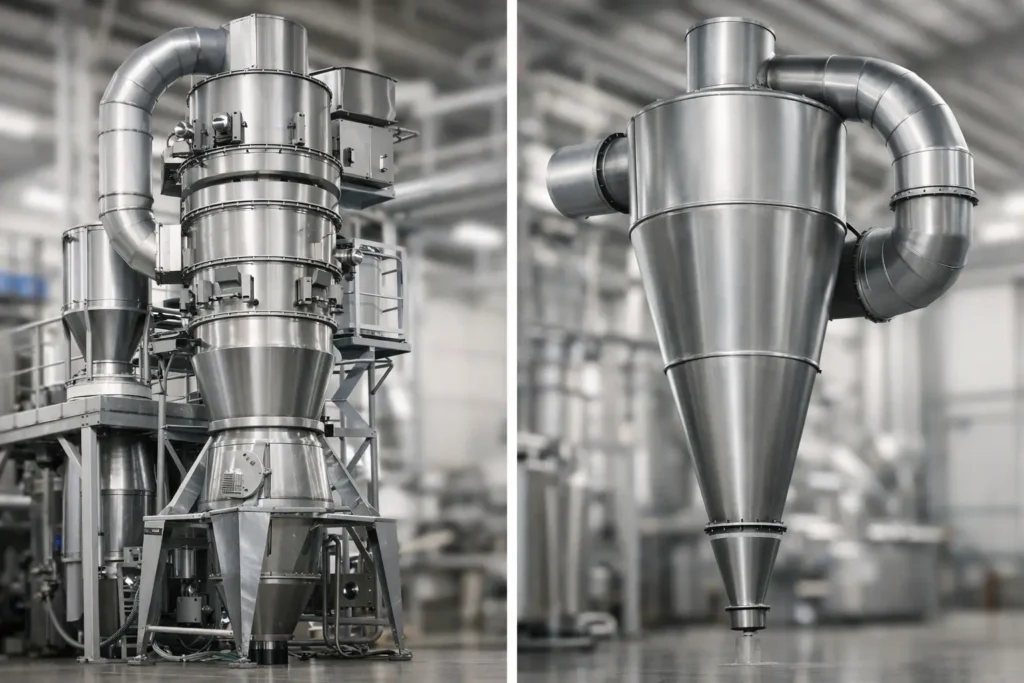
An air classifier is a precision separation device. It uses a controlled air flow and, commonly, a rotating classifier wheel to divide particles according to aerodynamic behaviour. Fine particles are carried with the air stream to the product outlet, while coarse particles are rejected and returned to the mill or discharged separately. The operating point can be adjusted to achieve a defined cut size and manage the width of the particle size distribution.
A cyclone separator is primarily a collection device. It uses centrifugal force generated by a tangential air inlet to separate entrained solids from a gas stream. Material enters the cyclone at high velocity, spirals down the vessel wall and drops into a discharge hopper, while cleaner air exits through the top. A cyclone does not provide the same sharp, adjustable particle classification as a dynamic air classifier.
This distinction matters in closed-loop milling. If the objective is to prevent oversize particles reaching the finished product, a classifier is the control point. If the objective is to recover product from conveying air before filtration, a cyclone is generally the appropriate equipment.
How an Air Classifier Controls Product Quality
Dynamic air classifiers are used where particle size is a critical product attribute. Typical applications include mineral fillers, pigments, battery materials, pharmaceuticals, food powders, chemical intermediates and performance coatings. In these applications, a small shift in the coarse fraction can affect flowability, dissolution, colour development, surface finish, reactivity or packing density.
The classifier wheel generates a centrifugal field that opposes the drag force of the air stream. Fine particles with lower inertia follow the air towards the outlet. Coarser, heavier particles cannot pass the wheel at the selected operating condition and are rejected. By changing wheel speed, air volume, feed rate and the geometry of the classifying zone, engineers can tune the separation point for the material.
A well-engineered classifier system provides more than a nominal micron value. It enables repeatable control of the final particle size distribution, which is often more valuable than producing the finest possible powder. Excessive fines can increase dusting, reduce handling performance and raise energy use. Excess coarse material may compromise product quality or force reprocessing. The correct system balances specification, recovery and throughput.
When integrated with a jet mill, pin mill, turbo mill or air classifier mill, the classifier forms part of a continuous control loop. Oversize material remains in the milling circuit until it reaches the required size, while in-specification material exits promptly. This reduces overgrinding and supports more efficient use of energy.
Where classifiers have limits
An air classifier is not automatically the right answer for every powder. Very sticky materials, wet feed, highly fibrous products or materials with a wide variation in feed moisture may need pre-conditioning or a different separation approach. Classifier performance also depends on stable feed presentation. Surges in feed rate, inconsistent air balance and poor pressure control can broaden the cut and reduce repeatability.
The equipment is more complex than a cyclone and requires suitable controls, a correctly designed fan and effective containment. For abrasive products, wear protection around the feed zone, wheel and internal liners is a key engineering consideration. These requirements add capital cost, but can be justified where product value or specification risk is high.
What a Cyclone Separator Does Well
Cyclone separators are valued for their simplicity, compact footprint and ability to recover a substantial proportion of solids from an air stream without filter media. They are widely used after milling, pneumatic conveying, drying and dust collection stages. In a typical powder processing line, a cyclone may receive product-laden air from a mill and discharge recovered powder through a rotary valve into a bin, bagging station or onward conveying system.
For relatively coarse material, cyclones can achieve dependable collection efficiency at low operating cost. They contain no moving internal parts, are straightforward to inspect and can be manufactured in materials and finishes suited to food, chemical, mineral or industrial applications. Their pressure drop and collection characteristics are predictable when the unit is correctly sized for the air volume and material loading.
A cyclone is also useful as a first-stage separator ahead of a secondary filter. Removing the bulk of product before a bag filter or cartridge collector reduces filter loading and can lower maintenance demands. This arrangement is common where fine powder recovery, dust control and clean exhaust air are all required.
Why a cyclone is not a precision classifier
Although a cyclone preferentially captures larger and denser particles, its separation curve is not a controlled particle-size cut in the way a dynamic classifier is. Its performance changes with air velocity, particle density, particle shape, solids concentration and cyclone geometry. Fine particles may leave with the exhaust air, especially where the material has a low density or the target size is in the fine micron range.
Using a cyclone alone to remove oversize particles from a finished powder stream is therefore unreliable when specifications are tight. It may improve gross separation, but it cannot consistently replace a classifier where narrow distributions or low coarse tails are required.
Selecting Equipment Around the Process Duty
The most useful selection question is not which machine is better. It is what must be separated, and why.
Choose an air classifier when the process requires a controllable cut point, a defined top size, selective removal of coarse material or a narrower particle size distribution. It is particularly appropriate for high-value powders where consistent performance is linked to particle size and where a closed-circuit milling arrangement can reduce rework.
Choose a cyclone separator when the duty is product recovery from process air, pre-separation ahead of final filtration, or bulk removal of relatively coarse solids. It is often the lower-cost and lower-maintenance option where the finished product is already within specification and the main requirement is efficient collection.
Many production lines need both. A classifier can define the product fraction after milling, while a cyclone recovers that classified product from the conveying air. Downstream filters then capture the remaining fines and protect the fan and exhaust system. This integrated arrangement gives the plant control where it matters and practical recovery throughout the line.
Factors That Affect Real-World Performance
Particle size alone does not determine equipment selection. Density is significant because aerodynamic separation depends on how particles respond to air flow and centrifugal forces. Two materials with the same sieve result can behave very differently if one is a light, irregular organic powder and the other is a dense mineral.
Moisture, temperature and material chemistry must also be assessed. Hygroscopic materials can build up on classifier components or bridge in cyclone hoppers. Heat-sensitive materials may require cooled process air, insulated equipment or cryogenic milling. Potentially combustible dusts need an engineered approach to containment, venting, suppression, isolation and earthing in line with the site risk assessment and applicable standards.
Throughput is equally important. A classifier selected only for laboratory cut-point performance may not maintain the same separation efficiency at production feed rates. Conversely, an oversized cyclone operating outside its intended air velocity range can lose collection efficiency. Pilot trials with representative feedstock are the most reliable way to establish the relationship between product specification, capacity and energy demand.
Engineering the Whole System, Not Just the Vessel
Separation performance is shaped by the surrounding system. Fan selection governs available air volume and pressure. Duct sizing influences velocity and pressure loss. Rotary valves, screw feeders and discharge arrangements must prevent air leakage while maintaining reliable solids flow. Instrumentation for differential pressure, air flow, temperature and classifier speed provides the data needed to keep the process within its validated operating window.
For regulated or contamination-sensitive applications, cleanability and material traceability should be considered early. Stainless-steel contact surfaces, sanitary construction, polished finishes, quick-release access and contained discharge arrangements may be as important as the separation duty itself. For abrasive minerals and metals, replaceable wear liners and protected high-wear zones can materially improve lifecycle cost.
DP Pulveriser UK approaches these decisions as part of an application-specific powder processing system, from laboratory evaluation through to full-scale production. That is particularly valuable where milling, classification, collection and conveying must operate as one controlled process rather than a set of standalone machines.
The right separator is the one that protects the finished product specification without adding unnecessary complexity. Define the separation duty first, test the material under representative conditions, and engineer the air circuit around stable, repeatable operation. That is how a powder line moves from merely collecting material to consistently making the product the market requires.