DP Pulveriser UK - Innovating the Future of Size Reduction
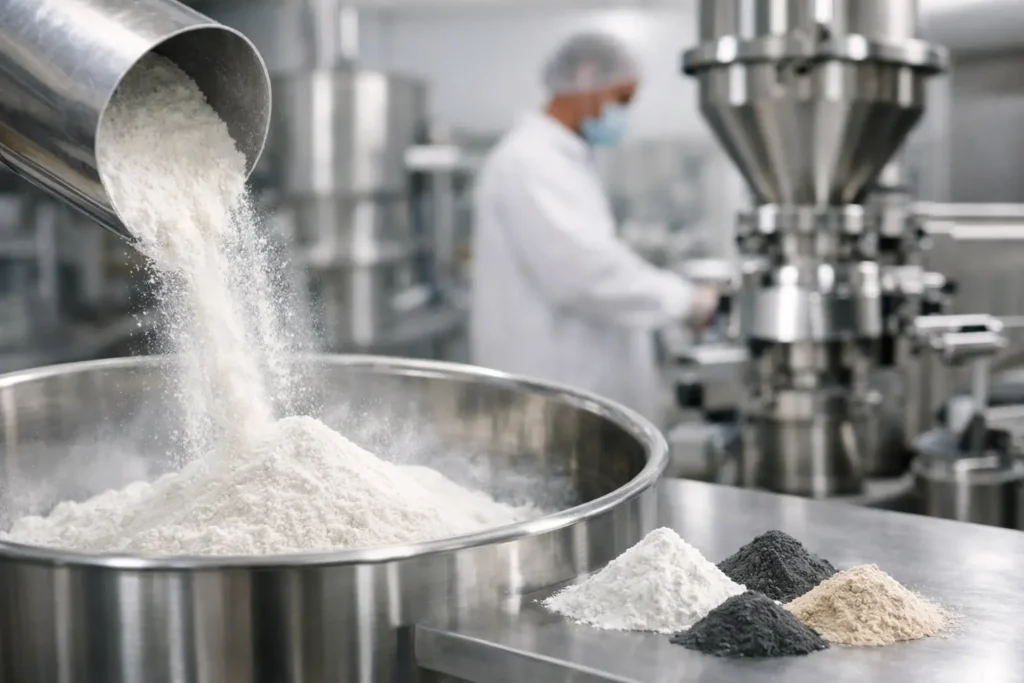
A powder that is too coarse will not dissolve as intended. A blend with poor flow will not fill consistently. A material that picks up heat or moisture at the wrong stage can fall out of specification before it reaches final packing. That is why the question what is powder processing matters in practical manufacturing terms – it sits directly between raw material behaviour and final product performance.
What is powder processing?
Powder processing is the controlled set of operations used to convert bulk solids into a powder with the required particle size, particle size distribution, flow characteristics, density, moisture level and blend uniformity for a given application. In production environments, it commonly includes milling, grinding, classification, mixing, conveying, dosing, containment and product recovery.
The key point is that powder processing is not a single machine or a single step. It is a system. The process must be matched to the material and to the production target, whether that means tighter top size control in pharmaceuticals, better dispersion in pigments, improved solubility in food ingredients, or higher surface area in battery materials.
Why powder processing matters
In many industries, powder properties define how the product behaves in the next stage of manufacturing. Fine control over particle size can affect reaction rates, blend homogeneity, compressibility, dissolution, coating performance and bulk handling efficiency. Poor control creates variation that shows up later as lower throughput, more rejects, unstable downstream processing or inconsistent finished product quality.
This is where engineering discipline becomes critical. The same target fineness can be achieved in different ways, but the route chosen affects energy consumption, heat generation, contamination risk, wear rate and total cost of ownership. A process that works in a trial can still fail in commercial production if feed variability, scale-up effects or material sensitivity have not been properly accounted for.
The main stages in powder processing
Size reduction
Size reduction is often the starting point. It takes feed material and reduces it to a defined particle range using impact, attrition, compression or shear, depending on the equipment and the material.
The right mill depends on what the powder needs to become. A hammer mill may suit more general duty reduction where a broader distribution is acceptable. A pin mill can be effective for brittle materials and higher fineness targets. A jet mill is typically selected when very fine particle sizes are needed with minimal heat input and tight contamination control. Cone mills and universal mills are often preferred where gentler handling or more predictable granule conditioning is required.
The trade-off is straightforward – finer powders generally require more energy, and not every product benefits from being milled as fine as possible. Over-processing can reduce flow, increase dusting and create handling problems downstream.
Classification
Classification separates particles by size, often in line with the mill. This stage improves control by removing oversize material and allowing the process to hit a narrower specification.
For process engineers, classification is often where product consistency is won or lost. A mill on its own may reduce average size, but an integrated classifier determines how precisely the final cut point is maintained. That matters when the process must protect yield while still meeting a strict upper particle limit.
Mixing and blending
Once the target powder size is achieved, the next requirement is usually uniformity. Mixing brings together ingredients so that every sample taken from the batch matches the intended formulation.
This sounds simple until powder behaviour is considered. Differences in particle size, shape and bulk density can drive segregation rather than uniformity. A blend that looks acceptable in a mixer may separate during transfer, storage or filling. Effective powder processing therefore considers not just how materials are mixed, but how they are discharged, conveyed and presented to the next machine.
Handling and conveying
Powders move differently from liquids and solid parts. Some flood. Some bridge. Some compact under their own weight. Others create dust, absorb moisture or pose explosion risks.
Handling and conveying systems are part of powder processing because they protect product integrity between operations. The design of hoppers, feeders, pneumatic conveying lines, rotary valves and transfer points can influence segregation, attrition and throughput. In regulated sectors, containment and cleanability are equally important.
What affects powder processing performance?
Materials rarely behave exactly as datasheets suggest. In practice, powder processing performance is shaped by a combination of feed characteristics, target specification and plant constraints.
Hardness is one factor, because it determines how much energy is needed for size reduction and how quickly wear parts may degrade. Moisture content also matters. A powder that mills cleanly in dry conditions may smear, cake or blind screens if moisture rises. Temperature sensitivity can be equally significant. Heat generated during milling may soften polymers, damage actives or alter fat-containing food ingredients, which is why cryogenic milling is sometimes the better route.
Particle shape and friability add another layer. Some products fracture cleanly. Others produce excessive fines or change shape under mechanical stress. Where particle morphology affects final performance, process selection must look beyond size alone.
What is powder processing equipment designed to achieve?
Control, not just throughput
Well-engineered powder processing equipment is designed to deliver repeatable output, not simply high capacity. Throughput matters, but not if it comes at the expense of particle size control, product loss or line stability.
For that reason, industrial systems are typically specified around a set of measurable outcomes: target D50 or top cut, acceptable distribution width, bulk density range, required moisture level, blend uniformity, containment requirement and cleaning standard. The equipment then needs to achieve those outcomes consistently across shifts, batches and raw material variability.
Scalability from trial to production
A recurring challenge in powder processing is scale-up. A material can behave one way in a laboratory mill and very differently in a production line. Residence time, feed method, airflow, thermal load and classifier performance all change with scale.
That is why serious projects usually require process development rather than simple machine selection. The objective is to prove that the powder can be produced at commercial rate without sacrificing specification or creating avoidable operating cost.
Industry examples where powder processing is critical
In pharmaceuticals and nutraceuticals, powder processing supports content uniformity, compressibility and dissolution. In food production, it can improve solubility, mouthfeel, blending consistency and pack fill accuracy. In chemicals, coatings and pigments, particle size strongly influences dispersion, reactivity and finish quality. In minerals and metals, the focus may be on liberation, narrow sizing and efficient classification. In battery materials, fine control over contamination, particle distribution and handling conditions is often non-negotiable.
The equipment may vary by sector, but the requirement is similar – controlled transformation of material properties so downstream production performs as expected.
Common mistakes when defining a powder processing system
One of the most common mistakes is specifying equipment around a nominal micron target without defining the full particle size distribution. Another is evaluating a mill in isolation when the real problem sits in feeding, classification or powder transfer.
It is also common to underestimate how much the raw material can vary. Seasonal moisture shifts, source changes and upstream processing differences can all affect performance. A powder processing system needs enough flexibility to manage that variability without constant operator intervention.
Finally, energy efficiency should be judged across the whole line, not just at the mill motor. Recirculation load, dust extraction, compressed air demand, yield loss and maintenance frequency all influence operating cost.
Choosing the right approach to powder processing
The best powder processing solution is usually application-specific. There is no universal answer because powders respond differently to force, heat, residence time and handling method. A fine chemical with tight contamination limits will not be processed in the same way as a mineral filler or a food ingredient with fat content.
For manufacturers, the practical question is less about buying a machine and more about engineering the right process window. That includes selecting the mill type, defining classifier performance, controlling feed rate, managing heat, designing reliable transfer systems and ensuring the entire line can be cleaned and maintained efficiently. This is where an experienced process partner such as DP Pulveriser UK can add value, particularly when the requirement extends from development work through to full production installation.
If a powder specification is linked to product quality, process stability and plant economics, it deserves more than a generic solution. The right processing strategy turns difficult powders into predictable production outcomes.