DP Pulveriser UK - Innovating the Future of Size Reduction
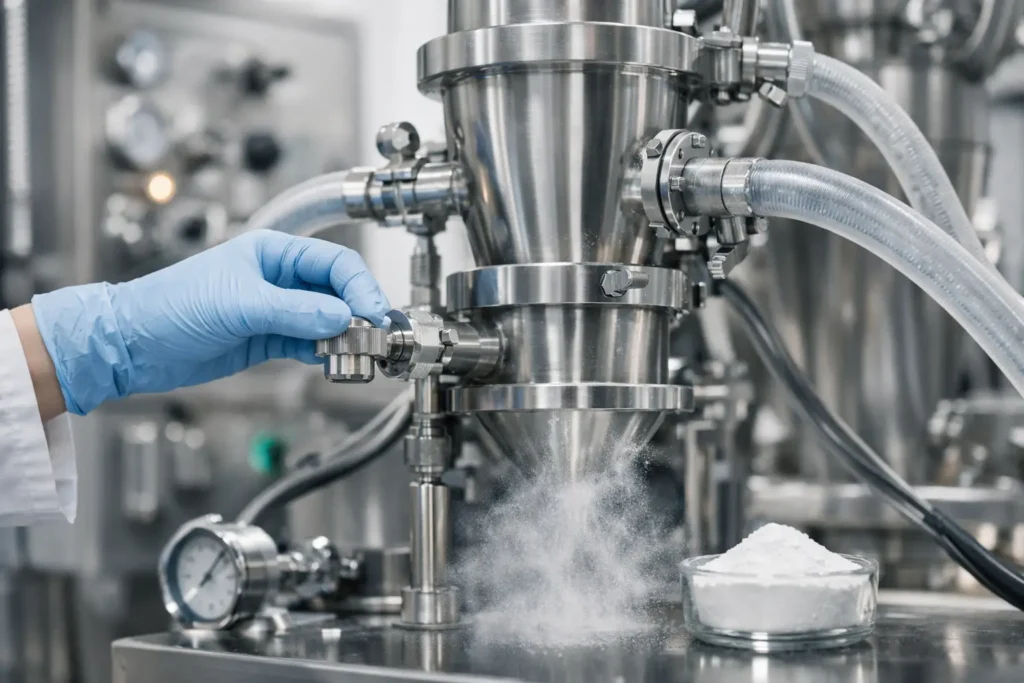
A jet mill can produce exceptionally fine, clean and tightly controlled powders, but only when the process is set around the material rather than a nominal micron target. Selecting jet mill parameters requires a clear view of feed behaviour, required particle size distribution, throughput, moisture sensitivity and downstream handling. A setting that delivers a 10 µm result for one material may cause poor yield, excess fines or unstable operation with another.
For production teams, the objective is not simply to achieve the smallest possible particle size. It is to establish a repeatable operating window that delivers the specified distribution at the required capacity, with acceptable energy use, wear rates and product recovery.
Start with the required powder specification
The target d50 is a useful starting point, but it is rarely enough to define a jet milling process. Many applications are governed by the upper end of the particle size distribution, such as d90 or d99, because oversized particles can affect dissolution, coating appearance, tablet uniformity, battery performance or product texture. Other processes need a controlled proportion of fines to support packing density, reactivity or dispersion.
Define the finished-product requirement before setting mill pressure or feed rate. This should include the required particle size distribution, moisture limit, bulk density, flow characteristics, colour or contamination limits, and any requirements for particle shape. For regulated applications, the specification should also identify the sampling method and analytical technique. Laser diffraction results, for example, can vary with dispersal settings, refractive index assumptions and sample preparation.
The milling target must be linked to a production target. A laboratory result achieved at a few kilograms per hour does not automatically transfer to an industrial installation operating continuously. Scale-up should preserve the process conditions that control particle classification and collision energy, while allowing for differences in gas consumption, conveying distance and feed consistency.
Material behaviour determines the operating window
Jet mills reduce size through high-velocity particle-to-particle impact. This makes them particularly suitable where low contamination, fine particle size reduction or heat-sensitive processing is required. However, the technology is not equally effective for every feedstock.
Hard, brittle materials generally respond well to impact-based micronisation. Softer, waxy, fibrous or highly elastic materials may absorb energy rather than fracture efficiently. A sticky powder can build up in the feed system or classifier zone, while a hygroscopic powder may agglomerate before it reaches the grinding chamber. Materials with a broad incoming particle size distribution can also require pre-conditioning or pre-milling to maintain a stable feed.
Moisture, fat content, melting point and electrostatic behaviour should be assessed early. Even a modest increase in feed moisture can change flowability and reduce classification efficiency. Where heat generation or oxidation is a concern, chilled or conditioned process gas may be appropriate. Cryogenic milling may be considered for materials that soften, smear or lose functional properties at ambient temperature.
A representative trial remains the most reliable route to defining the process. It should use production-grade feed wherever possible, rather than an idealised development sample. Variability in raw material source, particle size, moisture and storage conditions must be accounted for before a final operating envelope is approved.
Selecting jet mill parameters that control performance
The main process variables are linked. Adjusting one parameter without considering the others can improve one part of the particle size distribution while reducing throughput, increasing gas consumption or destabilising the process.
Grinding gas pressure and flow
Higher gas pressure increases particle velocity and collision energy, which can support finer size reduction. It also increases gas use and can create excessive fines if the classifier setting and feed rate are not adjusted accordingly. The practical question is not whether maximum pressure produces a smaller d50, but whether it delivers the required distribution efficiently.
Gas flow also governs transport through the mill and classifier. Insufficient flow can lead to poor circulation, chamber build-up or inconsistent product removal. Excessive flow may carry partially milled particles through the system too quickly or overload downstream filters. Compressed air is commonly used, although nitrogen may be required where oxygen control, explosion protection or product stability demands an inert atmosphere.
Feed rate and feed consistency
Feed rate is one of the most influential variables in production. At too low a rate, the mill may consume substantial energy for limited output and generate an unnecessarily fine product. At too high a rate, particle concentration rises, collision conditions change and the classifier may allow coarse material into the finished product.
Consistent dosing matters as much as nominal feed rate. Loss-in-weight feeders, suitable screw geometry, agitation and hopper design can prevent bridging, rat-holing and pulsation. A jet mill cannot compensate for an unstable feed system. If feed density or flow changes during a batch, the particle size distribution is likely to move with it.
Classifier speed and cut point
In fluidised-bed jet mills, the integrated dynamic classifier controls which particles leave as product and which remain for further milling. Increasing classifier speed typically produces a finer cut point, but it can reduce throughput and raise energy demand. Reducing speed increases capacity but may allow more coarse particles to pass.
The correct classifier setting depends on the shape of the required distribution. A narrow specification may justify a lower throughput to achieve a sharper separation. Where a broader distribution is acceptable, a different balance may provide a better cost per kilogram. The aim is stable classification, not the highest possible rotor speed.
Nozzle configuration and mill geometry
Nozzle number, orientation and size influence the velocity field inside the milling chamber. These parameters should be selected with the material’s density, hardness, feed size and desired fineness in mind. A configuration suited to a dense mineral may not be appropriate for a low-density organic powder.
Mill geometry also affects residence time and collision frequency. This is why equipment selection should begin with application data, not only a capacity figure from a catalogue. The mill, classifier, feed unit, gas supply, cyclone and filter must operate as one engineered system.
Balance particle size against throughput and energy
There is no universal optimum setting. Finer products usually require greater gas energy, higher classifier speeds, lower feed rates or a combination of all three. The resulting increase in specific energy can be justified for high-value pharmaceutical, pigment or battery materials, but may not be economical for a less demanding mineral application.
Production decisions should therefore be based on a performance map rather than a single trial point. Test several combinations of pressure, feed rate and classifier speed, then compare d10, d50 and d90 values against throughput, specific gas consumption, product temperature and yield. This identifies where the process has a useful operating margin.
A narrow operating window can be acceptable when raw material is tightly controlled and production is closely monitored. If feed properties vary between suppliers or seasons, a wider, more tolerant window is often more valuable. Process resilience reduces rejected batches and unnecessary operator intervention.
Design for containment, recovery and cleanability
A jet milling installation is only as effective as its surrounding powder handling system. Fine powders can be difficult to collect, prone to electrostatic adhesion and sensitive to moisture pickup. Cyclone efficiency, filter media, pulse-cleaning performance and conveying layout all affect product yield and housekeeping.
For pharmaceutical, food and high-specification chemical production, the system may also require contained charging, clean-in-place capability, validated product-contact materials and controlled changeover procedures. Abrasion-sensitive products may need ceramic-lined or specialist alloy contact parts to minimise contamination. Conversely, an aggressive abrasive feed may justify wear protection even where trace contamination is less critical.
Dust hazard assessment should be incorporated at the concept stage. When handling combustible powders, the design may require inert gas operation, explosion venting, suppression, isolation or a combination suited to the site and material risk assessment. These requirements affect equipment layout and operating cost, so they should not be treated as a late-stage addition.
Establish parameters through structured trials
A disciplined trial programme turns jet mill selection from informed judgement into measurable process engineering. Begin with material characterisation and a defined product specification. Establish a baseline run, then change one principal variable at a time while recording pressure, gas flow, classifier speed, feed rate, temperature, product yield and full particle size data.
Once a promising range is identified, confirm it through longer-duration runs. Short tests can hide gradual build-up, feeder instability, filter loading or temperature effects. The final settings should include upper and lower limits, along with clear responses for common deviations such as rising product coarseness or reduced throughput.
DP Pulveriser UK supports this progression from laboratory evaluation through pilot trials and full-scale process design, helping manufacturers specify milling, classification and powder handling equipment around real production requirements.
The most effective jet milling process is one that gives operators room to run consistently, not one that achieves an impressive result only under perfect test conditions. Choose parameters that protect product specification, throughput and recoverable yield together, then validate them against the variability that production will inevitably introduce.