DP Pulveriser UK - Innovating the Future of Size Reduction
A production line can look stable on paper and still lose margin at the mill. The usual signs are familiar – drifting particle size, excess fines, rising recirculation, heat build-up, or a product that behaves well in trials but not at full throughput. In many of these cases, a pin mill for powder processing is worth serious consideration because it combines high tip speed, controlled impact reduction and scalable performance in a compact footprint.
For manufacturers handling powders in pharmaceutical, food, chemical, mineral and performance material applications, the attraction is straightforward. A pin mill can deliver narrow target ranges, efficient size reduction and repeatable output when the material and process conditions are a good fit. The key is understanding where it performs exceptionally well, where another milling technology may be better, and how system design affects the result.
What a pin mill for powder processing does well
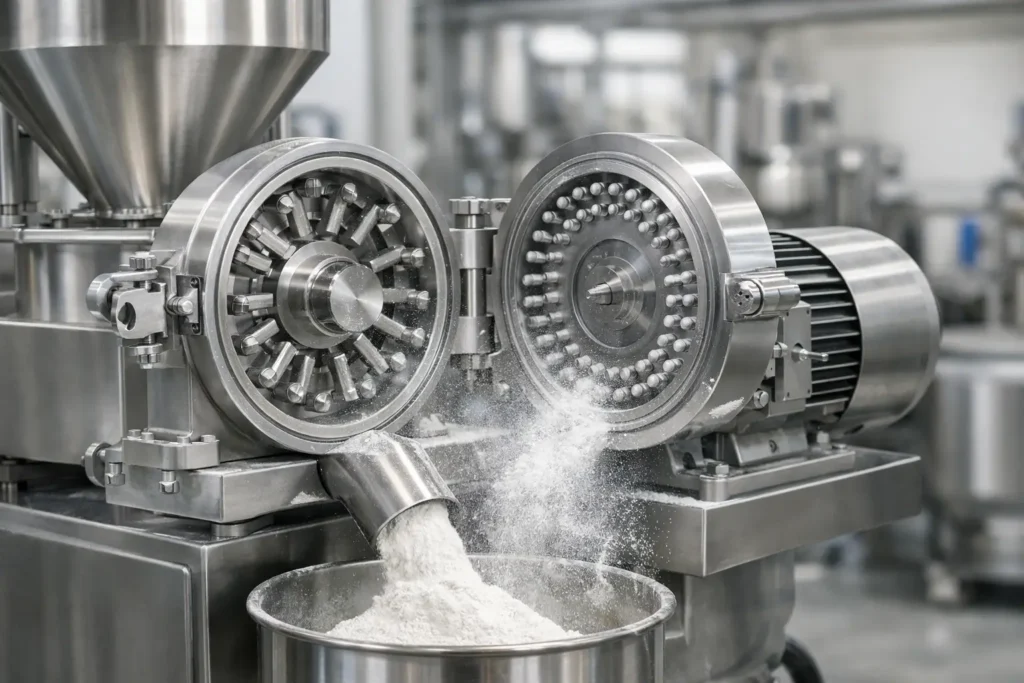
A pin mill reduces particle size through impact. Two discs fitted with intermeshing pins rotate relative to one another, or one rotating disc works against a stationary disc, depending on the design. As material enters the grinding zone, it is accelerated and repeatedly struck by the pins until it reaches the required size and exits the chamber.
This mechanism suits applications where processors need fine to medium-fine powders with a controlled distribution and dependable throughput. Compared with lower-energy milling methods, pin mills can achieve tighter reduction in a single pass for many friable or moderately hard materials. They are also well suited to deagglomeration, where the objective is to break soft clusters apart without excessive over-grinding.
In practical terms, that matters because product performance is often linked directly to particle size. Flowability, blend uniformity, dissolution rate, bulk density, coating quality and reactivity can all shift when the distribution drifts. A correctly specified pin mill helps stabilise those variables rather than forcing operators to compensate further downstream.
How the milling principle affects product quality
The strength of the pin mill lies in intensity and control, but the same factors require disciplined engineering. High peripheral speed creates strong impact forces, which is why pin mills are effective for precise particle size reduction. It also means heat generation, wear profile and feed consistency need to be managed properly.
Material behaviour is the deciding factor. Brittle, crystalline and friable feedstocks often process very effectively because they fracture cleanly on impact. Softer, fatty, sticky or highly heat-sensitive products can be more challenging. In those cases, the issue is not that a pin mill cannot work, but that the system may need cooling, inerting, modified rotor speed, optimised feeding or a different machine type altogether.
This is where process development matters. Buyers sometimes compare mill types by headline micron figures alone, but throughput, temperature rise, moisture content and contamination risk can be more important than the nominal top-end fineness. A mill that reaches the target size in the laboratory may still be the wrong choice if it cannot maintain product integrity at production scale.
Where pin mills are used in industry
Pin mills are established across sectors because they bridge the gap between coarse reduction and very fine micronisation. In food and nutraceutical processing, they are commonly used for sugar, starches, spices, dehydrated ingredients and functional powders where consistency and hygienic design matter. In chemicals and minerals, they are used for resins, fillers, pigments, salts and a wide range of industrial powders that require predictable particle size and efficient throughput.
In pharmaceutical and allied regulated environments, pin mills can support intermediate size reduction, deagglomeration and controlled milling of actives or excipients where repeatability, cleanability and containment are central to the specification. Battery and advanced materials producers also use impact milling where controlled PSD contributes to downstream mixing, coating or performance.
The common requirement across these sectors is not simply smaller particles. It is repeatable powder behaviour in a production environment.
Choosing the right pin mill for powder processing
The best machine is defined by the application, not by catalogue position. Throughput target, feed size, hardness, moisture, temperature sensitivity, required D50 or top cut, and cleaning regime all shape the specification. The system boundary matters as well. Feed method, air handling, collection, explosion protection and controls can influence final performance as much as the milling chamber itself.
Rotor configuration and speed determine impact energy. Higher speed can improve fineness, but there is a trade-off in heat generation, wear and potential over-processing. Pin design and spacing also affect breakage pattern and residence time. For some products, a more aggressive setup improves efficiency. For others, it increases fines and reduces yield.
Screening is another point buyers often oversimplify. Some pin mills run without screens and rely on the internal dynamics of the machine, while others incorporate classification or downstream separation to tighten the result. If the process calls for a narrow distribution, integrating the mill into a broader powder handling and classification system can produce a more stable outcome than trying to force the duty through a standalone machine.
The operational factors that decide success
A pin mill is rarely judged on first-pass particle size alone. In production, success is measured by consistency over time. Stable feed rate is critical because surge feeding changes the load in the grinding zone and can widen the distribution. Likewise, uncontrolled feed temperature or moisture can alter fracture behaviour and cause build-up inside the chamber.
Wear resistance should be considered early, particularly with abrasive materials. Pin and liner wear gradually changes the milling profile, which can shift PSD before operators notice an obvious fault. Selecting the right metallurgy and designing for maintainability reduces unplanned stoppages and protects product quality.
Dust control, containment and hygiene are equally important. Fine powder processing places demands on seals, aspiration, filter design and access for inspection. In regulated or high-value processes, validation support and ease of cleaning are not optional extras. They are part of the core engineering requirement.
Pin mill versus other milling technologies
Pin mills are highly capable, but they are not universal. A hammer mill may be better suited to coarser reduction or tougher feeds where a broader output is acceptable. A cone mill is often preferred for gentle sizing, calibration and low heat generation, especially in pharmaceutical transfer operations. Jet milling becomes attractive when ultra-fine micron ranges are required and contamination from mechanical contact must be minimised.
Air classifier mills can offer a strong alternative when producers need fine grinding with tighter top-size control in one integrated unit. Turbo mills and universal mills may suit materials with different breakage characteristics or where process flexibility is a priority.
The real comparison is not which machine is best in general, but which machine gives the lowest total cost of ownership for the specific powder, throughput and quality target. That includes yield, energy use, wear parts, downtime, cleaning time and the cost of off-spec material.
Scaling from test work to industrial production
Scale-up is often where milling projects succeed or fail. Laboratory results are useful, but full-scale behaviour changes with feed presentation, thermal load, residence time and continuous duty conditions. A disciplined test programme should examine not only PSD, but also throughput stability, product temperature, bulk density, flow properties and cleaning performance.
For manufacturers planning capacity growth, it is sensible to evaluate how the milling solution integrates into the full process line. Feeding, conveying, screening, blending and packing all affect the economics of the system. An engineered approach, rather than a machine-only purchase, usually delivers better long-term performance. That is particularly true where manufacturers need to move from pilot batches to repeatable commercial output without changing product behaviour.
This is where an experienced process partner adds value. Companies such as DP Pulveriser UK work across milling, classification, mixing and complete powder processing systems, which allows the equipment choice to be based on the process requirement rather than a single machine category.
When a pin mill is the right decision
A pin mill is often the right choice when you need efficient impact reduction, consistent particle size, compact installation and strong throughput for friable to moderately hard powders. It becomes especially attractive when deagglomeration and controlled fineness are both required within the same production step.
It is less straightforward when the material is highly sticky, strongly heat-sensitive or demands ultra-fine performance beyond the practical range of mechanical impact milling. In those cases, the answer may still involve a pin mill, but only with the right supporting system design, or it may point to a different technology entirely.
The most reliable route is to treat milling as a process engineering decision, not simply a procurement item. When particle size affects product value, line efficiency and customer acceptance, the mill has to do more than reduce material. It has to support a stable manufacturing outcome, shift after shift. That is the standard worth designing for.