DP Pulveriser UK - Innovating the Future of Size Reduction
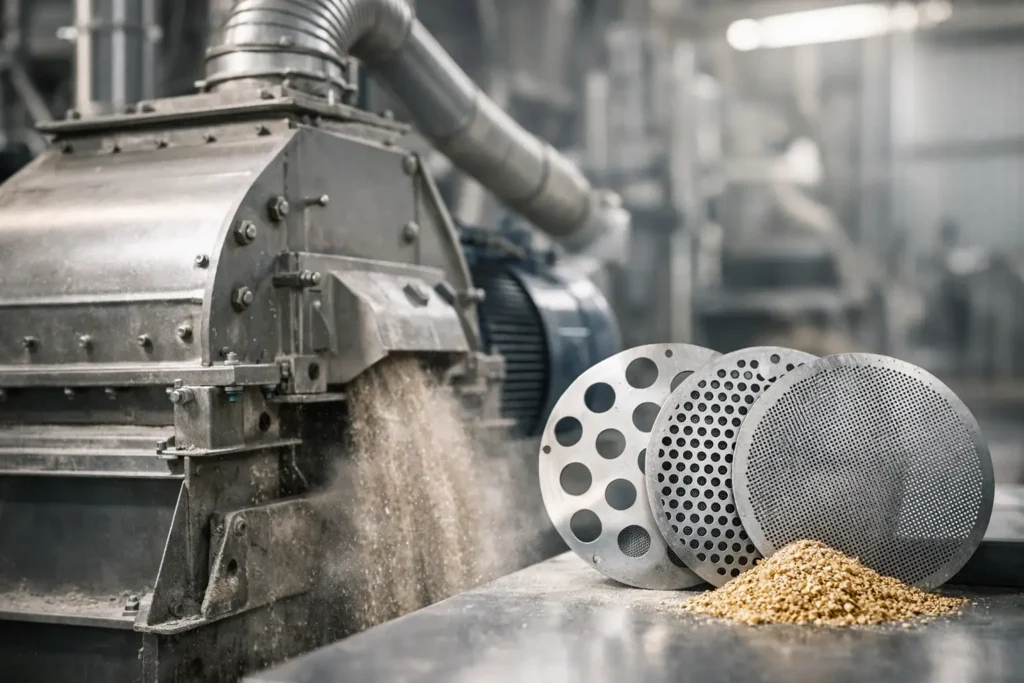
A hammer mill can have the correct rotor, motor and feed system yet still produce inconsistent powder if the screen is poorly specified. Optimising hammer mill screen selection is therefore not a final commissioning detail. It is a core process-engineering decision that affects particle size distribution, capacity, heat generation, energy consumption, wear rate and product quality.
For manufacturers processing food ingredients, minerals, chemicals, nutraceuticals or agricultural materials, the objective is rarely simply to install the smallest aperture that will produce a nominal target size. The right screen must deliver the required product specification at a stable, commercially viable throughput. Achieving that balance requires the screen to be matched to the material, the mill configuration and the wider production line.
Why the screen governs hammer mill performance
In a hammer mill, reduction takes place through repeated impact, shearing and particle-to-particle collision. Material remains in the milling chamber until fragments are sufficiently small to pass through the screen apertures. The screen therefore controls retention time as well as the size at which material can leave the mill.
A smaller aperture generally increases the proportion of fine material, but it also keeps particles in the chamber for longer. This raises the number of impacts required per particle, increasing power draw, wear and the likelihood of temperature rise. With heat-sensitive materials, such as certain food products, polymers or pharmaceutical excipients, this can affect flowability, moisture behaviour, flavour, active stability or downstream handling.
Conversely, a larger screen can increase throughput and reduce specific energy consumption, but may allow excessive coarse material to pass. If the final product requires a tight particle size distribution, an oversized aperture can create a downstream classification burden or result in material falling outside specification.
The screen must be considered as part of a controlled size-reduction system, not as an interchangeable perforated component.
Start with the required particle size distribution
Nominal aperture size is not the same as final particle size. A 2 mm screen does not guarantee that every discharged particle will be 2 mm or below, nor does it describe the proportion of fines created during impact. Hammer geometry, rotor speed, material friability, feed rate and airflow all influence the resulting distribution.
The first step is to define the product requirement in measurable terms. This may include a top-size limit, a target median size, a specified sieve fraction or a maximum permitted coarse percentage. For high-specification products, the requirement may also include limits on fines because excessive fines can reduce flow, increase dust loading or alter blend uniformity.
Once the specification is clear, screen selection can be based on production trials rather than assumptions. A representative material sample should be evaluated at the intended moisture content, feed condition and temperature. Results from a dry, free-flowing laboratory sample can be misleading when full-scale production material arrives in agglomerated, warm or variable-density form.
Material behaviour changes the answer
Brittle materials such as crystalline salts, dry minerals and many friable food ingredients often fracture efficiently and can pass through relatively fine apertures at good rates. Fibrous, elastic or oily products behave differently. They may flatten against the screen, form mats around apertures or require a different hammer profile and lower feed loading to prevent blockage.
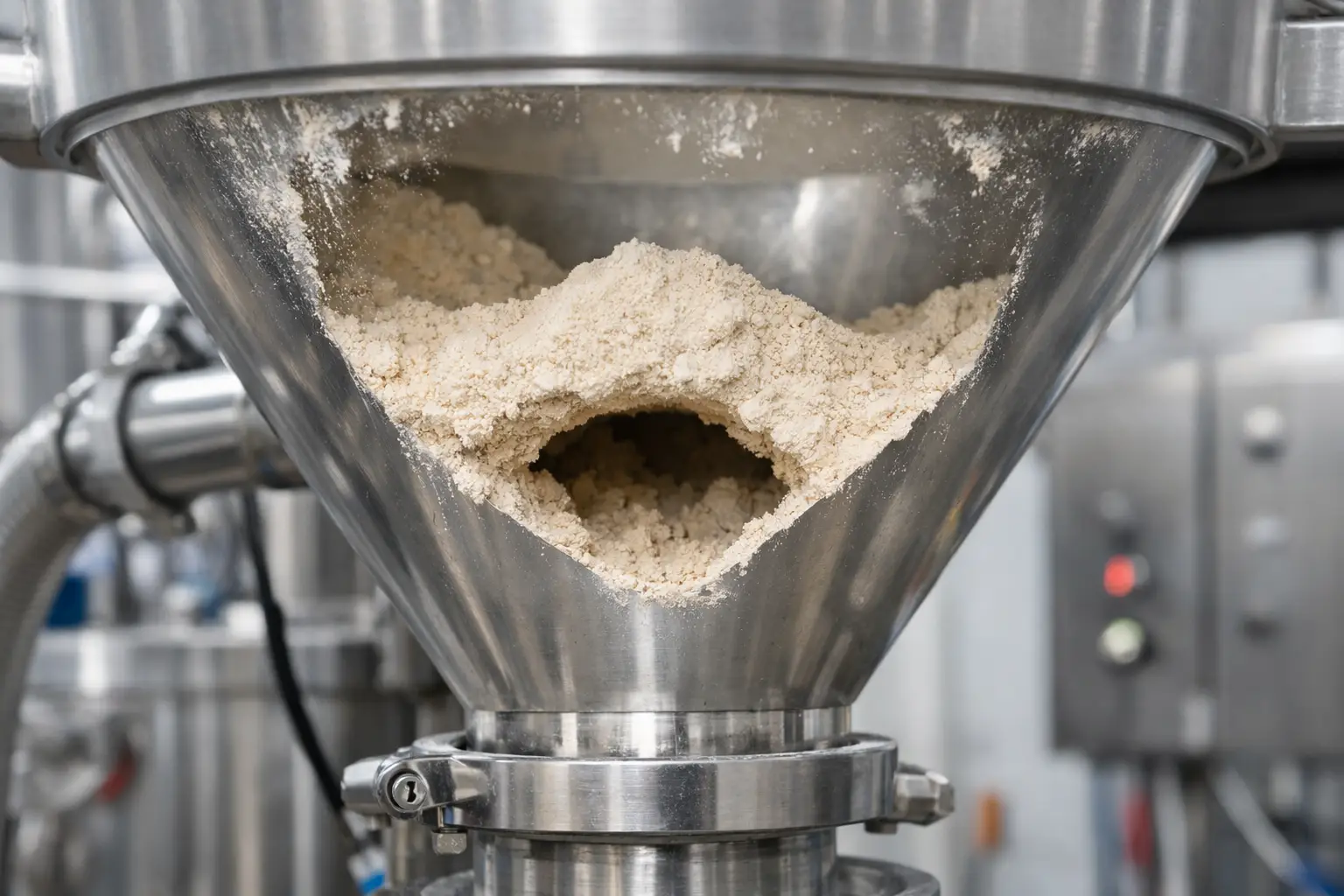
Moisture is particularly influential. A modest increase in moisture can turn a clean-running milling operation into one with screen blinding, reduced discharge and rising mill temperature. Hygroscopic materials may also absorb ambient moisture during handling, changing performance between seasons or production areas.
Where a product is difficult to mill, the answer is not automatically a coarser screen. Pre-conditioning, controlled feeding, cooling, upstream de-agglomeration or a different milling technology may provide better control. The correct solution depends on the required outcome and the material’s failure mechanism.
Aperture size, open area and hole pattern
Aperture size receives most attention, but it is only one screen variable. Open area determines how much total discharge path is available. Two screens with the same aperture can perform very differently if wire thickness, perforation pitch or hole pattern changes the available open area.
Higher open area generally supports faster discharge and improved throughput. It can reduce the residence time of correctly sized particles, limiting unnecessary over-grinding and heat build-up. However, the mechanical strength of the screen must remain appropriate for rotor speed, material abrasiveness and the risk of tramp contamination.
Hole geometry also matters. Round perforations are commonly used and provide predictable performance for many free-flowing powders and granules. Slotted screens may assist with fibrous or elongated materials, but they can permit a different particle shape and broader top-size profile. Conical perforations can influence discharge direction and may reduce the tendency for certain materials to lodge in the aperture.
Screen thickness must be assessed alongside aperture geometry. A thick screen creates a longer passage through each perforation. This can improve durability, but it can also restrict discharge for materials that are tacky, flaky or irregularly shaped. In abrasive mineral applications, a thicker, wear-resistant screen may offer a lower total cost of ownership despite a reduction in initial capacity. For a low-density nutraceutical blend, a thinner screen with suitable support may be the more efficient choice.
Match the screen to rotor speed and mill configuration
Screen selection cannot be separated from tip speed. Higher rotor speeds deliver greater impact energy and can improve fine grinding of brittle materials. They also increase wear, noise, power demand and the risk of thermal degradation. A fine screen paired with excessive tip speed may produce more fines than required while placing unnecessary load on the drive system.
Hammer design and arrangement influence how material is presented to the screen. Swing hammers, fixed hammers, blunt profiles and sharper leading edges each suit different duties. The clearance between hammers and screen is equally significant. If clearance is too large, milling efficiency can fall; if too tight, friction, wear and local heating can increase.
Air movement through the mill also deserves attention. Adequate airflow helps convey fine particles through the screen and out of the grinding chamber. Poor extraction can cause material to circulate, raising residence time and increasing the chance of screen blockage. In an integrated line, the mill, fan, cyclone, filter and conveying system should be sized as one process rather than selected independently.
Avoid using screen size as the only control lever
When output falls or particle size drifts, production teams often change the screen first. That can be useful, but it can also conceal the real cause. Feed rate fluctuations, worn hammers, damaged screens, incorrect rotor direction, inadequate aspiration and inconsistent raw material are all capable of changing mill performance.
A disciplined operating review should examine the condition of the complete milling zone. Screen apertures can enlarge through abrasive wear, particularly around high-velocity impact areas. This may gradually increase coarse carry-over before it becomes obvious in routine checks. Screens can also distort, crack or lose tension, creating product-quality and contamination risks.
Monitor amperage, differential pressure where applicable, mill temperature, throughput and particle size data together. A change in one measurement is more useful when interpreted against the others. For example, lower throughput with rising temperature and stable motor load may indicate reduced screen open area caused by blinding. Rising throughput accompanied by a coarser product may point to screen wear or damage.
Build trials around real production conditions
Laboratory and pilot trials are the most reliable route to screen specification when product quality is critical. Test a practical aperture range, rather than one presumed answer, and record product distribution, throughput, energy use, temperature and screen condition. The preferred option is often not the finest screen that reaches specification, but the aperture that holds specification with sufficient operating margin.
That margin matters when incoming raw material varies. A mill that performs well only with perfectly dry, uniform feed can become a production constraint quickly. A properly engineered system accounts for expected variation in bulk density, moisture, particle shape and feed temperature.
Scale-up should also account for differences in residence time, airflow and feed presentation. A screen that succeeds in a small development unit is a valuable starting point, but it should be verified in the production machine with the intended feeder, extraction arrangement and downstream collection equipment. DP Pulverizer UK applies this application-led approach to help manufacturers move from development work to dependable full-scale processing.
Set a practical screen management standard
Screens are wear components, but their replacement should be controlled rather than reactive. Maintain a documented inspection regime based on material abrasiveness, production hours and quality risk. Inspect for enlarged holes, cracks, distortion, blocked perforations and loss of mounting integrity.
Keep screens clearly identified by aperture, thickness, perforation pattern, material grade and intended application. This prevents an apparently similar screen being fitted during a changeover. In regulated environments, traceability and inspection records also support quality assurance and investigation of any product deviation.
Cleaning method matters as much as cleaning frequency. Aggressive mechanical cleaning can damage fine perforations, while incomplete cleaning can cause cross-contamination or progressively reduce open area. The chosen screen material and finish should suit the cleaning regime, product chemistry and hygienic requirements.
The strongest screen selection is the one that gives operators a stable process rather than a narrow laboratory result. By treating aperture, open area, screen construction, airflow and material behaviour as connected variables, manufacturers can protect particle size control while improving throughput, efficiency and equipment life.