DP Pulveriser UK - Innovating the Future of Size Reduction
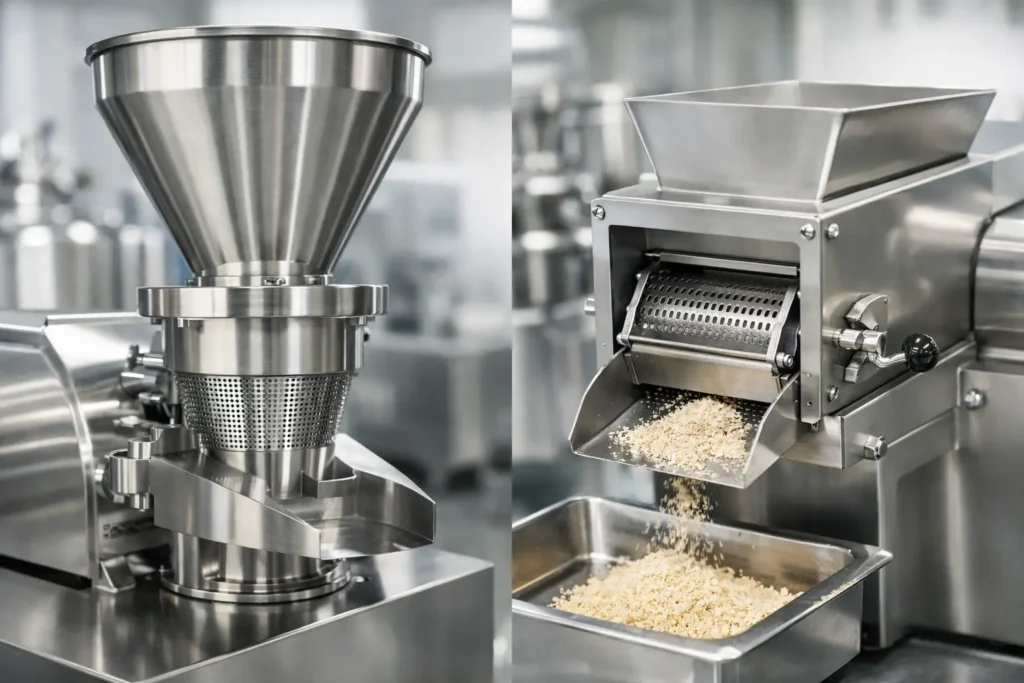
A poor sizing choice is often discovered downstream: tablet weight variation, uneven drying, blocked filters, poor blend uniformity or a granule that will not flow consistently into the next stage. The cone mill versus oscillating granulator decision should therefore begin with the material’s behaviour and the duty required, not simply with the machine’s purchase price or installed footprint.
Both machines break down agglomerates and control oversize material. Both can be valuable parts of pharmaceutical, food, nutraceutical and chemical processing lines. Their operating principles, however, lead to different outcomes in particle size distribution, granule shape, throughput, cleaning requirements and suitability for wet or dry product. Selecting the right system requires a clear view of the process objective.
Cone mill versus oscillating granulator: the operating difference
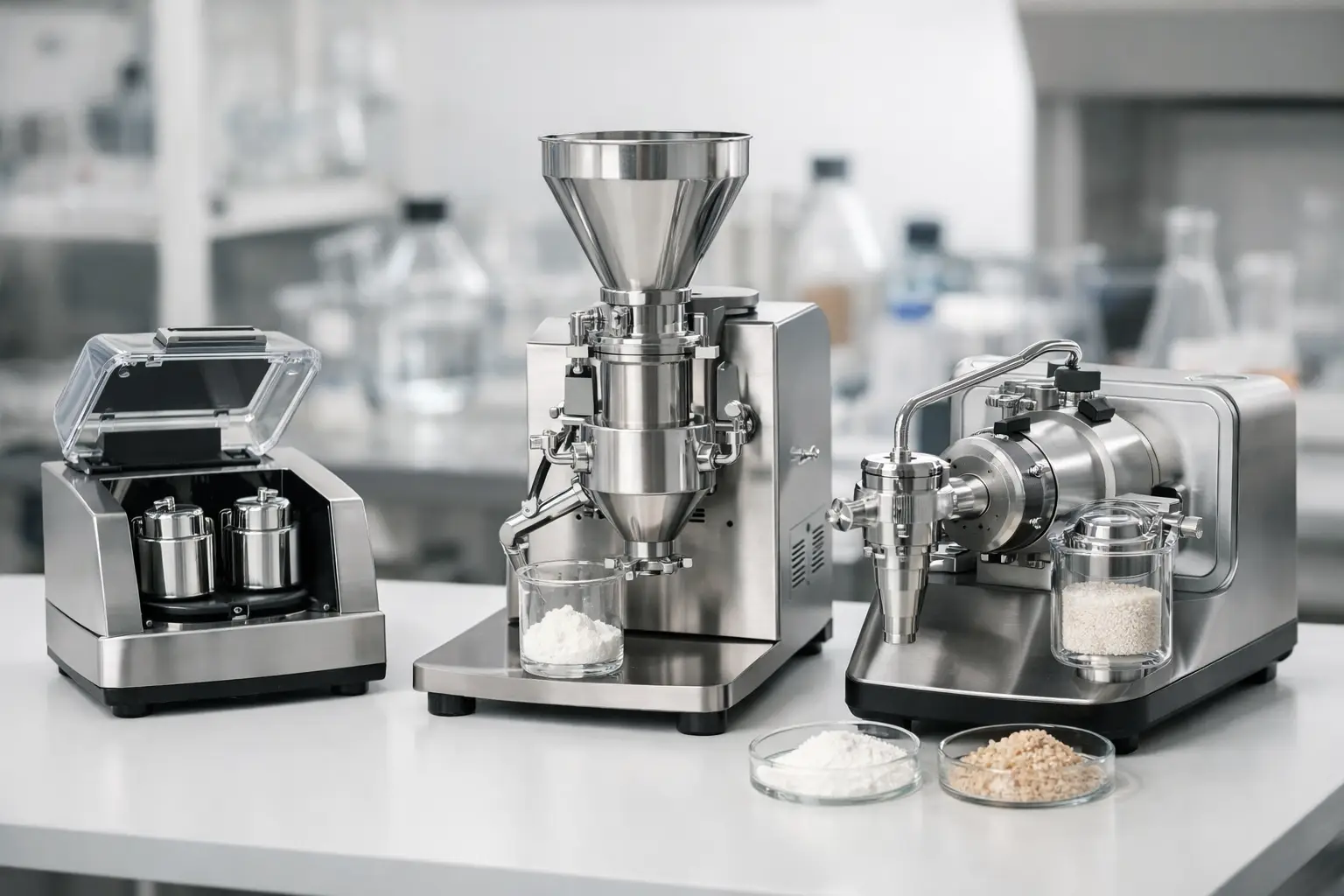
A cone mill, also called a conical mill, uses a rotating impeller within a conical screen chamber. Material enters the chamber, is presented to the screen by the impeller and passes through once it has reached the required size. Impeller profile, rotational speed, screen aperture and screen type can all be selected to suit the product and duty.
This action is generally controlled and comparatively low impact. It makes cone milling well suited to deagglomeration, delumping, calibration and controlled size reduction where protecting particle form and limiting fines matter. In many production environments, a cone mill is positioned before blending, after drying, before compression or as part of a contained powder transfer route.
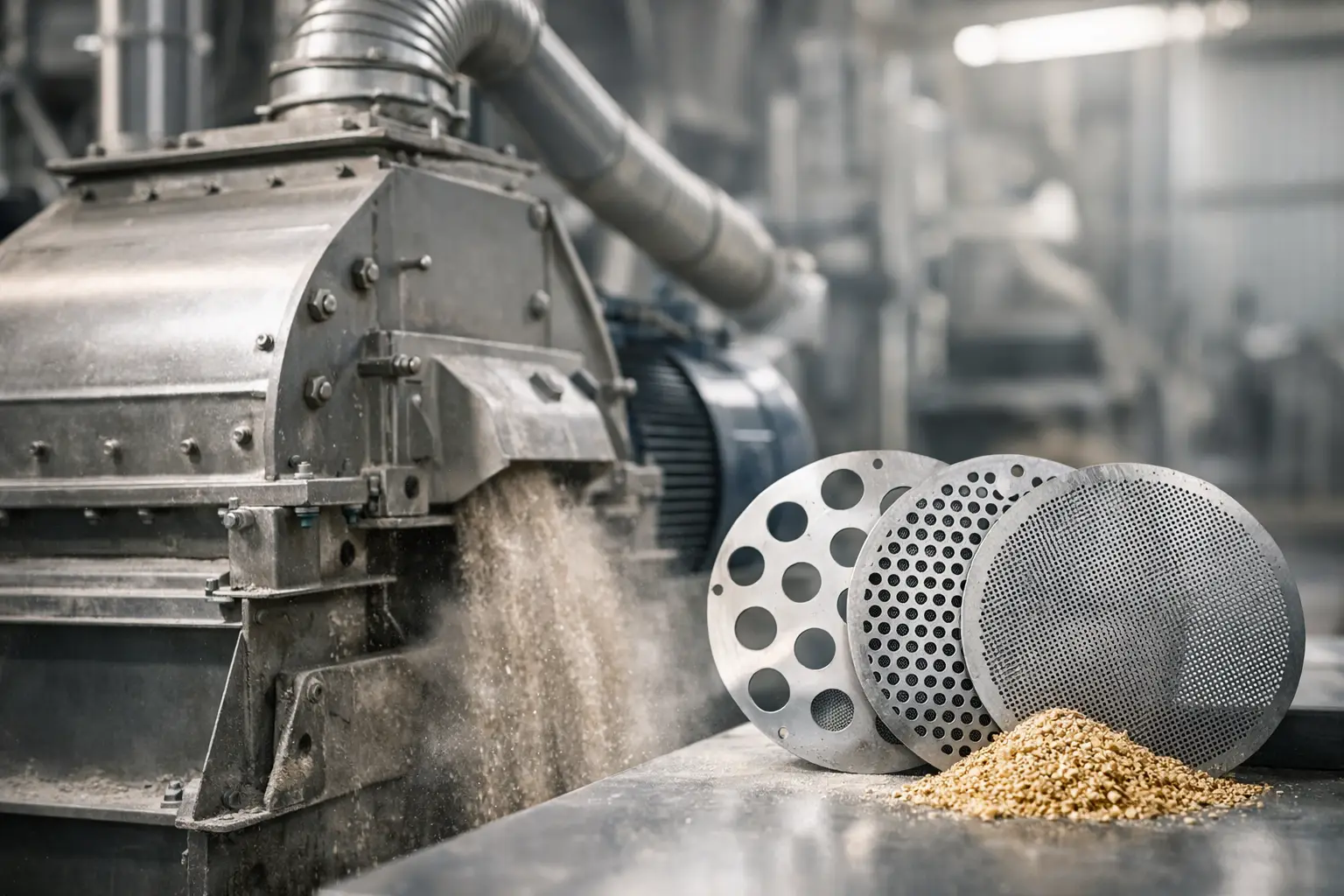
An oscillating granulator uses a horizontal rotor with oscillating bars or blades that move material back and forth through a perforated screen. The reciprocating motion creates a more direct mechanical working action. It has long been used for wet granulation, particularly to convert moist mass into granules before drying, and can also be used for dry material sizing where a coarser, more open granule is acceptable.
The distinction is significant. A cone mill controls particle presentation to the screen through a rotating impeller. An oscillating granulator works the mass against the screen through an oscillating action. Neither principle is universally superior. The better option depends on whether the process needs gentle calibration, intensive wet mass granulation, a narrow operating window or straightforward coarse sizing.
Where cone mills perform best
Cone mills are frequently specified when a production line requires repeatable particle size reduction without excessive attrition. Their enclosed geometry can support efficient dust control and integration with bins, vacuum transfer systems, feeders and downstream blenders. For manufacturers handling potent, hygroscopic or high-value powders, this controlled configuration can be as important as the milling result itself.
For dry powders, cone milling is particularly effective at breaking soft agglomerates formed during storage, transport or compaction. It can improve flow into tablet presses, capsule fillers, sachet lines and packaging equipment while avoiding the aggressive reduction that may create excessive fines. This is relevant where fines adversely affect segregation, dust extraction load, dissolution behaviour or product appearance.
Cone mills can also process dried granules after fluid-bed or tray drying. In this duty, the aim is usually to remove oversize lumps and deliver a consistent granule fraction for blending and compression. The combination of an appropriate screen and lower impeller speed can retain a useful proportion of the granule structure rather than reducing the batch unnecessarily.
However, a cone mill is not automatically the right choice for every wet mass. Very sticky formulations, highly plastic materials or dense wet masses may require careful feeding and configuration. If the product smears across the screen or builds up within the chamber, throughput and granule consistency will suffer. Trials with representative material are essential before specifying screen geometry, impeller design and drive arrangement.
Where oscillating granulators remain effective
Oscillating granulators are a practical option for traditional wet granulation processes. Their mechanical action can form a coarse, open wet granule from a properly prepared mass, allowing more uniform drying than an unprocessed wet cake. In applications where the granulator is a defined step between mixing and drying, the technology is familiar, effective and comparatively straightforward to operate.
The equipment can also be useful where product is relatively forgiving and the target is a broader granule distribution rather than tightly controlled calibration. Certain food ingredients, agricultural materials and non-critical chemical formulations may benefit from its direct, productive sizing action.
The trade-off is that oscillating granulation can impose more mechanical stress on the material. The repeated action against the screen may generate a broader distribution, alter fragile granule structure or create fines, depending on moisture content, formulation cohesion and screen condition. Wet mass that is too dry can fracture irregularly; mass that is too wet can smear, blind the screen or form dense lumps.
Screen wear and inspection should also be treated as process-control issues, not just maintenance tasks. A worn or damaged screen changes the granulation result. For regulated production, documented screen integrity checks, cleanability and repeatable assembly are fundamental to maintaining batch consistency.
Comparing the process outcomes
The following comparison provides a useful starting point, but it should not replace application testing.
| Evaluation factor | Cone mill | Oscillating granulator | |—|—|—| | Primary action | Rotating impeller presents material through a conical screen | Oscillating rotor works material through a perforated screen | | Typical duty | Deagglomeration, calibration and controlled dry or dried-granule sizing | Wet mass granulation and coarse sizing | | Particle-size control | Often more controlled, with adjustment through screen and impeller selection | Often broader and more dependent on wet mass condition | | Product stress | Generally lower impact | More direct mechanical working action | | Process integration | Well suited to enclosed, inline and contained systems | Often used as a discrete granulation stage | | Key risk | Poor performance with unsuitable sticky or highly plastic feed | Smearing, screen blinding or excess fines when moisture is not controlled |
The quality of the feed material remains decisive. A well-specified mill cannot compensate for inconsistent binder distribution, variable moisture content, poorly dried granules or a batch containing hard foreign material. Upstream mixing, liquid addition, drying profile and transfer conditions must be considered alongside the granulator itself.
How to specify the right machine
Start by defining the required product outcome in measurable terms. This may include target particle size distribution, maximum oversize, acceptable fines level, bulk density, flowability, moisture range and downstream performance. For pharmaceutical products, it may also include dissolution profile, tablet hardness, content uniformity and compression behaviour. For food and chemical applications, the focus may be dispersibility, packing density, appearance or reaction performance.
Then assess the material across its realistic operating range, not only under ideal laboratory conditions. The process engineer should consider batch-to-batch moisture variation, storage time, ambient humidity, temperature sensitivity, feed consistency and whether the material bridges or compacts. A machine that performs well on a small, freshly prepared sample may behave differently at production throughput after several hours of operation.
Capacity should be evaluated as a system requirement. A high nominal throughput means little if the machine requires frequent screen cleaning, inconsistent manual feeding or repeated recirculation. Consider feed method, discharge arrangement, operator access, dust extraction, cleaning time and the equipment’s ability to match the pace of upstream and downstream stages. The lowest total cost of ownership usually comes from stable production rather than the highest stated kilogram-per-hour figure.
For regulated or hygiene-critical applications, specify construction and cleanability early. Product-contact materials, surface finish, tool-free access, screen retention, clean-in-place requirements, containment level and validation documentation all influence the final design. These features should be engineered around the actual process, rather than added after the core machine has been selected.
Scale-up and trials reduce selection risk
Scale-up from development to commercial production is where many apparently simple sizing processes become difficult. The energy applied to the material, residence time, screen open area and feed rate do not always scale linearly. A formulation that produces an acceptable granule at laboratory scale may need a different screen, impeller speed or feed arrangement at larger capacity.
Application trials should therefore use representative product, target moisture conditions and realistic throughput. The test programme should measure more than sieve data. Observe dust generation, temperature rise, screen blinding, cleaning effort, material retention and the performance of the next process step. Where possible, assess the finished product rather than judging the result only at the granulator discharge.
DP Pulveriser UK approaches this type of selection as a process-engineering exercise, matching equipment configuration and ancillary handling systems to the required production outcome. That is particularly valuable where milling, conveying, classification and mixing must operate as one controlled line.
The practical question is not which machine is better in isolation. It is which machine produces the required granule, at the required rate, with a repeatable operating window that your operators can maintain shift after shift. Establish that answer through representative trials, then specify the equipment around the process rather than forcing the process to fit the equipment.