DP Pulveriser UK - Innovating the Future of Size Reduction
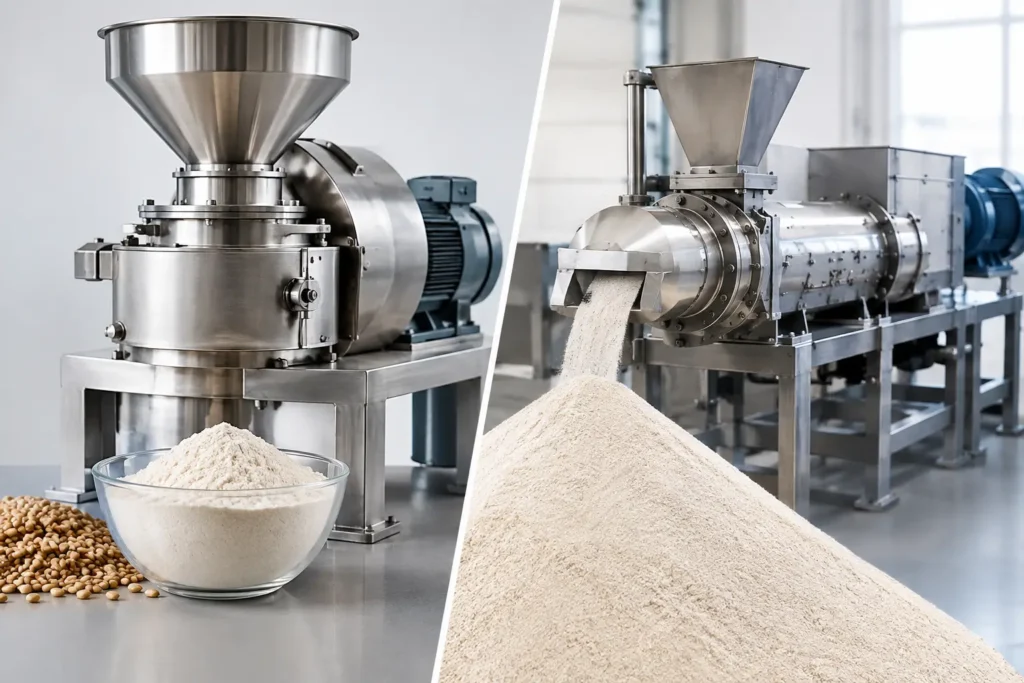
A milling system that meets a pilot plant specification can become the production bottleneck as soon as demand rises. Equally, a high-throughput line can introduce unnecessary complexity where formulation changes, small campaigns or stringent clean-down requirements dominate. The decision between batch versus continuous milling therefore affects far more than machine capacity. It shapes particle size consistency, material handling, validation, labour requirements and total operating cost.
For process engineers and production teams, the right choice begins with the material and the duty. Friable minerals, cohesive food powders, heat-sensitive nutraceuticals and high-value active ingredients respond differently to residence time, feed stability and thermal input. The best milling arrangement is the one that controls those variables reliably at the required production scale.
Batch versus continuous milling: the operating difference
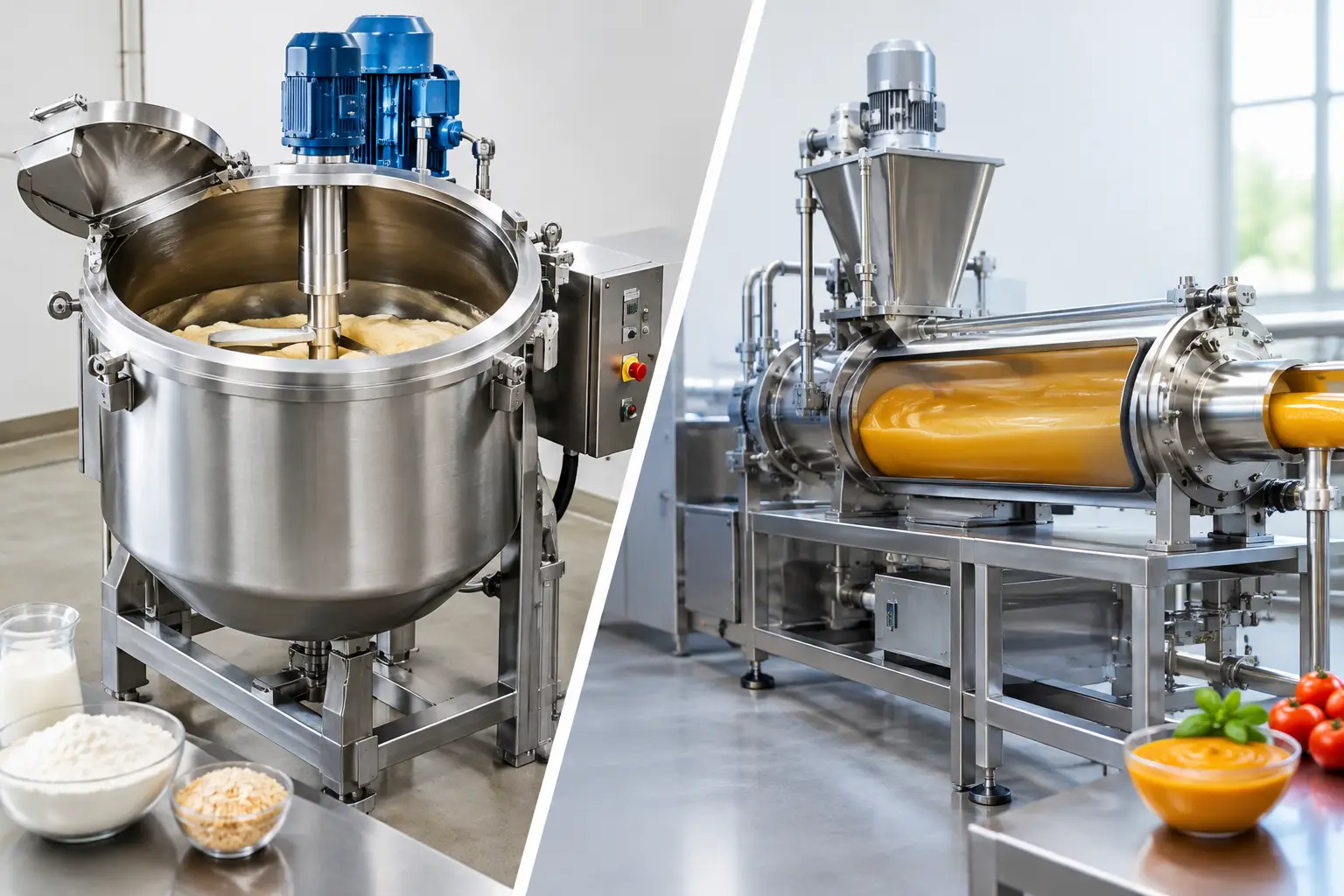
Batch milling processes a defined quantity of material in individual lots. Material is loaded, milled to the required specification, discharged and then the system is prepared for the next batch. Depending on the application, the milling stage may include screening, classification, blending or intermediate holding before packing.
Continuous milling receives material at a controlled, ongoing rate and discharges product continuously. Feed systems, milling equipment, air classification, conveying and collection must operate as one balanced process. A loss-in-weight feeder, rotary valve or screw feeder commonly controls the incoming rate, while downstream separation and dust collection maintain stable operating conditions.
Neither configuration is inherently superior. Batch operation provides clear lot definition and operational flexibility. Continuous operation can deliver significantly higher output and more uniform process conditions when the feed is stable. The distinction matters because a mill does not operate in isolation: upstream conditioning and downstream powder handling often determine whether a process performs as designed.
Where batch milling is the stronger choice
Batch milling is often appropriate where production volumes are modest, product portfolios are broad or formulations change frequently. It allows operators to process a specific lot, inspect the result and make controlled adjustments before committing further material. This can be especially useful during product development, short production runs and the manufacture of high-value powders.
Traceability is another practical advantage. Each batch can be linked to defined raw-material records, operating parameters and quality-control results. In regulated pharmaceutical, nutraceutical and speciality chemical environments, that level of segregation can simplify release procedures and investigation of deviations.
Batch systems can also be easier to adapt to variable feed materials. If moisture content, bulk density or incoming particle size changes between deliveries, the operator can adjust mill speed, classifier settings, screen size or feed rate for the individual lot. This does not remove the need for process discipline, but it gives the production team an opportunity to respond before variability carries into a larger quantity of finished product.
The trade-off is non-productive time. Loading, discharge, cleaning, inspection and documentation create intervals in which the mill is not reducing material. For a low-volume or multi-product facility, that may be entirely acceptable. At high annual tonnage, however, these intervals can constrain output and raise labour cost per kilogram.
Batch processing and containment
For dusty, potent or sensitive materials, batch equipment must still be engineered around containment. Properly designed sealed charging points, local extraction, contained discharge and compatible collection systems protect operators and reduce product loss. The fact that a system is batch-operated should not be mistaken for a simpler safety requirement.
Cleaning also requires careful assessment. A system with easy access may suit frequent product changes, but internal geometry, seals, filters and conveying routes all influence cleaning time and verification. For allergen-sensitive food applications or high-containment pharmaceutical duties, a changeover strategy should be defined before equipment selection.
When continuous milling creates an advantage
Continuous milling is designed for sustained output. Once feed rate, mill settings and air or classifier conditions have reached a stable operating window, the process can produce a consistent stream of powder with fewer stops. This makes it particularly effective for high-volume mineral, chemical, food, pigment and battery-material applications where demand is predictable and campaigns are long.
The principal benefit is not simply tonnes per hour. Continuous operation can improve consistency because the mill sees a more stable feed and operates closer to a defined steady state. When material enters at a controlled rate, the resulting particle size distribution is less affected by the start-stop variation that can occur between batches.
Continuous lines also reduce manual handling. Automated feeding, pneumatic conveying, classification, collection and transfer to storage can form a closed process. This can improve housekeeping, reduce dust exposure and support more efficient use of labour. It can also reduce the risk of contamination introduced through repeated manual charging and discharge.
However, a continuous system requires good feed discipline. Bridging in a hopper, pulsation from a feeder, inconsistent bulk density or uncontrolled lumps can cause variations in mill load and particle size. The mill may be correctly specified yet fail to meet its performance target because the feeder, hopper design or upstream conditioning has not been engineered for the powder’s flow properties.
Scale is not the only consideration
A common assumption is that continuous processing only makes sense for very large plants. Throughput is a major factor, but it is not the only one. A medium-scale operation with a single, stable formulation and regular production schedule may gain more from continuous milling than a larger site running frequent short campaigns.
Conversely, a high-volume plant may retain batch stages where ingredients require pre-blending, quarantine, controlled additions or individual quality checks. Many effective production lines are hybrid systems: raw materials are prepared in batches, then fed continuously through milling, classification and conveying stages.
Particle size control and product quality
Both approaches can achieve precise particle size reduction when the equipment is selected around the application. The relevant question is how reliably that specification can be maintained across the intended operating range.
For example, an air classifier mill can combine impact grinding and dynamic classification to limit oversize material, while a pin mill may suit materials requiring intensive impact at controlled feed rates. Jet milling can achieve fine particle sizes without mechanical grinding media, making it valuable where contamination control or heat sensitivity is critical. Cone mills, hammer mills and universal mills each have their own place where deagglomeration, sizing or coarser reduction is required.
In a batch process, operators may sample each lot and adjust settings where permitted by the process specification. In continuous milling, the emphasis moves towards maintaining stable inputs and monitoring outputs. Particle size analysis, motor load, pressure differential, airflow, temperature and feed rate can all provide useful process signals. For critical applications, real-time or near-line measurement may justify its cost by preventing off-specification product from accumulating.
Thermal behaviour should receive equal attention. Fine grinding generates energy, and energy becomes heat. A continuous system may benefit from controlled airflow, cooling or cryogenic milling where low melting points, volatile components or heat-sensitive actives are involved. Batch processing may offer more opportunity to limit exposure through shorter runs, but it can also create thermal variation if the mill is repeatedly started under changing load conditions.
Evaluating capital cost against total cost of ownership
Batch equipment may have a lower initial cost because its feed and transfer arrangement can be simpler. Yet this is not a reliable rule. Containment, automated discharge, cleaning provisions and batch documentation can add substantial complexity. Continuous systems often demand more integration at the outset, particularly for feeding, conveying, dust extraction and control architecture.
The better comparison is total cost of ownership. Consider annual output, labour per campaign, energy use, product yield, downtime, cleaning duration, wear-part replacement, spare-parts availability and the cost of producing off-specification material. A mill with a lower purchase price may be expensive over its operating life if it creates excessive fines, requires frequent intervention or cannot accommodate future capacity requirements.
Space and installation constraints also matter. Continuous lines can be compact when vertically arranged, using gravity flow between stages, but they require access for maintenance and may need careful zoning around dust control. Batch systems need room for charging, intermediate containers and movement of materials. A site survey should assess the complete process path, not only the mill footprint.
Define the process before selecting the mill
Equipment selection should be based on representative material trials rather than nominal capacity alone. Testing should establish achievable throughput, particle size distribution, temperature rise, yield, flow behaviour and the effect of normal feed variation. It should also assess cleaning access, wear characteristics and the suitability of the proposed collection method.
DP Pulverizer UK supports this progression from laboratory and pilot development through to engineered production-scale systems. That approach is valuable because scale-up is rarely a simple multiplication of motor power or chamber size. Airflow, feed control, residence time and conveying behaviour must be considered together.
A well-specified milling line gives operators a process they can control, maintain and scale with confidence. Whether that means defined batches or a continuous powder-processing train should follow the realities of the material, the production schedule and the quality standard the finished product must meet.