DP Pulveriser UK - Innovating the Future of Size Reduction
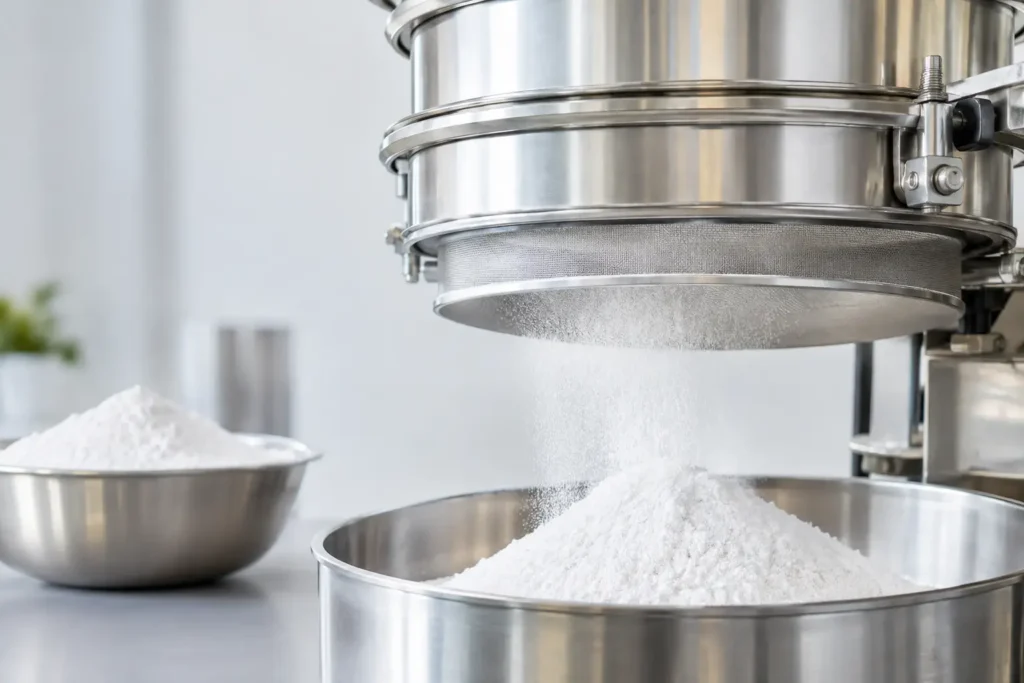
A narrow particle-size cut is rarely achieved by fitting a finer screen or simply increasing mill speed. It depends on the interaction between material behaviour, airflow, rotor geometry, feed consistency and product recovery. The best classifiers for narrow cuts are therefore those matched to the required separation duty, not necessarily those with the highest advertised cut point.
For manufacturers producing pharmaceutical excipients, mineral fillers, battery materials, pigments, food powders or specialty chemicals, classification performance directly affects product specification, yield and downstream process stability. A classifier that produces too much oversize can compromise finish and functionality. One that removes excessive fine material can reduce yield, create dust-handling issues and increase energy consumption.
What a narrow cut means in production
A classifier separates particles according to their aerodynamic behaviour. In an air classifier, centrifugal force moves coarser particles outwards while the process air carries finer particles through the classifying zone. The result is a fine fraction and a coarse fraction, each with its own particle-size distribution.
A narrow cut means there is a small transition zone between material reporting to the fines and material reporting to the rejects. In practical terms, particles slightly below the target size should consistently enter the fine product, while particles slightly above it should be rejected. The sharper that transition, the lower the proportion of misplaced coarse particles in fines and misplaced fines in the reject stream.
This is distinct from achieving a low d50 value. A system may produce a fine median size but still deliver a broad distribution. Where product performance relies on closely controlled size bands, the relevant measures include d10, d50, d90 and the separation curve, rather than the median alone.
Best classifiers for narrow cuts: the main options
High-efficiency dynamic air classifiers
For many dry powder duties, a high-efficiency dynamic air classifier is the strongest starting point when a sharp separation is required. These systems use a rotating classifier wheel to generate a controlled centrifugal field. Adjusting wheel speed changes the cut point, while airflow and feed rate influence the sharpness and capacity of separation.
Dynamic classifiers are particularly effective for fine and ultrafine materials where conventional sieving becomes impractical or inefficient. They are widely suited to minerals, industrial chemicals, pigments, fillers and advanced material powders, provided the feed is dry, free-flowing and adequately dispersed.
Their principal advantage is controllability. Operators can tune the classification conditions to maintain specification as feed characteristics change. The trade-off is that the system needs well-managed process air, accurate control instrumentation and routine attention to wheel wear, particularly with abrasive materials. Wear protection, suitable construction materials and access for inspection should be specified at the engineering stage.
Multi-wheel air classifiers
Where a single classifier wheel cannot provide the required throughput without sacrificing cut sharpness, multi-wheel classifiers offer a practical route forward. Multiple wheels divide the material loading across several classifying zones. This can increase capacity while retaining the fine separation performance associated with dynamic classification.
They are often considered for high-volume production of fine mineral products, coating ingredients, engineered fillers and battery-related powders. Their value is not simply higher output. By avoiding excessive loading of one wheel, the design can maintain a more stable airflow pattern and reduce bypassing at industrial scale.
The trade-off is higher capital complexity and a more demanding system layout. Feed distribution to each wheel must be uniform, and the downstream collection system must be designed to maintain the intended pressure balance. A poorly integrated multi-wheel installation can lose the performance benefit of the classifier itself.
Centrifugal classifiers
Centrifugal classifiers are a capable choice for medium-fine duties where a dependable separation is needed but the target cut is not at the extreme fine end. Depending on configuration, they can provide efficient removal of oversize particles, deagglomerate moderately cohesive feeds and support continuous production with relatively straightforward operation.
They are commonly appropriate where the objective is product protection rather than ultrafine precision: removing grit from a fine powder, separating a controlled coarse fraction or preparing feed for a downstream milling stage. Their operating costs can be favourable, particularly where the specification allows a slightly broader cut than a high-efficiency wheel classifier would achieve.
For very narrow distributions below the finer micron ranges, however, a centrifugal design may not offer the same selectivity as a purpose-designed dynamic wheel system. The right decision depends on the permitted oversize level, production rate and whether recirculation is acceptable.
Air classifier mills
An air classifier mill combines impact milling and internal dynamic classification in one machine. Material is reduced in the milling chamber, while particles small enough to meet the selected cut point pass through the classifier wheel and exit as product. Oversize material remains in the grinding zone until it is sufficiently reduced.
This arrangement is valuable when a process needs both particle-size reduction and controlled top-size limitation in a compact footprint. It can reduce handling between separate milling and classifying stages, which is particularly useful for powders that are dusty, sensitive to contamination or difficult to convey.
An air classifier mill does not replace a standalone classifier in every case. If the feed is already near the required size and the priority is exceptionally sharp fractionation, a dedicated classifier may provide better control. Conversely, where milling and classification are inseparable process requirements, the integrated route can reduce plant complexity and improve consistency.
Static air classifiers
Static classifiers use fixed vanes or a controlled air path rather than a rotating wheel. They are generally simpler, lower-maintenance machines for coarser separations, pre-classification and removal of large oversize material before fine milling.
They have a clear role in an efficient powder processing line, especially when they protect a mill from unnecessary coarse load or reduce the burden on a downstream dynamic classifier. However, they are not normally the first choice for a genuinely narrow, high-precision cut. Their separation performance is more sensitive to changes in feed rate and particle shape, and their transition zone is usually broader.
The material can determine the classifier
No classifier should be selected on particle size alone. Particle density, shape, moisture, agglomeration, surface chemistry and abrasiveness all change how a powder behaves in the classifying zone. Two materials with the same sieve analysis may separate very differently if one is plate-like, another is spherical, or one carries static charge.
Light, irregular particles can be carried into the fine product more readily than their nominal size suggests. Dense particles may require different airflow and wheel-speed conditions to reach the same cut point. Cohesive materials can enter as agglomerates, producing apparent oversize or inconsistent fines unless the feed is dispersed effectively before classification.
Moisture is especially significant. Even a modest increase can encourage build-up in the classifier, reduce flow stability and broaden the final distribution. For hygroscopic, heat-sensitive or challenging products, the wider system may need conditioned air, inert gas operation, cryogenic milling upstream or specialist feeding equipment.
Engineering factors that protect cut sharpness
A classifier is only as stable as the process around it. Feed should enter at a controlled, consistent rate and should be dispersed before it reaches the classifying zone. Surges from a screw feeder or poor pneumatic transfer can overload the classifier momentarily, sending coarse material into the fines stream.
Airflow must also be measured and controlled rather than treated as a fixed background condition. Filter loading, duct losses and changes in product collection can alter system resistance over time. A well-engineered installation accounts for pressure balance across the mill, classifier, cyclone and filter so that the separation conditions remain repeatable.
Product collection deserves equal attention. Cyclones, bag filters and rotary valves must be sized to recover fines without creating re-entrainment, leakage or pressure fluctuations. For high-value powders, minimising product hold-up and enabling clean access may be as important as the headline cut point.
Where contamination control is critical, specify the complete contact path: construction materials, surface finish, seals, bearing arrangement, cleanability and dust containment. Pharmaceutical, food and battery-material applications may have very different requirements, but each benefits from a classifier engineered as part of a complete process system rather than a standalone machine.
Selecting the right system for scale-up
Laboratory trials are the most reliable way to compare classifier options for a narrow-cut application. They establish more than particle-size data. They reveal throughput at specification, energy demand, heat generation, product recovery, wear behaviour and the effect of recirculation on total yield.
Scale-up should preserve the relevant process conditions, not merely increase machine size. Air velocity, wheel-tip speed, feed dispersion and residence time all influence classifier performance. A pilot programme gives process engineers the data needed to define acceptance criteria for a production system and avoid costly modifications after installation.
DP Pulverizer UK supports this application-led approach through milling, classification and complete powder-processing systems engineered around the material and required production outcome. The strongest equipment choice is one that meets the target distribution consistently at the required capacity, while remaining maintainable and efficient over its operating life.
For a narrow-cut process, prioritise a classifier trial that measures the full separation curve under realistic feed conditions. That evidence will show whether a high-efficiency dynamic classifier, an integrated air classifier mill or a staged classification line will deliver the specification with the lowest practical total cost of ownership.