DP Pulveriser UK - Innovating the Future of Size Reduction
A mill that is running continuously is not necessarily producing efficiently. When operators ask how to improve milling throughput, the practical answer is rarely to increase rotor speed or open the feed valve. Sustainable capacity gains come from matching the entire process – material, mill, air system, classification, feeding and discharge – to a defined production target.
For regulated and performance-critical powders, throughput must also be achieved without widening particle size distribution, raising product temperature, increasing contamination risk or creating an unstable process. The objective is not simply more kilograms per hour. It is more saleable product per hour, consistently and at the required specification.
Start with the true throughput constraint
The mill is often blamed for low output, but it may not be the limiting stage. Restricted upstream feeding, poor material flow from a hopper, insufficient conveying air, an undersized classifier, blocked filters or slow downstream packing can all cap the line before the mill reaches its useful operating range.
Measure actual mass flow at each stage rather than relying solely on nominal machine ratings. Compare feed rate, mill discharge rate, rejected oversize, recirculated material, filter loading and finished-product rate over a representative production run. This identifies whether the constraint is size reduction, separation, handling or changeover time.
Material behaviour must be included in that assessment. A free-flowing mineral powder and a cohesive hygroscopic nutraceutical ingredient can require entirely different feed arrangements at the same nominal rate. Moisture uptake, bulk density, fat content, electrostatic charge, abrasiveness and heat sensitivity all influence the achievable throughput.
How to improve milling throughput through mill selection
A correctly selected mill is the foundation of a high-output process. Equipment type should be selected by the required particle size, material characteristics, contamination requirements and capacity target, not by motor power alone.
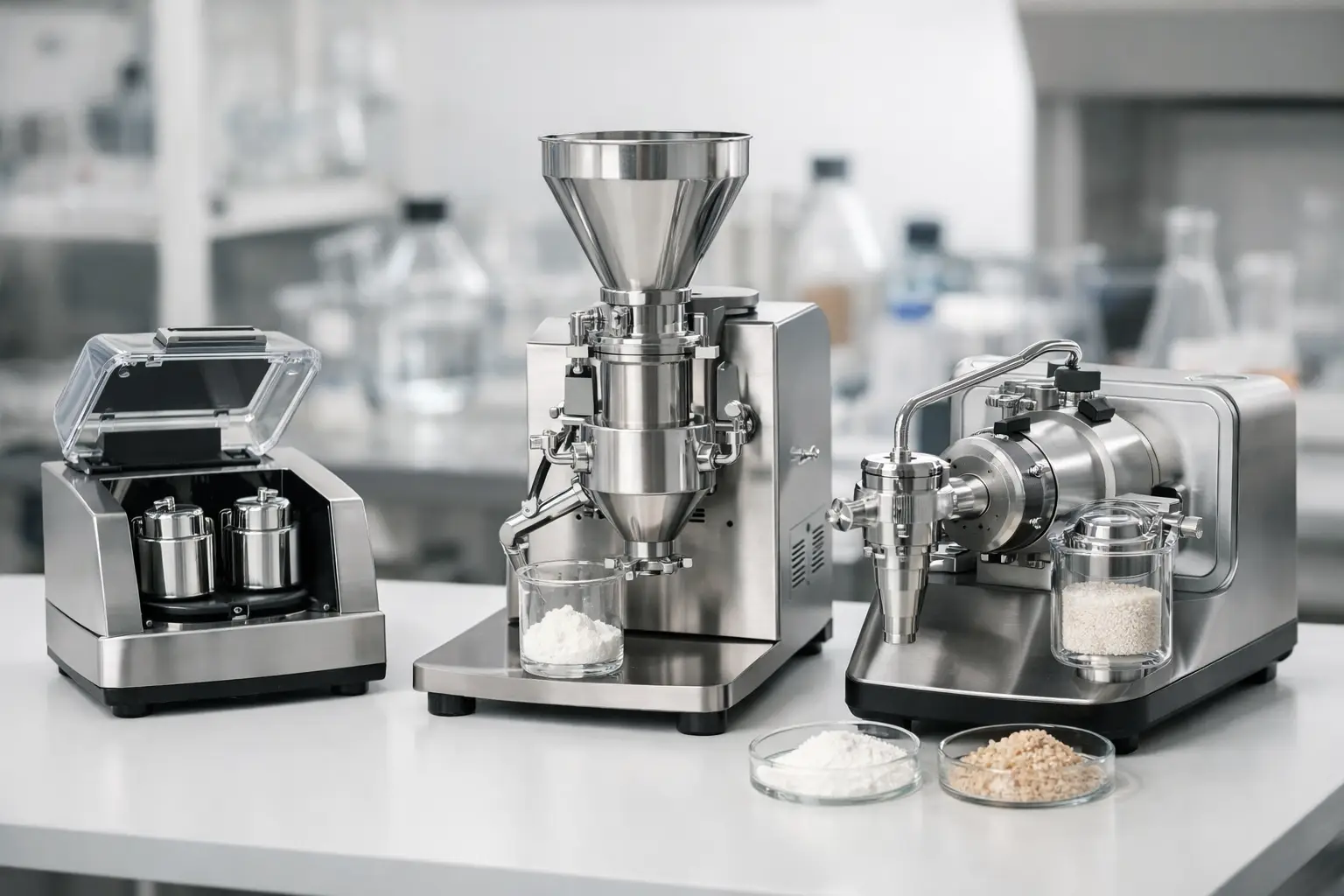
Hammer mills and universal mills can provide efficient size reduction for many friable materials and pre-processing duties. Pin mills are well suited to fine grinding where controlled impact is required. Turbo mills and air classifier mills offer a route to finer products with integrated separation, while jet milling may be appropriate for very fine, high-value or heat-sensitive materials. Cone mills are often selected for deagglomeration, sizing and controlled conditioning rather than aggressive grinding.
Each technology has a different throughput curve. Pushing a fine-grinding mill beyond its optimum feed rate can increase residence time, raise temperature and create excess fines without delivering more in-specification product. Conversely, a coarse screen or less intensive grinding configuration may increase rate but fail the product specification. The best solution depends on the permitted particle size distribution, not only on a top-size target.
Pilot trials are particularly valuable when scaling from laboratory development to production. They establish realistic specific energy consumption, wear rates, temperature rise and classifier settings before capital equipment is specified. This reduces the risk of installing a mill that is technically capable of achieving the target particle size but cannot do so at the required commercial rate.
Stabilise and control the feed
Mills perform best with a consistent, metered feed. Surging feed creates fluctuating mill load, inconsistent particle size distribution and avoidable stoppages. Starve feeding can be equally inefficient because the mill runs below its productive range while fixed energy and labour costs continue.
A suitable loss-in-weight feeder, screw feeder, vibratory feeder or rotary valve should be selected around the powder’s flow properties and the required turndown ratio. Hopper geometry, agitators, bin activators and bridge-breaking devices may be necessary for cohesive powders. Where feed material varies between batches, closed-loop control based on mill motor load, differential pressure or product flow can help maintain a stable operating point.
Do not treat feed conditioning as a secondary detail. Screening, lump breaking, drying or temperature control before milling can remove the variables that prevent consistent high-rate operation. For materials that soften or smear at ambient temperature, cryogenic milling or chilled process conditions may deliver greater effective throughput than attempting to force more material through a conventional mill.
Optimise air flow and classification
In pneumatic and air-classified systems, air is a process variable rather than a utility. It transports material, removes heat, controls residence time and supports particle separation. Inadequate air flow can cause product accumulation, unstable classification and high mill temperatures. Excessive air flow may carry oversized particles through the system, increase filter loading and consume unnecessary energy.
Classifier speed, air volume and pressure must be tuned together. Increasing classifier speed generally produces a finer cut, but it can reduce throughput because more material remains in the grinding zone or is returned for further size reduction. Reducing speed can increase output, but only if the resulting particle size distribution remains within specification.
The ducting and dust collection system also deserve close attention. Long duct runs, sharp bends, leaks, worn fans and overloaded filters add pressure losses that compromise conveying and separation. A system review should include fan duty, static pressure, filter area, pulse-cleaning performance and the condition of rotary valves. Improving these elements can release capacity without changing the mill itself.
Reduce recirculation and off-spec material
High recirculation is a warning that the process is expending energy on material that has already passed through the system. Some recirculation is designed into closed-loop milling and classification, but excessive recycle can indicate an unsuitable screen, incorrect classifier setting, poor feed distribution or insufficient grinding intensity.
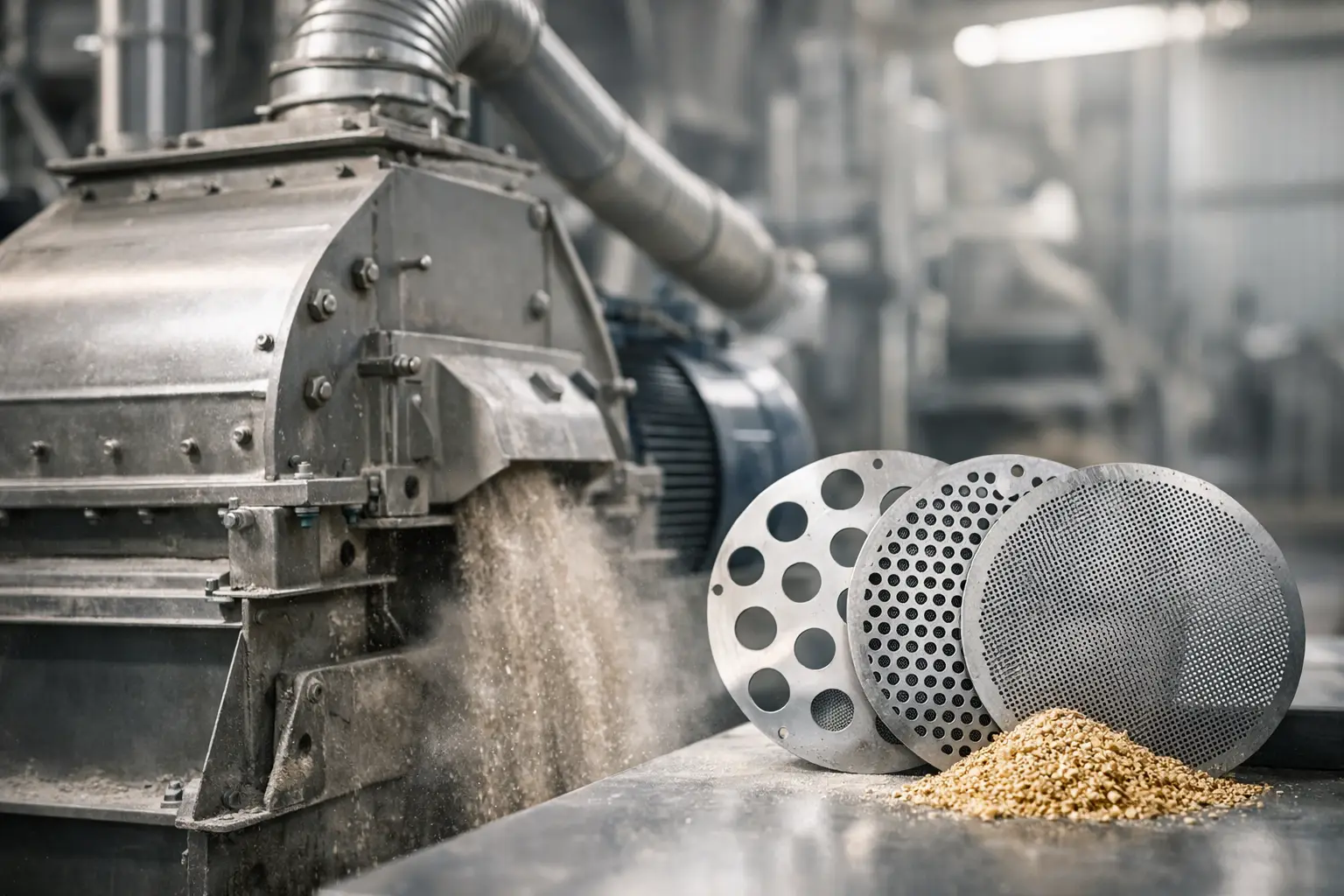
Track the proportion of material that becomes on-spec product on the first pass. If the line produces excessive fines, investigate impact speed, residence time, screen condition and feed rate. If it produces too much coarse material, assess whether the mill is overloaded, whether grinding components are worn, or whether the feed contains hard agglomerates that require pre-treatment.
Yield matters as much as nominal capacity. A line rated at a high feed rate may have lower useful throughput than a slower, controlled process if large volumes require rework, blending or disposal. The commercial measure should be tonnes of compliant product produced per shift.
Protect capacity with maintenance and wear control
Wear changes the process. Worn hammers, pins, beaters, liners, screens and classifier components reduce grinding efficiency and make particle size less predictable. Abrasive materials accelerate this effect, while sticky products can blind screens and build up on internal surfaces.
A preventive maintenance plan should combine calendar-based inspections with condition-based indicators. Monitor motor current, vibration, bearing temperature, differential pressure, product particle size and energy consumed per tonne. A gradual increase in specific energy or a loss of output at the same settings often identifies developing wear before an unplanned stoppage occurs.
Cleaning and changeover arrangements affect throughput as well. For pharmaceutical, food and speciality chemical production, accessible internals, hygienic construction and well-designed clean-in-place or wash-in-place provisions can significantly reduce lost production time. The right mill is not only the one that processes quickly; it is the one that can be safely returned to service quickly.
Integrate milling with powder handling
The greatest constraints frequently sit at the interfaces around the mill. An integrated system should provide controlled feeding, efficient discharge, contained transfer, dust management, storage and packing capacity that match the milling rate. If the mill must pause because a receiver is full, a filter cannot discharge or a packaging station is waiting, its theoretical capacity has little value.
Consider the complete material path, including bulk bag unloading, intermediate bulk containers, vacuum or pneumatic conveying, sieving, blending and final filling. Segregation, attrition and moisture exposure during transfer can compromise the work completed in the mill. For fine powders, a properly engineered enclosed handling system improves both throughput and housekeeping while supporting operator safety.
Automation can provide useful production data and reduce operator intervention, but it should be proportionate to the process. Automated recipe control, batch traceability and alarm management are valuable where repeatability and compliance are central. For simpler duties, reliable mechanical design and straightforward controls may provide the best total cost of ownership.
Establish a controlled optimisation programme
Avoid changing several settings at once. Establish a baseline using a defined material lot, then adjust one variable at a time: feed rate, rotor speed, screen size, classifier speed, air flow or conveying pressure. Record product size distribution, temperature, energy per tonne, yield and stability alongside output.
The most effective operating window is usually a balanced point rather than the maximum reading on any single instrument. It should give the required particle size, acceptable temperature, manageable wear and stable operation through normal material variation. Once established, document it in operating procedures and train teams to recognise deviations early.
DP Pulverizer UK approaches throughput as a system-engineering challenge, combining application testing with mill, classification and powder-handling design. The practical opportunity is to turn capacity improvement into a repeatable operating condition, not a short-term production push.