DP Pulveriser UK - Innovating the Future of Size Reduction

Particle size tells only part of the processing story. Two powders with the same measured size distribution can flow, compact, disperse, dissolve and react very differently when their particles have different shapes. Controlling particle shape during milling is therefore a critical consideration where powder behaviour affects product performance, production efficiency or downstream consistency.
For process engineers, the objective is rarely to create a universally ‘ideal’ shape. A free-flowing granular food ingredient, a high-surface-area chemical intermediate and a tightly packing battery material may each require a different morphology. The milling system must be selected and configured around the material’s fracture behaviour and the performance required after milling.
Why particle shape matters in powder processing
Particle shape influences how individual particles contact one another and how they interact with air, liquid binders, conveying equipment and processing tools. Angular particles tend to interlock and create higher internal friction. This can reduce flow through hoppers and feeders, increase bridging risk and make pneumatic conveying less predictable. However, angularity can also be valuable where mechanical keying, surface area or rapid dissolution is required.
More rounded or equant particles generally offer improved flow and packing characteristics. They may fill dies more consistently in tablet production, move more readily through handling equipment and produce a more uniform bulk density. Yet a rounded product is not automatically preferable. Producing it may demand additional processing energy, a separate rounding stage or a mill configuration that lowers throughput.
Shape also affects final product appearance and functional performance. In coatings and pigments, platelet-like, needle-like or irregular particles can alter gloss, opacity and dispersion. In pharmaceutical and nutraceutical applications, morphology may influence blending, segregation, compression and dissolution. For minerals, ceramics and battery materials, shape can affect packing density, surface chemistry and performance in the final assembly.
Particle size specifications should therefore be assessed alongside morphology, not in isolation. Laser diffraction provides valuable size data, but microscopy and image analysis are often needed to verify whether a milling process is producing the intended particle form.
How milling creates different particle shapes
Particle morphology is primarily determined by the way energy is transferred into the feed. Impact, compression, shear and attrition do not break materials in the same manner. Most industrial mills use a combination of these mechanisms, but the dominant force determines the likely shape outcome.
Impact-driven fracture
Hammer mills, pin mills and turbo mills use high-speed impact to fracture particles. Brittle materials commonly break into irregular, angular fragments under impact. This can be effective when rapid size reduction and high throughput are the main priorities, particularly for dry food ingredients, agricultural materials, minerals and many chemicals.
The trade-off is that aggressive impact can generate fines and broad shape variation. High rotor speed may increase reduction, but it can also create excess surface area, heat generation and particle damage. For heat-sensitive materials, this may affect product quality as well as morphology.
Attrition and particle-to-particle collision
Jet milling uses high-velocity gas streams to accelerate particles into one another. Because there are no mechanical grinding components in the milling chamber, jet mills are particularly suited to fine and ultra-fine applications where contamination control and low product temperature matter.
Particle-to-particle collision can create sharp, fractured particles in brittle materials, while also allowing precise control of the top size through integrated air classification. The final shape still depends on material structure. Crystalline materials may cleave along natural planes, whereas more ductile materials can deform, flatten or form flakes rather than fracture cleanly.
Shear and cutting action
Cone mills and certain universal mill configurations apply comparatively gentler size reduction through shearing and controlled screening. They are often selected for deagglomeration, conditioning and controlled granule sizing rather than severe comminution.
Where preserving a more regular granule form is important, lower-energy shear can be preferable to high-impact milling. This is particularly relevant for pharmaceutical granules, food powders and products where minimising fines improves handling and dosage consistency. The achievable particle shape is limited by the incoming material, but gentle processing avoids unnecessary breakage and excessive angularity.
The variables that determine morphology
Controlling shape requires more than choosing a mill category. The operating window has a direct effect on particle breakage, residence time and the proportion of fines. Process development should examine these variables as an interdependent set rather than adjusting one setting at a time on the production line.
Rotor or classifier speed is a central control point. Higher speed increases impact intensity and often reduces particle size, but may also produce a more angular product and a greater fines fraction. Lower speed can preserve coarser particles or reduce attrition, although it may leave oversized material in the discharge.
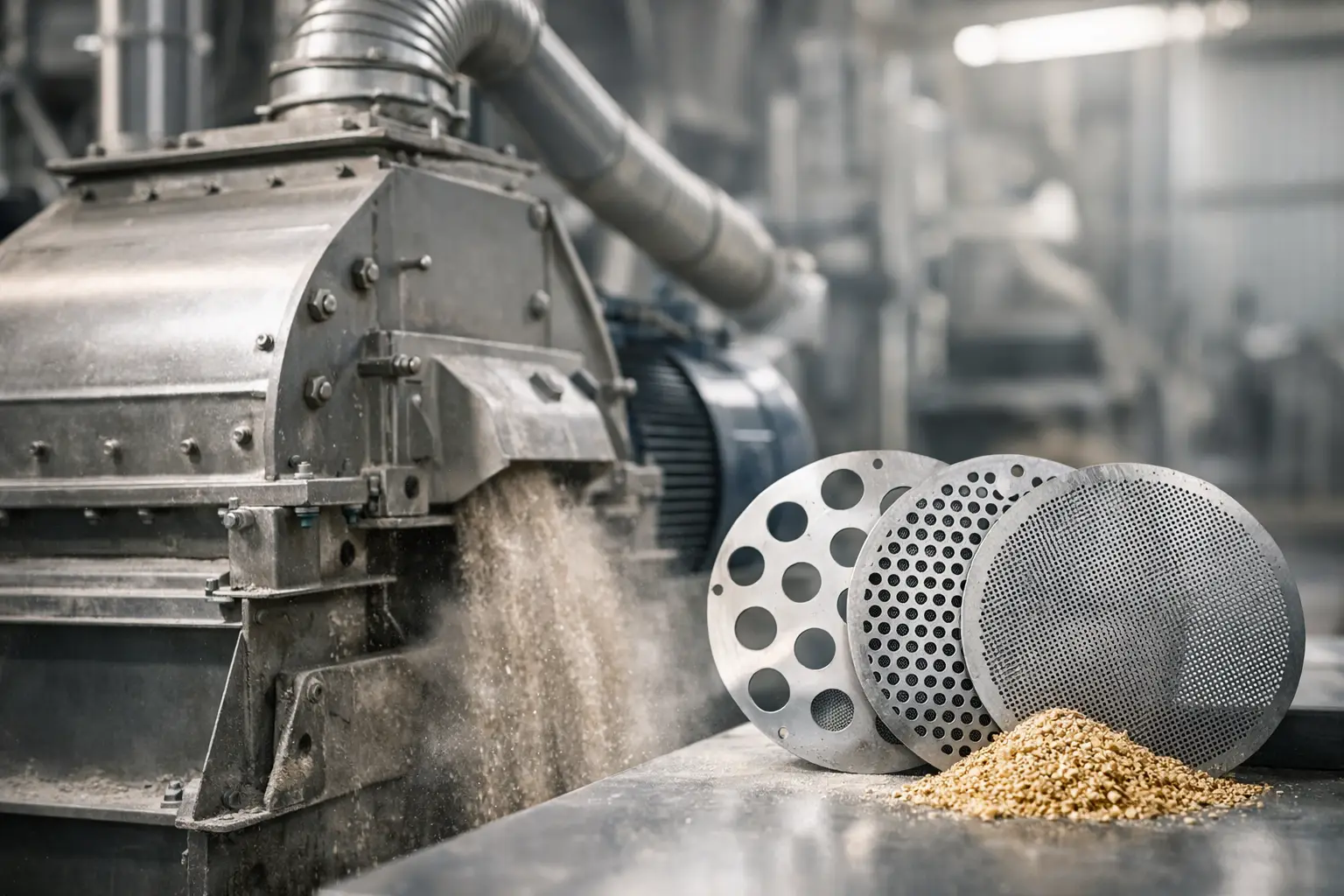
Screen aperture and screen design are equally significant in mechanical mills. A small aperture extends residence time because particles must be reduced further before discharge. This can increase the number of impacts received by each particle, changing both size distribution and shape. Screen open area, thickness and hole geometry can also influence throughput and heat build-up.
Feed rate must remain stable. Overfeeding can cushion impacts, increase recirculation and create a wider distribution of particle forms. Underfeeding may expose particles to unnecessary energy, leading to excessive fines. Consistent metering is particularly important when processing low-bulk-density powders or materials prone to agglomeration.
Moisture, temperature and feed condition often have as much influence as mill settings. A material that is brittle at low moisture may become ductile as moisture rises, producing flakes or smeared particles instead of clean fracture. Cryogenic milling can be used to embrittle elastic, waxy or heat-sensitive materials, enabling a more controlled breakage mechanism while limiting thermal degradation.
Classification is part of shape control
A milling circuit without effective classification can make morphology difficult to manage. Oversized particles continue circulating, receiving repeated impacts that may generate unwanted fines and irregular fragments. An air classifier mill addresses this by combining size reduction and dynamic classification in one system.
The classifier wheel rejects particles above the target cut point and permits suitably fine material to leave the milling chamber. This limits over-processing and improves control of the particle size distribution. Although classification does not directly turn angular particles into rounded ones, it prevents prolonged exposure to grinding forces that can damage the desired product fraction.
For demanding specifications, a separate classification stage may be justified. This is often the case where narrow size bands, tightly controlled fines content or high-value materials warrant additional process control. The decision depends on product value, required throughput, yield targets and the cost of handling recycled oversize material.
Match the system to the material and end use
A suitable solution starts with the material’s physical properties: hardness, brittleness, moisture content, melting point, abrasiveness, initial particle form and tendency to agglomerate. These characteristics need to be evaluated against the required product morphology, size distribution, capacity and cleaning or containment requirements.
For a brittle mineral where irregular fragments are acceptable, an impact mill may provide an efficient and economical route. For a heat-sensitive polymer or spice, cryogenic milling may create a cleaner fracture and avoid softening. For a pharmaceutical granule that must retain controlled flow and minimise fines, a cone mill may be more appropriate than an aggressive high-speed mill. Fine chemicals and high-purity materials may require jet milling with integrated classification to achieve precise particle size reduction without mechanical contact contamination.
Scale-up should not be treated as a simple increase in motor power. Tip speed, air volume, feed rate, residence time and classifier performance must be translated carefully from laboratory or pilot trials to commercial equipment. A process that produces the correct morphology at small scale can behave differently when throughput, thermal load and recycle volume increase.
DP Pulveriser UK supports this development process with laboratory-scale evaluation, pilot testing and engineered production systems. Testing provides a practical route to establish how a specific material responds before a full-scale milling line is specified.
Measure morphology before it becomes a production problem
Routine particle size testing remains essential, but morphology should be included in quality evaluation wherever shape has a known effect on product performance. Microscopy can reveal sharp edges, flakes, agglomerates and fractured surfaces that size data alone may conceal. Automated image analysis can quantify parameters such as aspect ratio, circularity and elongation, making morphology measurable rather than subjective.
The most effective specifications connect those measurements to a real manufacturing outcome. If poor hopper flow is the concern, assess morphology alongside bulk density, angle of repose and flow function. If a coating is dispersing poorly, evaluate shape together with surface area and dispersion energy. This establishes meaningful limits rather than imposing an arbitrary visual standard.
A well-engineered milling process does not merely reduce particles until they pass a screen or meet a d50 target. It applies the right breakage mechanism, operating conditions and classification strategy to produce powder that performs consistently in the next stage. When particle shape is treated as a controlled process output, manufacturers can reduce rework, protect yield and build greater certainty into the entire production line.