DP Pulveriser UK - Innovating the Future of Size Reduction
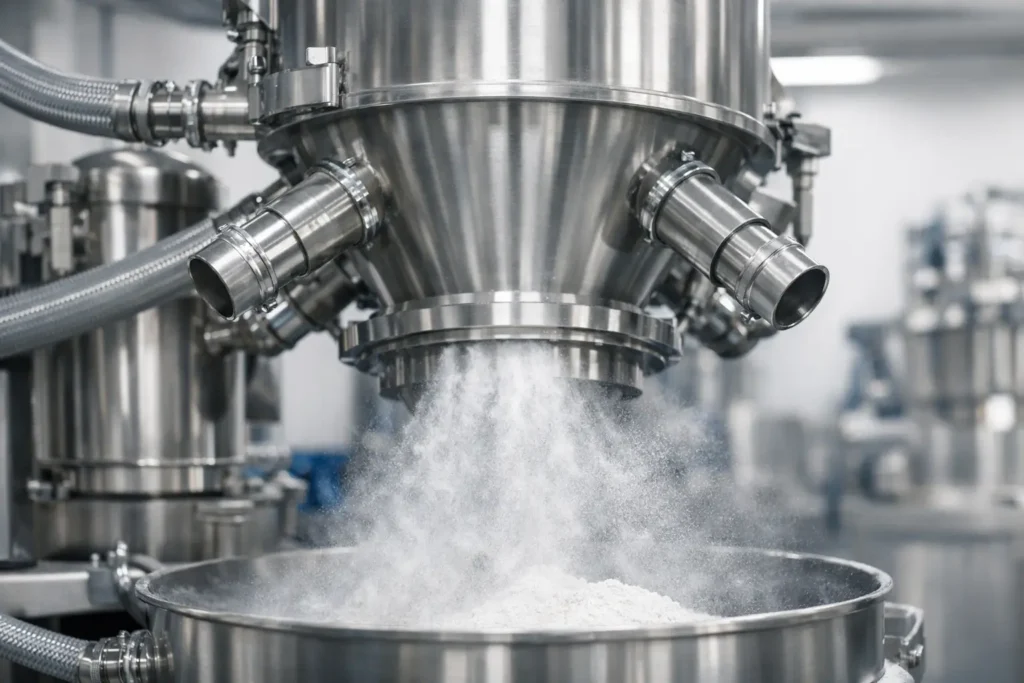
When a powder specification moves from merely acceptable to tightly controlled, conventional size reduction often stops being enough. A jet mill for fine grinding is typically selected when the process demands micron-level particle size reduction, narrow particle size distribution, low contamination, and minimal heat build-up during milling. For manufacturers working with pharmaceuticals, battery materials, pigments, speciality chemicals, or high-value food ingredients, those factors directly affect product performance, compliance, and yield.
Jet milling is not simply a finer version of mechanical grinding. It is a fundamentally different process that uses high-velocity compressed gas to accelerate particles and drive particle-on-particle impact. Because there are no high-speed mechanical grinding elements in the milling chamber, the process is particularly well suited to applications where purity, thermal sensitivity, and exact particle size control matter.
How a jet mill for fine grinding works
In a jet mill, compressed air or another process gas is introduced through nozzles at very high velocity. This creates a turbulent grinding zone where particles collide with one another and fracture. Rather than relying on pins, hammers, or rotating beaters, the mill uses fluid energy to generate the required impact forces.
The internal classifier, where fitted, performs an equally important role. Fine particles are carried out of the grinding chamber once they meet the target cut point, while coarser material remains in the grinding zone for further reduction. This is what allows a jet mill to achieve not only small particle sizes, but also a more controlled top size than many alternative milling technologies.
That distinction matters in production. In sectors where flowability, dissolution, reactivity, blending behaviour, or surface area must be managed precisely, the difference between an average particle size and a tightly controlled particle size distribution can be commercially significant.
Why manufacturers choose jet milling
The most common reason to specify jet milling is fine particle production without excessive heat. Mechanical mills can be highly effective, but as rotor speed and product fineness increase, heat generation, wear, and contamination can become limiting factors. A jet mill addresses those constraints in applications where material integrity is critical.
For temperature-sensitive materials, lower heat rise helps protect product quality. This can be important for active pharmaceutical ingredients, nutraceutical compounds, waxy products, resins, and certain food ingredients where softening, degradation, or loss of functionality is a concern.
Low contamination is another major advantage. Because grinding occurs through particle collision rather than direct contact with moving mechanical parts, wear from internal components is reduced. In high-purity applications, that can support tighter quality standards and lower the risk of unwanted metallic contamination.
Jet mills also offer excellent control at fine particle sizes. Where a process target sits in the low micron range, and where oversize particles cannot be tolerated, they often provide a more reliable route than general-purpose impact milling.
Where a jet mill fits – and where it does not
A jet mill for fine grinding is a strong solution, but not a universal one. It performs best when the material value, quality requirement, or process sensitivity justifies the technology. If the duty is simply coarse reduction, or if the target particle size can be achieved economically with a pin mill, hammer mill, or air classifier mill, those alternatives may offer lower operating cost.
Material behaviour also matters. Jet milling is generally most effective on friable products. Very elastic, highly fibrous, or strongly adhesive materials can be more difficult to process efficiently unless the system is engineered around those characteristics. Moisture content, feed consistency, and bulk density all influence performance.
There is also an energy consideration. Compressed gas is central to jet milling performance, but it is not free. Plants comparing technologies should evaluate the full operating model, including compressor demand, air treatment, throughput expectations, maintenance profile, and the cost of achieving the specification by other means. In many high-specification applications, the performance benefit still clearly outweighs the utility cost. In others, a different milling route may be the more practical answer.
Key process benefits of jet milling
For technically demanding production environments, the value of jet milling is usually found in four areas: particle size precision, product quality, process repeatability, and scalable development.
Particle size precision improves downstream performance. Finer and more consistent powders can enhance dissolution rates, coating behaviour, reaction efficiency, blending uniformity, or packing density depending on the application. In sectors such as battery materials and speciality chemicals, those changes are not minor process improvements. They can alter final product performance.
Product quality benefits from the low-heat, low-contamination nature of the process. This is particularly relevant where product purity, colour stability, active ingredient integrity, or controlled morphology are under scrutiny.
Repeatability matters just as much as fineness. A process that reaches the target size in one trial but drifts in full production is not a strong process. Well-engineered jet milling systems support stable operation through controlled feed presentation, classifier performance, and gas flow management.
Scalability is often overlooked at the equipment selection stage. Many manufacturers first encounter jet milling in laboratory or pilot work, then face a difficult transition to production. The right supplier approach is not simply to provide a larger machine. It is to build a process route that translates lab data into commercial throughput while preserving the required particle profile.
Important design considerations for a jet mill for fine grinding
No two powder processing duties are identical, which is why system design matters more than headline machine type. Selecting a jet mill should begin with the application, not the catalogue.
Feed characteristics are the first variable. Hardness, friability, moisture, abrasiveness, and initial top size all affect how the material behaves in the grinding chamber. A stable, correctly prepared feed will always support better milling performance than an inconsistent upstream process.
Throughput requirement is equally important. Very fine results are achievable, but production rate and target fineness must be assessed together. In most milling systems, pushing for a tighter cut point can reduce throughput. That is not a fault in the technology. It is a normal engineering trade-off that should be sized into the process from the start.
Gas selection may also matter. Compressed air is common, but inert gas systems may be necessary for reactive, oxidisable, or explosive products. In regulated or hazardous environments, containment, pressure resistance, filtration, and explosion protection all need to be considered as part of the whole installation.
Wear protection should not be ignored, especially with abrasive products such as advanced ceramics, minerals, or certain inorganic chemicals. Material of construction, internal lining options, and classifier design all contribute to long-term reliability and product purity.
Typical applications across industry
Jet mills are widely used where very fine particle sizes and controlled distributions are essential. In pharmaceuticals, they support micronisation of active compounds and excipients where bioavailability and content uniformity are critical. In food and nutraceutical processing, they can be applied to speciality ingredients that require fine, consistent powder characteristics without excessive thermal stress.
In chemicals and pigments, jet milling is often chosen to improve dispersion, colour development, and reactivity. In battery and advanced materials, precise particle engineering can affect electrode behaviour, density, and end-product consistency. Mineral and metal powder processors also use jet milling where contamination control and fine classification are central to the process outcome.
The common thread is not the industry label. It is the process requirement: precise particle size reduction under controlled conditions.
Beyond the mill – system integration matters
The best milling result rarely comes from the mill alone. Feeding, conveying, dust collection, classification, and product discharge all influence overall plant performance. A jet mill that is technically capable of the target size can still underperform if the surrounding system introduces feed surges, poor containment, or inconsistent product recovery.
That is why serious production operations tend to evaluate complete process integration rather than standalone equipment. A properly engineered system should account for upstream conditioning, controlled feeding, gas handling, filtration efficiency, cleaning access, and downstream powder handling. This is particularly important when moving from development scale to continuous industrial duty.
For manufacturers investing in long-term capacity, the more useful question is often not Which mill is cheapest? It is Which system will hold specification reliably, protect product quality, and deliver the lowest total cost of ownership over time? That is where engineering support, test work, and application knowledge make a measurable difference. Companies such as DP Pulveriser UK are typically engaged at this stage because the requirement is no longer a machine purchase alone. It is a process solution.
Choosing the right route
If your process requires ultra-fine particle size reduction, tight control over top size, low contamination, and careful handling of heat-sensitive materials, jet milling deserves serious consideration. If your target is less demanding, another milling technology may be the better fit.
The right decision starts with testing, clear process data, and an honest view of the specification you need to meet. Fine grinding is rarely just about making powder smaller. It is about producing the right powder, at the right consistency, in a way that supports efficient and dependable manufacturing.