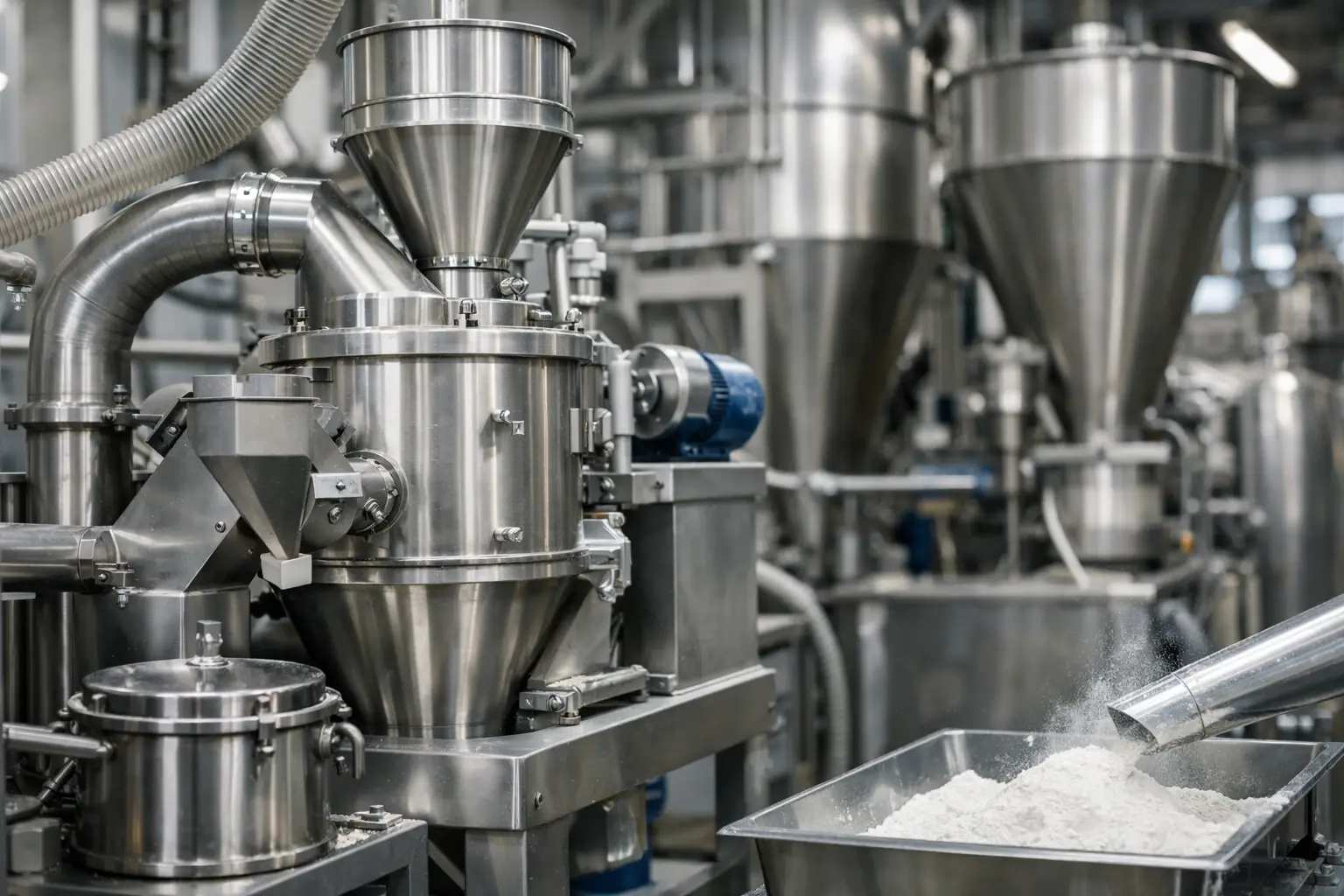
DP Pulveriser UK - Innovating the Future of Size Reduction
A powder that is too coarse rarely fails in an obvious way. More often, it creates a chain of production problems – poor flow, inconsistent blending, slow dissolution, uneven reaction rates, off-spec product, excessive waste, or avoidable energy use downstream. That is why the question, what is particle size reduction, matters far beyond the mill itself. In industrial processing, it is a controlled mechanical operation used to reduce solid materials into smaller, more consistent particles so the material performs correctly in the next stage of production or in the final product.
At a simple level, particle size reduction means breaking larger particles into smaller ones. In practice, it is an engineering decision tied to product specification, throughput, bulk density, temperature sensitivity, contamination risk, hygiene requirements and total operating cost. The target is not just smaller particles. The target is the right particle size distribution for the application.
What is particle size reduction in manufacturing?
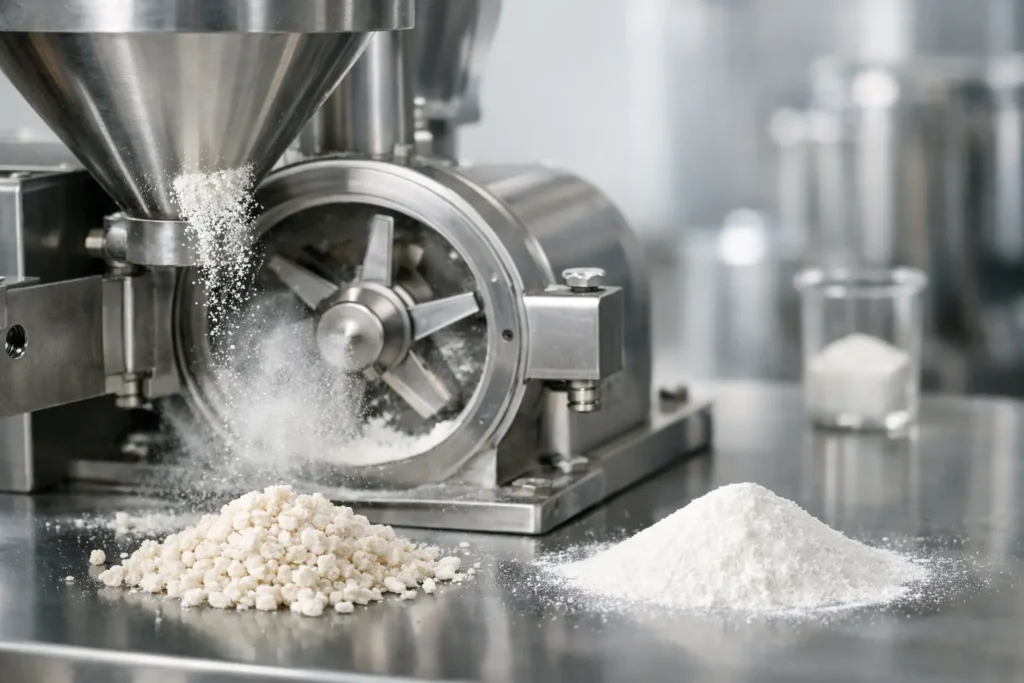
In manufacturing environments, particle size reduction is typically achieved by applying mechanical forces that fracture, shear, cut, crush or impact a material. Depending on the feed material and the process objective, this can happen in a hammer mill, pin mill, jet mill, cone mill, turbo mill, universal mill or air classifier mill, among other systems.
The selected method depends on what the material can tolerate and what the process demands. A brittle chemical compound may respond well to impact. A heat-sensitive product may require a lower temperature approach or cryogenic milling. A pharmaceutical or nutraceutical ingredient may need tight control over fines and contamination. A mineral application may prioritise throughput and wear resistance. The principle is universal, but the process design is highly application-specific.
This distinction is critical because size reduction is rarely judged on particle size alone. In production, success is measured by how consistently the system delivers the required output while maintaining yield, protecting product quality and fitting within the realities of plant operation.
Why particle size reduction matters
Reducing particle size changes how a material behaves. Smaller particles offer more surface area, which can improve dissolution, reaction speed, coating behaviour, absorption and dispersion. A narrower particle size distribution can improve blend uniformity and packing behaviour. In many sectors, that directly affects product performance and regulatory compliance.
In pharmaceuticals, particle size can influence bioavailability, content uniformity and compressibility. In food processing, it affects mouthfeel, mix consistency and handling. In chemicals, it can determine reaction efficiency and product stability. In battery materials, coatings and advanced powders, particle size control often sits at the centre of process performance.
There is, however, a trade-off. Finer is not always better. Over-grinding can increase dust generation, damage fragile materials, raise product temperature, reduce flowability or create a particle size distribution that is too broad for the application. For many manufacturers, the challenge is not how to achieve the smallest possible particle. It is how to reach the specified size range efficiently and repeatedly at commercial scale.
How particle size reduction works
Different milling technologies reduce size in different ways. Impact mills use high-speed force to shatter particles. Pin mills rely on repeated impact between rotating and stationary pins. Hammer mills are often suited to general-purpose reduction where a broader output range is acceptable. Cone mills tend to be used for deagglomeration, sizing and gentle reduction, particularly where a more controlled and lower-energy process is needed.
Jet mills are used when very fine particle sizes are required, especially for heat-sensitive or contamination-sensitive products, because they use high-velocity gas rather than mechanical grinding media. Air classifier mills combine impact milling with internal classification, allowing finer control over top size and helping to reduce oversize material in the final product. Cryogenic systems bring the material to a low temperature before or during milling, making elastic or heat-sensitive products easier to fracture while protecting product integrity.
No single machine is best in all cases. The right solution depends on feed size, hardness, abrasiveness, moisture content, required fineness, throughput target and whether the process must run continuously, in batches, or as part of a fully integrated line.
Key factors that affect the result
When engineers assess what is particle size reduction in practical terms, they are really assessing control. The result is shaped by more than the mill type alone.
Material properties are the first variable. Hard, fibrous, sticky, hygroscopic, abrasive or heat-sensitive materials each behave differently under mechanical stress. A mill that performs well with brittle minerals may be unsuitable for oily food ingredients or temperature-sensitive active compounds.
The target specification is the next factor. This includes not only average particle size, but also the particle size distribution, top cut, amount of fines and required consistency from batch to batch. In many applications, a broad distribution creates problems even when the average size appears acceptable.
Operating parameters also matter. Rotor speed, feed rate, screen size, classifier settings, airflow, system temperature and dwell time all influence the final output. So do plant-level considerations such as dust control, material transfer, containment, cleanability and automation.
This is why process development should not be treated as an afterthought. Lab and pilot testing can reveal whether the chosen technology will produce the right product behaviour before capital equipment is committed at full production scale.
What particle size reduction is not
It is easy to think of size reduction as a simple crushing step. In reality, it is not just breaking material down until it passes through a screen. It is also not isolated from the rest of the process.
If upstream feeding is inconsistent, the mill will struggle to deliver consistent output. If downstream conveying, classification or mixing is poorly matched, the gains achieved in milling can be lost immediately. For this reason, many manufacturers now evaluate particle size reduction as part of a wider powder handling and processing system rather than as a standalone machine purchase.
That broader view often leads to better outcomes. An integrated line designed around the material, throughput and final specification can reduce rework, improve yield and lower total cost of ownership.
Measuring and controlling particle size reduction
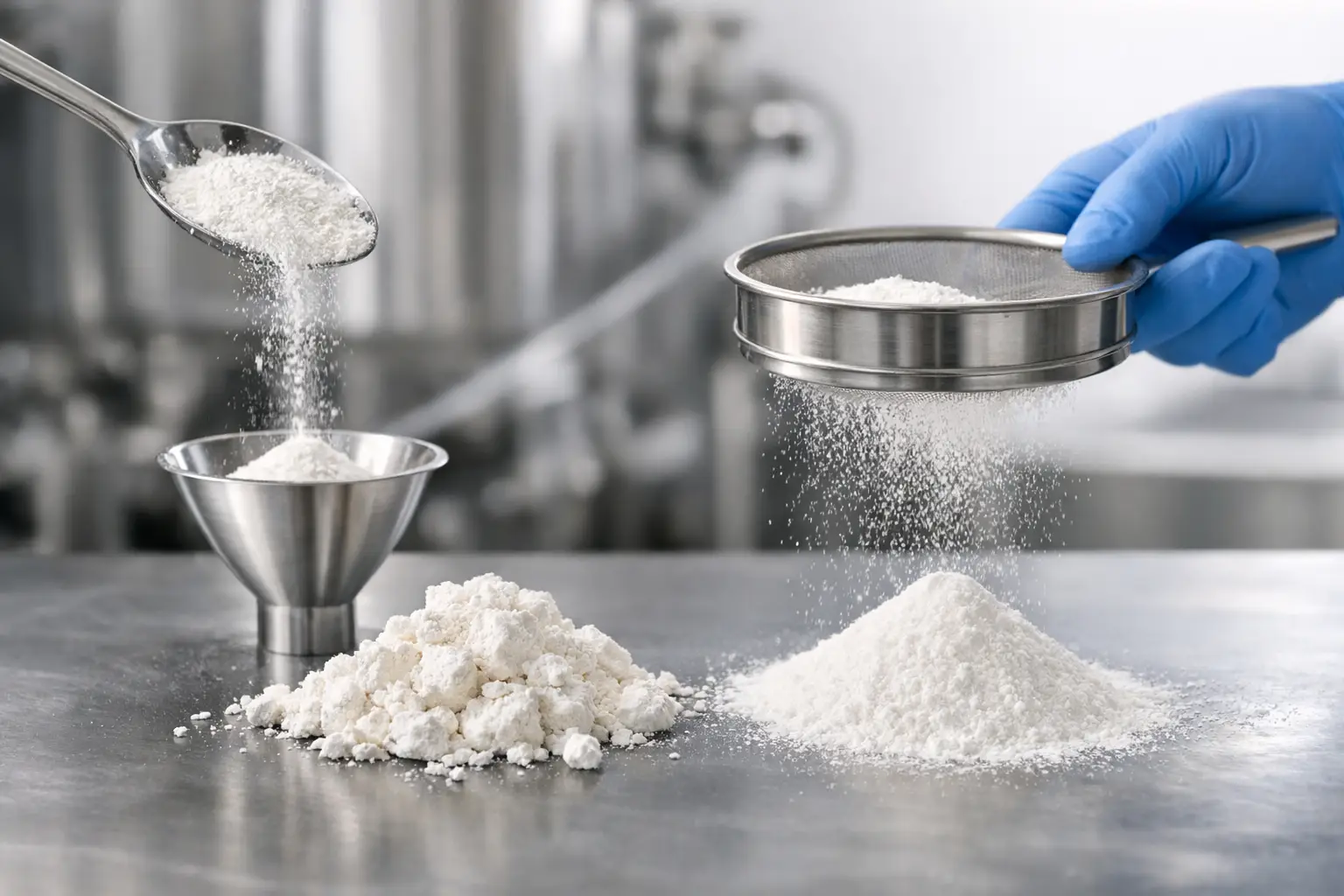
The output of a size reduction process is usually measured using particle size analysis methods suited to the material and the target specification. Depending on the application, that may involve sieve analysis, laser diffraction or other analytical techniques. The chosen method should reflect how the material is expected to perform in use, not just how it looks on a test report.
Control is equally important. A process that produces acceptable product in the laboratory may drift in production if feed conditions vary or equipment settings are not stable. Reliable size reduction therefore depends on repeatable operating windows, appropriate machine configuration and, where necessary, integrated classification.
For regulated industries, documentation, validation and cleanability are part of the engineering requirement. For high-throughput industrial environments, wear resistance, energy consumption and maintenance access become equally important. The right answer depends on the production context.
Choosing the right approach to particle size reduction
The most effective approach begins with the application, not the machine catalogue. Engineers need to understand what the finished powder must do, what the material characteristics are, and how the process must scale from development to production.
For some products, a simple impact mill may provide the best balance of cost and throughput. For others, only a jet mill or classifier mill will deliver the fineness and control required. In difficult applications, a complete system may be needed, combining feeding, milling, classification, conveying, dust management and mixing in one engineered line.
This is where technical partnership matters. A supplier that understands powder behaviour, scale-up and system integration can reduce risk significantly. For manufacturers working in performance-critical sectors, that can be the difference between a process that merely runs and one that consistently delivers commercial output within specification.
At DP Pulveriser UK, that engineering-led approach is central to how particle size reduction systems are developed – from laboratory trials through to full-scale production solutions.
What is particle size reduction really about?
At its core, particle size reduction is about control over material behaviour. It shapes how powders flow, blend, react, compress, disperse and perform in the real world. The mill is important, but the real objective is process consistency and product quality.
When the reduction method matches the material and the application, manufacturers gain more than a smaller particle. They gain a more stable process, higher throughput, improved uniformity and fewer compromises elsewhere in the line. That is usually where the real value sits.