DP Pulveriser UK - Innovating the Future of Size Reduction

A powder spill at a transfer point is rarely just a housekeeping issue. It can indicate poor containment, expose operators to hazardous dust, contaminate adjacent batches and, for combustible materials, contribute to an explosive atmosphere. A well-engineered powder handling safety guide therefore begins at the process line, not with a brush and shovel after material has escaped.
For manufacturers processing pharmaceuticals, food ingredients, chemicals, minerals, pigments or battery materials, safe handling depends on understanding the material and designing every interface around it. Milling, sieving, blending, conveying, filling and discharge must operate as one controlled system. The objective is to protect people and product while maintaining throughput, cleanability and repeatable process performance.
Start with the powder, not the equipment
Powders vary substantially in behaviour. Particle size distribution, moisture content, bulk density, flowability, abrasiveness, electrostatic charge and toxicity all influence the level and type of control required. A fine, dry powder may become airborne readily; a cohesive powder may bridge in a hopper and prompt unsafe manual intervention; an abrasive mineral can erode bends and seals until containment is compromised.
Before selecting or modifying equipment, establish a documented material profile. This should include the safety data sheet, occupational exposure limits where applicable, dust explosibility data, minimum ignition energy, particle size, moisture range and temperature sensitivity. Where the powder is new, blended, recycled or subject to a change in upstream process conditions, testing may be necessary. Assumptions based on a similar material can produce an unsafe design.
Combustible dust assessments should consider the credible worst case. Milling often creates a finer fraction than incoming material, increasing surface area and potentially changing ignition sensitivity. A process that is safe for coarse feedstock may require different safeguards after size reduction or classification.
Control dust at every transfer point
The most reliable way to protect operators is to prevent dust becoming airborne. Local extraction is valuable, but it should support good containment rather than compensate for poorly designed connections, damaged seals or unsuitable filling arrangements.
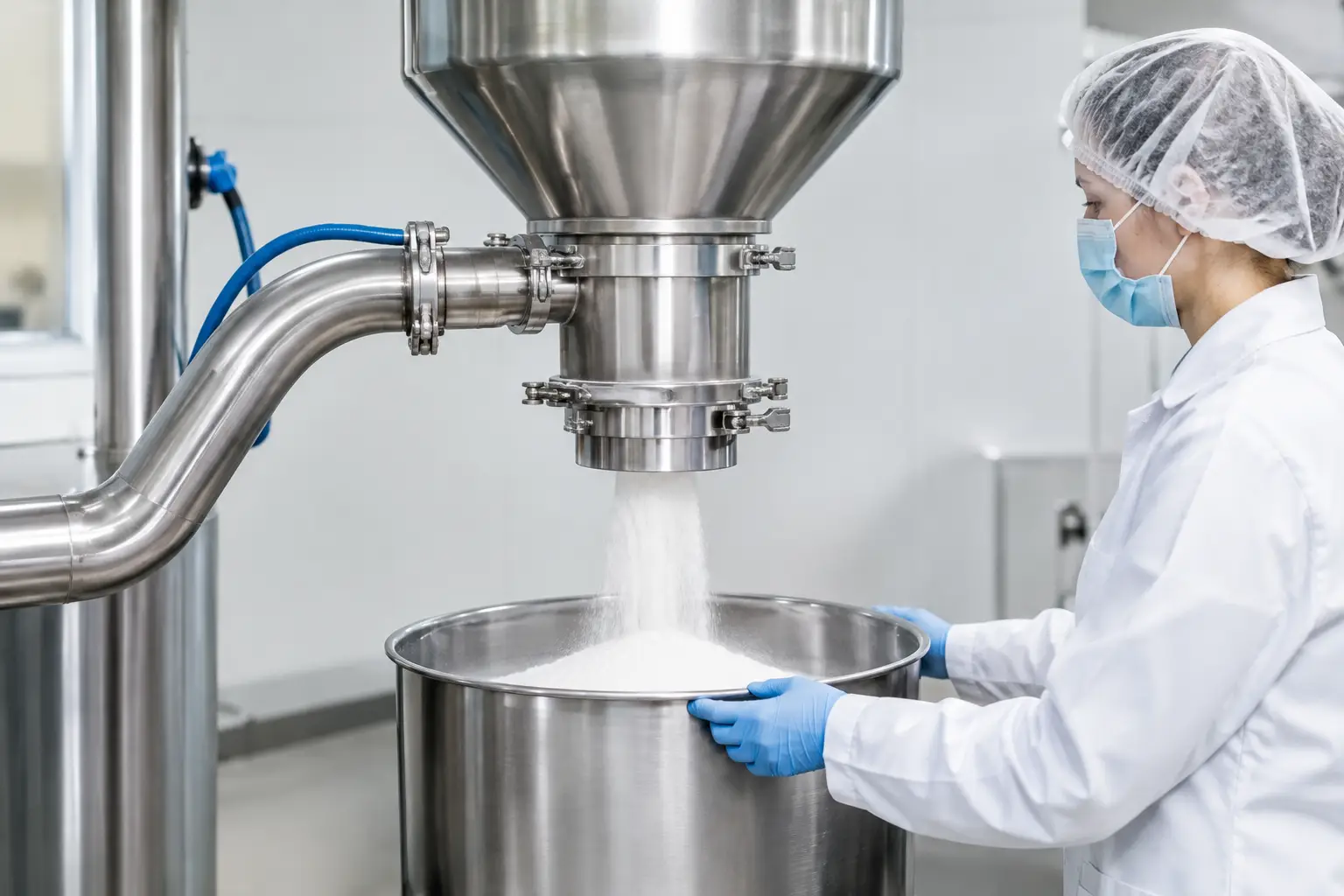
Enclosed conveying routes, sealed chute connections, correctly specified flexible connectors and controlled bag-emptying stations reduce dust release at source. Hopper and vessel vent filters must be sized for the displaced air during filling and for the duty cycle, then maintained so that blinding does not increase pressure or force dust through weak points. Capture velocity alone is not a measure of success: visible dust at an operator position, residue around flanges and filter differential pressure provide more meaningful operating evidence.
The level of containment must reflect the material hazard. For nuisance dust, an enclosed transfer with effective extraction may be sufficient. Potent pharmaceutical ingredients, sensitising substances and materials with low exposure limits may require higher-containment charging, split butterfly valves, isolators or glovebox arrangements. The trade-off is clear: higher containment adds capital cost and operational complexity, but it can reduce exposure risk, cleaning burden and costly cross-contamination.
Avoid unsafe manual recovery
Operators should not need to strike hoppers, open access doors during operation or reach into equipment to restore flow. These actions introduce exposure, mechanical and ignition hazards. Where poor flow is predictable, engineer the solution through hopper geometry, agitation, vibration, mass-flow design, appropriate discharge aids or controlled feeder selection.
Similarly, powders should never be cleaned with compressed air. It disperses dust into the workplace and may create or extend a combustible cloud. Use appropriately rated industrial vacuum equipment and written cleaning methods that account for the powder’s hazard classification.
Manage combustible dust as a process hazard
Where a dust can form an explosive atmosphere, UK operations must assess the risk under DSEAR and apply suitable controls. The assessment needs to examine how a dust cloud could form, where it may accumulate, credible ignition sources and the consequences of an event. It must cover the whole line, including mills, classifiers, dust collectors, filters, elevators, bins, conveyors and filling stations.
Ignition sources are not limited to open flames. Mechanical friction, overheated bearings, impact sparks, electrical equipment, hot surfaces, electrostatic discharge and smouldering material can all be relevant. Preventative maintenance is therefore a safety control, not merely an availability activity. Bearing condition, belt tracking, rotor clearances, product build-up and abnormal vibration require defined inspection intervals and clear escalation limits.
For equipment within classified hazardous areas, electrical and mechanical equipment selection must be appropriate for the zone and dust characteristics. Earthing and bonding should be continuous across conductive equipment, flexible hoses, containers and mobile transfer equipment where static charge can arise. Verification should be part of commissioning and periodic inspection, rather than assumed because a cable is visible.
Prevention does not eliminate the need to consider protection. Depending on the process and explosion assessment, suitable measures may include explosion venting to a safe location, flameless venting, suppression, containment and isolation systems. Dust collectors deserve particular attention because they concentrate fine material and are often connected directly to process equipment. A protection measure installed on one vessel may be ineffective if flame or pressure can propagate through ductwork into connected equipment.
Design equipment for safe, repeatable operation
A production line is safest when normal operation is straightforward. Clear access for inspection, tool-free or controlled access where appropriate, adequate lighting and ergonomically positioned controls reduce the incentive for improvised workarounds. Equipment should be designed around how operators actually charge, sample, clean, inspect and discharge it.
Interlocks and permissives must reflect genuine hazards. A mill should not run when extraction is unavailable if the process relies on it for containment. A rotary valve may require confirmation of downstream availability. Access doors need suitable guarding and isolation arrangements before they can be opened. However, excessive or poorly understood alarms can encourage bypassing. Each control should have a defined purpose, a tested failure response and a practical reset procedure.
For integrated systems, control logic should consider upstream and downstream equipment rather than treating each machine in isolation. A blocked filter, stopped screw conveyor or full receiving hopper can quickly create unsafe pressure, spillage or mechanical loading elsewhere in the line. Instrumentation for pressure, temperature, filter differential pressure, motor load, level and vibration can identify developing faults before operators are exposed to a hazardous intervention.
Build safety into cleaning and changeover
Cleaning is often where containment standards decline. Powder retained in dead legs, poorly accessible ducting, flexible connections and filter housings can affect both worker exposure and batch integrity. Hygienic applications also require materials, weld finishes and equipment geometry that support validated cleaning where required.
Define whether the process uses dry cleaning, vacuum cleaning, wet cleaning or a combination. The correct method depends on product chemistry, water sensitivity, microbiological requirements and explosion risk. Introducing water can control airborne dust, but it may create caking, corrosion, effluent issues or a cleaning validation challenge. Dry methods avoid those concerns but demand effective extraction and disciplined residue removal.
Changeover procedures should identify all retention points, including feeders, classifier wheels, transfer lines, gaskets, filters and collection vessels. Visual inspection alone may not be enough for high-value, potent or highly coloured products. Where cross-contamination is critical, equipment selection should favour accessible product contact areas and minimise crevices from the outset.
Make maintenance and isolation non-negotiable
Many serious incidents occur during fault-finding, cleaning or maintenance rather than normal production. A documented isolation procedure should cover electrical, pneumatic, hydraulic, mechanical, thermal and stored-energy sources. Lock-off and tag-out arrangements must be specific to the asset and verified before work begins.
Maintenance teams also need to understand the process hazard. Opening a filter housing, replacing a flexible connector or entering a hopper can release accumulated powder or expose personnel to confined-space and engulfment risks. Permit-to-work controls, competent supervision and suitable respiratory protective equipment should be determined by the task and exposure assessment, not issued as a default substitute for containment.
Use operating data to improve the system
Safety performance should be reviewed alongside production performance. Repeated filter alarms, increased cleaning hours, unexplained product loss, frequent seal replacement and operator reports of dust are useful indicators of a design or maintenance problem. Treating them as isolated minor issues allows risk to accumulate.
A structured management-of-change process is equally essential. Changes to product grade, milling speed, throughput, filter media, conveying air volume or packaging format can alter dust generation and containment performance. Reassess the implications before the change reaches routine production, particularly where particle size reduction or higher output is planned.
DP Pulverizer UK approaches powder processing as an integrated engineering task: material behaviour, equipment duty, containment, control and maintainability must be aligned. The best safety outcome is not achieved by adding controls after installation. It is achieved when the line is engineered so that safe operation is also the most efficient way to run it.