DP Pulveriser UK - Innovating the Future of Size Reduction
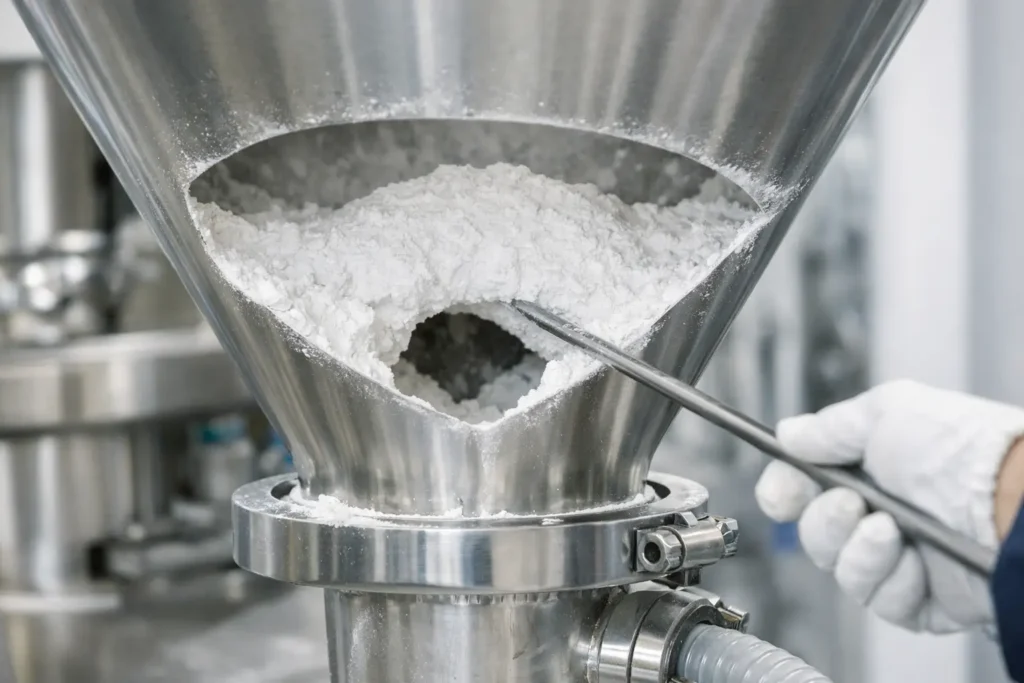
A hopper can appear full while the feeder beneath it is starved of material. That disconnect is often the first operational sign of powder bridging. Understanding powder bridging causes is essential where output consistency, batch accuracy and controlled particle handling directly affect product quality, plant availability and operating cost.
Bridging is not simply a hopper problem. It is the result of an interaction between the powder’s physical properties, its condition at the time of processing, the vessel geometry and the way material is withdrawn. Treating it with a larger vibrator or more aggressive agitation may restore flow temporarily, but it can also compact product, create segregation or damage fragile particles. The most reliable solution begins with a proper assessment of the whole process.
What powder bridging looks like in production
Powder bridging occurs when material forms a stable arch or dome across the outlet of a hopper, bin, IBC or feed chute. The structure supports the weight of powder above it, preventing normal discharge. Depending on the powder and equipment, the bridge may be intermittent, collapse without warning, or remain in place until an operator intervenes.
This should be distinguished from ratholing. In a rathole, material flows through a narrow channel above the outlet while stagnant powder remains around the vessel walls. Both conditions reduce usable hopper capacity and destabilise downstream feeding, but their root causes and design remedies can differ.
For a milling, classification or mixing line, unstable hopper discharge can lead to fluctuating feed rates. The consequences include inconsistent mill loading, wider particle size distribution, reduced classifier efficiency, poor blend uniformity and unplanned production stoppages. In regulated sectors, repeated manual intervention can also introduce hygiene, traceability and safety concerns.
The main powder bridging causes
Cohesive forces between particles
Fine powders tend to be more cohesive than coarse, free-flowing granules. As particle size falls, the influence of van der Waals forces, electrostatic attraction and liquid bridges becomes more significant relative to particle weight. This is why a material that flows acceptably as a coarse feedstock may bridge after fine grinding or air classification.
Particle shape matters as well. Irregular, fibrous, plate-like or highly angular particles can interlock more readily than rounded particles. Products with a broad particle size distribution may also pack densely, as fine particles fill the voids between larger ones. The resulting bed can have high shear strength even where its average moisture content appears low.
Moisture uptake and humidity variation
Moisture is one of the most common triggers for bridging. Hygroscopic materials can absorb water during storage, transfer or processing, creating liquid bridges at particle contact points. Small changes in ambient humidity may be enough to turn a marginally free-flowing powder into a cohesive one.
The problem is often more pronounced after a shutdown. Powder held in a hopper overnight can cool, absorb moisture or experience condensation, especially where vessel surfaces are colder than the surrounding air. Some food ingredients, salts, mineral powders, detergents and pharmaceutical excipients are particularly sensitive to this effect.
Material temperature should be considered alongside humidity. Warm powder entering a cooler vessel may create local condensation. Conversely, elevated temperature can increase tackiness in materials containing fats, waxes, polymers or low-melting components. Drying, insulated storage, controlled air handling and appropriate product conditioning can all be more effective than relying on mechanical flow aids alone.
Hopper geometry and outlet design
A powder that flows reliably from one hopper may bridge in another because vessel geometry directly governs wall friction, stress distribution and outlet flow pattern. Shallow hopper angles, abrupt transitions, narrow outlets, ledges, weld lips and poorly designed valve interfaces can all provide conditions for stable arches to form.
The outlet must be sized for the powder’s measured flow behaviour, not selected from a generic rule of thumb. Cohesive powders may require a significantly larger opening than expected. The hopper wall angle must also be steep enough for the product’s wall friction characteristics, taking account of the actual construction material and surface finish.
A polished stainless-steel surface is not automatically the best answer. Some powders adhere differently to polished, blasted, coated or worn surfaces, and friction can change over time as residues build up. Equipment design should therefore be validated using representative material, including realistic moisture level, bulk density and particle size distribution.
Compaction, storage time and head pressure
Powders change while they are held under load. The longer a material remains in a vessel, the more likely it is to consolidate, particularly if it is fine, compressible or moisture-sensitive. High head pressure can strengthen a bridge near the outlet, while vibration during transport or nearby equipment operation can densify the material further.
This is a frequent issue in production lines that run in campaigns. A hopper may perform adequately during continuous filling and discharge, then bridge after several hours of static storage. Batch scheduling, refill strategy and vessel sizing should be evaluated as part of the solution. Bigger storage capacity is not always beneficial if it increases residence time and consolidation.
Electrostatic charge and environmental conditions
Dry powder conveyed through pipes, flexible connections or filters can accumulate electrostatic charge. Charge may increase particle adhesion to vessel walls and contribute to agglomeration, particularly with fine organic powders, pigments and polymer materials. It can also introduce a serious dust ignition risk where the powder is combustible.
Effective earthing and bonding are fundamental, but they do not replace a full dust hazard assessment. Relative humidity, conveying velocity, filter performance and the choice of contact materials can all affect charge generation. Where electrostatics are suspected, the issue should be investigated alongside product flow testing and ATEX requirements.
Diagnosing the cause before selecting a remedy
The fastest route to repeatable flow is to avoid assuming that every blockage has the same cause. Operators can provide useful evidence: whether bridging occurs at start-up, after a refill, only on humid days, or only with a particular product lot. However, a lasting engineering decision should be supported by material characterisation.
Relevant testing may include bulk density, moisture content, particle size distribution, compressibility, wall friction and shear-cell flow properties. These results indicate how the powder behaves under consolidation and help determine the required outlet dimension and hopper angle. Testing should use material that reflects normal production conditions rather than an ideal laboratory sample.
It is also necessary to inspect the complete path from discharge vessel to process equipment. A hopper can be correctly designed yet still experience restricted flow because of a small rotary valve, an overfilled screw feeder, a restrictive flexible sleeve or pressure imbalance across a filter. In pneumatic systems, excessive vacuum or pressure variation can further alter how material discharges.
Engineering measures that improve flow
The preferred approach is to design for mass flow where practical. In mass flow, all material moves when product is withdrawn, reducing stagnant zones, segregation and prolonged residence time. This typically requires a hopper profile and outlet engineered around the specific powder rather than a standard cone section.
Where geometry alone is insufficient, flow aids can be selected carefully. External vibrators, pneumatic knockers, air pads, fluidisation systems, agitators and live-bottom feeders each have a place, but they are not interchangeable. Vibration can work well for some granular products, yet it may compact cohesive fine powder. Air injection can promote flow in suitable materials, but uncontrolled aeration may cause flushing, dust release or unstable feeder performance.
For demanding powders, an integrated discharge system often provides the best control. A suitably designed hopper paired with a variable-speed screw feeder, agitator or live-bottom arrangement can maintain controlled extraction without relying on manual intervention. The feeder must still be matched to the material. Screw geometry, agitation intensity, hopper interface and control logic all influence whether the system delivers stable mass flow.
Upstream processing may also need adjustment. Milling conditions affect particle shape, fines generation and temperature, all of which can affect flowability. Classification can remove excess fines, while mixing can distribute flow agents or reduce local moisture variation where formulation permits. In some applications, conditioning or deagglomeration immediately before feeding is preferable to long-term storage of a highly cohesive powder.
Preventing repeat failures during scale-up
A powder handling arrangement that works at laboratory scale may not perform the same way at production scale. Changes in hopper diameter, fill height, residence time and throughput alter the stresses acting on the powder. Scale-up should therefore include representative trials, preferably using the intended feed system and production-relevant quantities of material.
For new lines and process upgrades, the strongest outcome comes from treating milling, conveying, storage, dosing and dust collection as one connected system. DP Pulverizer UK applies this application-led approach to powder processing equipment and turnkey lines, helping manufacturers align particle size control with dependable material handling.
The practical objective is not merely to clear the next bridge. It is to establish a process in which powder behaviour is understood, equipment is engineered around it and production can run at its intended rate with confidence.