DP Pulveriser UK - Innovating the Future of Size Reduction
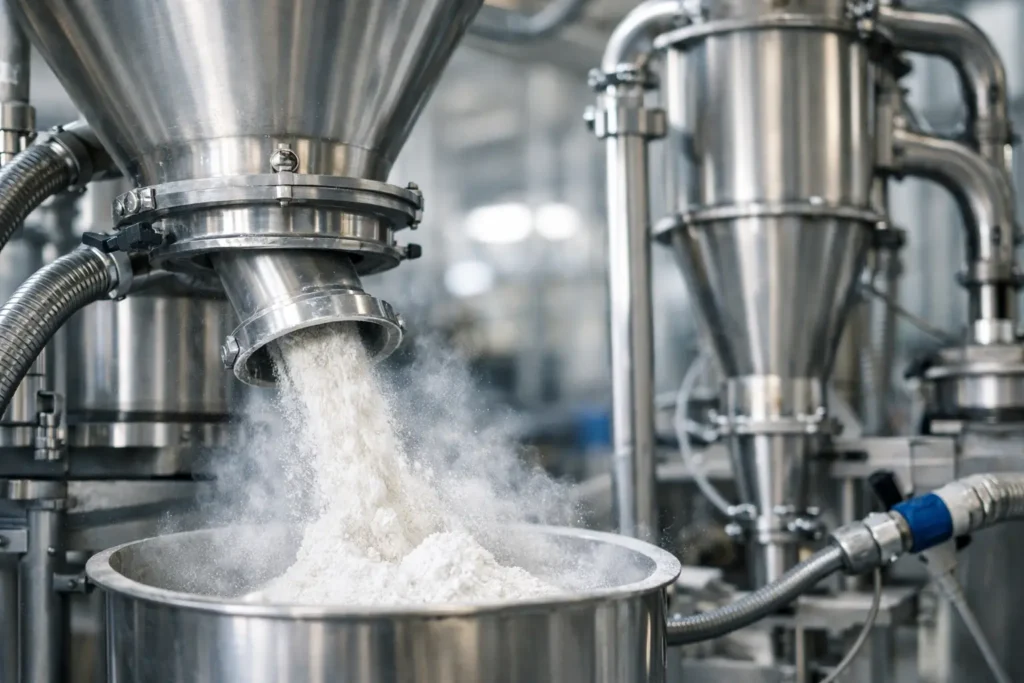
A conveying line can be the point at which a well-controlled milling or mixing process loses consistency. Poorly matched conveying velocity, an unsuitable feeder or an overlooked bend can cause segregation, product build-up, excessive fines and unplanned stoppages. Effective powder conveying system design treats transfer as a controlled process step, not simply a way to move material between machines.
For manufacturers handling pharmaceuticals, food ingredients, chemicals, minerals, battery materials or pigments, the right system must protect particle size distribution, maintain hygiene or containment, and deliver the required production rate with predictable energy use. The correct answer is rarely a standard conveyor. It is an engineered arrangement based on the powder, the duty and the operating environment.
Start with the powder, not the pipework
The same nominal particle size can behave very differently in a conveying line. A free-flowing granule may transfer reliably at low velocity, while a fine, aerated or cohesive powder may bridge in a hopper, adhere to pipe walls or compact at the receiver. Design data therefore needs to go beyond bulk density on a material data sheet.
A practical assessment considers particle size distribution, shape, true and bulk density, moisture sensitivity, abrasiveness, temperature, electrostatic behaviour and dust explosibility. Flow properties matter equally: the angle of repose, permeability, compressibility and tendency to cake or agglomerate influence feeder selection, air requirements and vessel geometry.
Material behaviour can also change after milling. A jet-milled powder, for example, may be finer, more aerated and more prone to segregation than the incoming feed. A conveying system must be specified for the material at its actual transfer point, including realistic variations in moisture, lot quality and operating temperature.
Define the duty before selecting a conveying method
Conveying technology follows the production requirement. The key questions are how much material must move, over what distance and lift, between which process stages, and at what level of containment. Batch transfer and continuous transfer demand different control strategies. So do frequent product changes and a single-material, high-throughput line.
Mechanical conveying can be highly effective over short, accessible routes where gentle handling or simple metering is required. Screw conveyors, flexible screws and belt systems are familiar options, but must be assessed for product degradation, residue retention and cleaning access. They are not automatically suitable for abrasive materials, high-purity applications or routes with multiple changes in direction.
Pneumatic conveying is often preferred where enclosed transfer, flexible routing and dust control are priorities. It can connect mills, classifiers, mixers, storage vessels and packing equipment while reducing manual handling. The trade-off is that air conveying must be accurately engineered. Excess velocity raises energy consumption, pipe wear and particle attrition; insufficient velocity increases the risk of line blockage and unstable flow.
Vacuum conveying is particularly valuable for contained charging, hygienic applications and shorter transfers. Pressure conveying may suit longer distances, higher capacities or discharge into multiple destinations. The required choice depends on product sensitivity, route geometry, throughput and the degree of process isolation required.
Selecting dilute phase or dense phase transfer
In dilute-phase pneumatic conveying, material remains suspended in a relatively high-velocity air stream. This approach can be appropriate for non-fragile, free-flowing powders and granules, especially where line lengths are moderate and consistent transfer is required. It is a proven option, but not always the most economical or product-protective solution.
Dense-phase conveying moves material at lower gas velocity, often in plugs or dunes. It can reduce particle damage, pipe erosion and air consumption for suitable products. This makes it attractive for fragile granules, abrasive powders and applications where material degradation would compromise quality.
Dense phase is not a universal upgrade. Cohesive materials may form unstable plugs, and poor control of pressure, air injection or receiver discharge can create stoppages. It also requires appropriate pressure-rated components and a control philosophy designed around the material. Testing is often the most reliable way to establish whether dense-phase transfer will produce the expected benefits.
Engineer the complete powder conveying system design
The pipe is only one component of a conveying system. Reliable operation depends on the relationship between intake, feeder, air mover, pipeline, bends, receiver, filters, discharge device and controls. A weakness at any one point can limit the performance of the entire line.
Feed control is especially significant. Rotary valves, screw feeders, venturi pick-up points and vacuum receivers each introduce material differently into the air stream. An inconsistent feed rate causes pressure fluctuations and uneven loading, which can lead to surging, blockages or poor separation at the receiving vessel. For materials prone to bridging or ratholing, hopper design and flow aids must be evaluated alongside the feeder rather than added after commissioning.
Pipeline diameter and conveying velocity should be calculated for the material and duty, with allowance for start-up, stop-start operation and reasonable process variation. A line designed solely around its nominal throughput may be unstable when rates are reduced. The layout also matters. Long horizontal sections, unnecessary vertical lifts and tight-radius bends each add pressure loss and wear risk.
Bends require particular attention when handling abrasive powders or materials sensitive to impact. Long-radius bends can reduce attrition and pressure loss. Wear-resistant bends or replaceable sections may reduce maintenance costs in mineral, metal or ceramic applications. The lowest purchase price is seldom the lowest lifetime cost if bends require frequent replacement or cause repeated production interruptions.
Receiving, filtration and discharge
At the receiving end, the vessel must separate product from conveying air without becoming a restriction. Filter area, media selection and cleaning method need to match the air volume and dust characteristics. Fine powders may blind filters; sticky products may require a different cleaning arrangement or operating sequence.
Receiver discharge is another common source of instability. The vessel should empty completely and consistently before the next transfer cycle where batch integrity matters. Cone angle, surface finish, agitators, vibration and valve selection must support mass flow where necessary. A poorly discharging receiver can negate the benefits of a well-designed pipeline.
Containment, hygiene and safety are design inputs
In regulated and high-value applications, containment cannot be treated as an accessory. Transfer points, filter change procedures, sampling arrangements and discharge connections must be considered from the outset. Closed charging and controlled decanting reduce operator exposure, airborne dust and cross-contamination risk.
For food, nutraceutical and pharmaceutical production, cleanability affects both compliance and productive time. Material-contact finishes, gasket selection, dead-leg avoidance and access for inspection should be defined according to the cleaning method and validation requirements. A system designed for dry cleaning may need a different construction from one intended for wet cleaning or clean-in-place operation.
Many organic powders, metals and chemical products also present a combustible dust hazard. Where applicable, the system design must account for dust hazard assessment findings, zoning, earthing and bonding, explosion protection, pressure relief and isolation. Equipment selection should support the site’s wider safety strategy rather than addressing each item in isolation.
Design for control, maintenance and scale-up
A conveying system should provide useful operating information, not just an on-off function. Pressure measurement at key points can indicate developing restrictions, unstable feed or filter loading. Level detection, load cells and recipe-controlled transfer sequences improve batch repeatability and prevent overfilling. For multi-product plants, controls should support validated changeover procedures and clear operator guidance.
Maintainability deserves the same attention as capacity. Filters, seals, rotary valves and wear bends are service items. They should be accessible without unnecessary dismantling or prolonged entry into restricted areas. Spare parts commonality and sensible isolation arrangements reduce downtime over the life of the plant.
Scale-up from laboratory or pilot processing requires care. A powder that conveys well at a few kilograms per hour can behave differently at production scale because of longer lines, larger receivers, higher air volumes and more demanding feeder duties. Process trials with representative material provide a stronger basis for equipment selection than assumptions based on a small sample or generic powder category.
DP Pulveriser UK can integrate conveying with milling, classification, mixing and collection equipment, allowing the transfer system to be engineered around the complete process rather than attached to it afterwards. This approach helps protect product quality from feed through to final discharge.
The most dependable conveying lines are those designed around real material behaviour and real production conditions. Establish the duty, test the difficult powder characteristics and specify each interface with the same care as the mill or mixer. The result is more consistent flow, cleaner operation and a processing line that remains productive when demand increases.