DP Pulveriser UK - Innovating the Future of Size Reduction
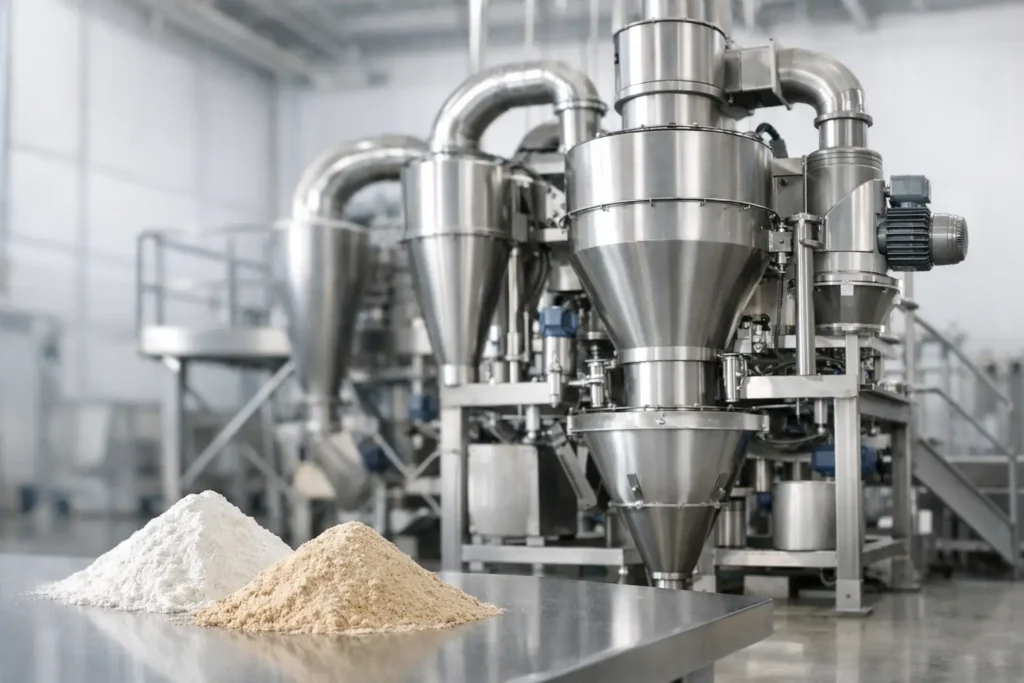
A classifier that produces the correct laboratory cut point but cannot hold it across a production shift is not the right classifier. In demanding powder operations, particle size control affects downstream flow, dissolution, coating performance, packing density, reactivity and final product consistency. This air classifier selection guide focuses on the engineering decisions that determine whether a system performs reliably at plant scale.
Start with the separation duty
An air classifier separates a feed material into fine and coarse fractions using a controlled air stream and centrifugal force. The fine fraction is carried with the air to a collection system, while particles with sufficient mass are rejected and returned or discharged as coarse material. The objective is rarely simply to make powder finer. It is to achieve a defined particle size distribution, at a specified throughput, with acceptable yield and operating cost.
The first decision is therefore the required separation duty. Define the target cut point, commonly expressed as d50, alongside the acceptable upper particle limit and the required proportion of fines. A d50 specification on its own is not enough. Two products can share the same median particle size yet behave very differently if one contains a significant coarse tail.
For example, a coating formulation may need a tightly controlled top size to avoid surface defects. A mineral filler may prioritise high recovery of a specified fine fraction. In battery materials, a narrow distribution may be required to support consistent electrode processing. The required classification result must be tied to the actual performance requirement of the finished product.
Establish the feed particle size distribution
Classifier performance is governed by the material presented to it. Feed that is already close to the desired cut point is generally easier to separate than feed containing a broad range of particle sizes or a high proportion of oversize particles. Obtain representative particle size data from the actual upstream process, not only from an isolated sample.
Consider normal feed variation as well as the average. Changes in mill screen condition, grinding energy, raw material source, moisture or bulk density can shift the feed distribution and alter the classifier result. If feed variability is substantial, the selected system needs sufficient adjustment range and control capability to maintain the required product specification.
Select the classifier principle for the process
The most suitable design depends on target fineness, material characteristics, capacity and how the classifier will connect to the wider process. Static classifiers have no rotating classifying wheel and are often suitable for coarser separations or applications where a simple, low-maintenance arrangement is appropriate. Their separation precision is more limited than dynamic systems.
Dynamic air classifiers use a high-speed rotor or classifying wheel to create a more defined separation zone. Rotor speed, airflow and feed rate can be adjusted to control the cut point. They are normally the stronger choice where tight control of fine powders is required, particularly in chemicals, pigments, mineral processing, food ingredients and specialist pharmaceutical applications.
An air classifier mill combines impact grinding and classification in one machine. Material remains in the milling chamber until it is sufficiently fine to pass through the classifier, which can reduce recirculation and simplify the process footprint. This arrangement is effective where milling and classification conditions need to work together, but it is not automatically preferable to a standalone classifier. Where a process already has a suitable mill, a separate classifier may provide greater flexibility, easier maintenance planning and clearer control of the separation stage.
Material properties determine the real operating window
Particle size is only one part of classifier selection. The material’s physical and chemical behaviour determines how consistently it will disperse, separate and convey.
Moisture is a frequent constraint. Slightly damp or hygroscopic powders can agglomerate, adhere to internal surfaces and reduce separation efficiency. A classifier may then appear to be producing a coarser cut than expected because fine particles are travelling as agglomerates. Drying, conditioned air, insulation or an alternative process arrangement may be required before the classification stage.
Particle shape and density also matter. Dense, rounded particles respond differently to the centrifugal field than low-density flakes, fibres or irregular particles. A cut point achieved with a dense mineral cannot be assumed for an organic powder at the same rotor speed and airflow. Cohesive materials may need carefully designed feed dispersion to prevent clumps entering the classifying zone.
For abrasive feeds, wear protection should be treated as a process-performance requirement, not an optional upgrade. Liner materials, rotor construction and wear-part access influence contamination risk, maintenance intervals and the ability to retain a stable cut over time. For potentially combustible dusts, the system must be assessed for dust explosion risks, suitable venting or suppression, earthing, containment and compliance with the applicable ATEX requirements.
Size capacity for sustained throughput, not headline output
A classifier should be selected against the required production rate at the specified cut point. Nominal capacity figures can be misleading because throughput falls as the target becomes finer, the feed becomes more difficult to disperse or the required top-size control tightens.
When comparing equipment, ask for performance data that reflects the target material and duty. The useful question is not, “What is the maximum tonnes per hour?” It is, “What tonnes per hour can be sustained while meeting this particle size specification, recovery target and product temperature limit?”
Allowance should also be made for production realities: filter cleaning cycles, changeovers, planned maintenance, feeder accuracy and variations in upstream supply. A unit operating close to its practical limit may meet capacity during a short trial but create an avoidable bottleneck in continuous production.
Examine the complete air and collection system
An air classifier is part of an integrated system. The fan, ducting, cyclone, filter receiver, rotary valve and conveying arrangement all influence separation performance. Inadequate airflow control or pressure instability can shift the cut point. Poorly sized collection equipment can increase pressure drop, reduce recovery or allow fines to build up in the system.
The air circuit must be designed around the material and environment. An open circuit is often appropriate where ambient air is acceptable. A closed-loop or inert gas system may be needed where oxygen control, solvent handling, moisture exclusion, temperature management or product protection is critical. Filter media selection must account for particle size, dust loading, cleanability and any requirements for hygienic or contained processing.
Build controllability and validation into the specification
For high-value or regulated powders, repeatability matters as much as peak performance. Specify the operating parameters that require measurement and control, including classifier wheel speed, airflow, feed rate, inlet and outlet pressure, temperature and product collection rate. The appropriate level of automation depends on the process, but the objective is consistent: maintain the classification conditions that produce the approved product.
A variable-speed classifier provides valuable operational range, yet adjustments must be understood in context. Increasing wheel speed generally produces a finer cut, but may reduce throughput or yield. Raising airflow can carry more fine material through the system, but excessive airflow may affect separation sharpness or increase filter loading. The best operating point is a balance, established through material trials rather than assumption.
Where traceability is required, consider recipe control, data logging, controlled access levels and documented cleaning procedures. Pharmaceutical, nutraceutical and food applications may also require polished contact surfaces, sanitary construction, rapid dismantling and validation-ready design. Chemical and battery-material plants may instead place greater emphasis on containment, inerting, wear resistance and prevention of cross-contamination.
Use trials to reduce scale-up risk
Material trials are the most reliable way to select an air classifier. A well-planned programme should test representative feed at realistic moisture levels and evaluate particle size distribution, yield, throughput, temperature, energy demand and any signs of coating, agglomeration or excessive wear.
Scale-up should not be based solely on geometric similarity. Air velocity, residence time, rotor tip speed, feed dispersion and collection efficiency must all be considered. If the process is moving from R&D to commercial production, test more than one operating point. This identifies the practical operating window and shows how the system will respond when feed properties vary.
The trial should also assess downstream behaviour. A fine fraction that meets laser diffraction data but bridges in a hopper, loads poorly into a blender or causes excessive dust during packing may not deliver the intended production benefit. Classification is successful when it improves the whole process, not merely the particle size report.
Specify for lifecycle performance
Purchase price is only one part of the decision. Energy use, wear-part replacement, cleaning time, access for maintenance, spares availability and operator workload all contribute to total cost of ownership. A lower-cost unit can become expensive if it requires frequent intervention to maintain product quality.
Ask how quickly the classifying wheel, liners and filter components can be inspected or replaced. Check whether the feed system can deliver a stable mass flow and whether the equipment can accommodate future capacity or product changes. For multi-product plants, changeover design and cleanability deserve the same attention as cut-point capability.
DP Pulveriser UK approaches classifier selection as an application-engineering exercise, combining laboratory and pilot evaluation with production-scale milling, classification, collection and powder handling systems. The right solution is the one that gives operators a controllable, maintainable route to the required product specification – shift after shift, not only under ideal trial conditions.