DP Pulveriser UK - Innovating the Future of Size Reduction
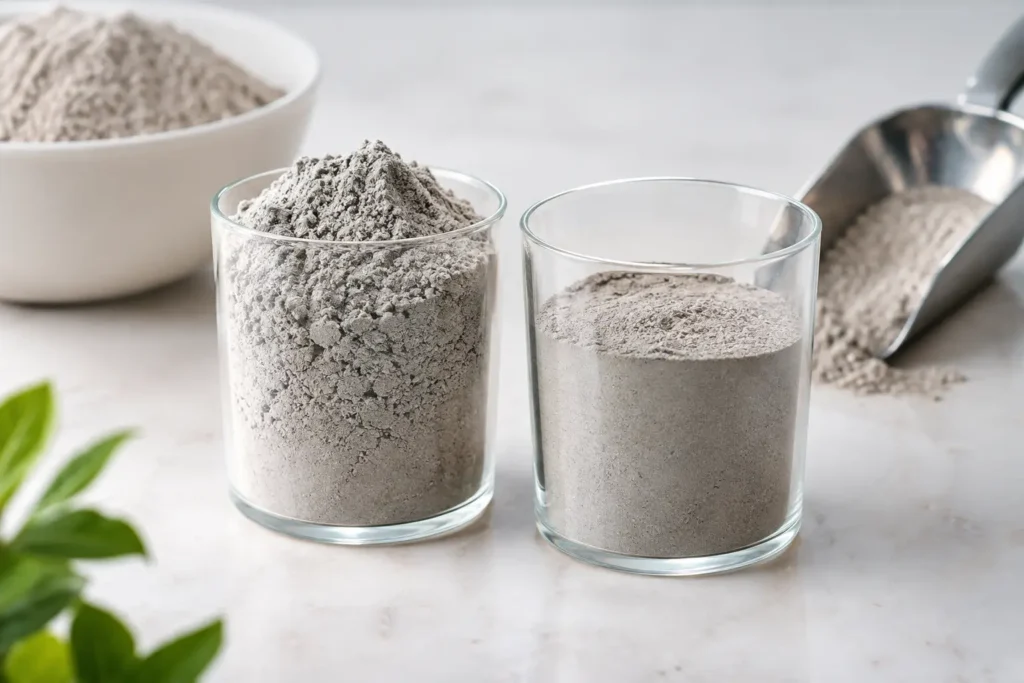
A powder that filled a container consistently last week can suddenly bridge in a hopper, underfill a pack or overload a conveying line. Bulk density changes are often treated as a material variability issue, but they are usually a process signal. They indicate that particle size, particle shape, moisture, air content or powder conditioning has moved outside the range assumed by the equipment and operating method.
For production teams, the consequence is not limited to a different kilogram-per-cubic-metre reading. Changes in bulk density affect feeder accuracy, storage capacity, pneumatic conveying behaviour, mixer performance, tablet compression, packaging weights and batch-to-batch consistency. Controlling them requires an understanding of both the powder and the complete processing line.
What bulk density measures
Bulk density is the mass of a powder divided by the volume it occupies, including the air spaces between particles. It is commonly measured after filling a defined vessel under a specified method. Tapped density uses controlled vibration or tapping to reduce void spaces, producing a more compact value.
The difference between loose and tapped density is often as informative as either figure alone. A wide difference suggests that the powder can rearrange and compact significantly during handling. This may be acceptable for a mineral filler loaded into bulk bags, but it can create substantial dosing variation in pharmaceutical, nutraceutical, food and battery-material applications.
Bulk density is not an intrinsic material constant in the same way as true particle density. A single powder can produce different readings depending on how it is milled, conveyed, discharged, sampled and measured. Specifications therefore need a defined test method, sample conditioning requirements and acceptance range rather than a single isolated target value.
Why bulk density changes during processing
Particle size distribution and fines content
Particle size reduction is one of the most direct drivers of bulk density. When coarse particles are reduced, they can pack more efficiently, increasing bulk density. However, the outcome is not always linear. Very fine particles may become cohesive, retain more air or form agglomerates, reducing their ability to settle and causing a lower loose bulk density.
The particle size distribution matters as much as the median particle size. A controlled proportion of fines can fill spaces between larger particles and improve packing. Too many fines can increase surface area, electrostatic effects and interparticle attraction. This is why a mill setting that delivers the correct d50 may still create a handling problem if it generates an unsuitable fine fraction.
Milling technology has a decisive role. Impact mills, pin mills, air classifier mills and jet mills each create different particle size distributions and particle morphologies. Classifier speed, airflow, rotor configuration, feed rate and grinding energy must be selected as a system, not adjusted independently.
Particle shape, surface texture and fracture behaviour
Spherical particles generally flow and pack differently from angular, flaky or fibrous particles. Milling can convert a relatively regular granule into irregular fracture fragments with higher friction and more mechanical interlocking. Conversely, some materials become rounded through repeated impacts or attrition, changing how they settle in storage and fill dies or containers.
Surface texture also affects the result. Rough particles trap air and resist movement more readily than smooth particles. For pigments, minerals, agricultural powders and food ingredients, a seemingly minor change in feedstock hardness or moisture can alter fracture behaviour and produce a different shape profile after milling.
Moisture, temperature and humidity
Many powders have a narrow moisture window for reliable flow. Low moisture can increase dustiness and static charge; excessive moisture can create liquid bridges between particles, encouraging agglomeration, caking and wall build-up. Either condition can alter apparent bulk density.
Temperature compounds the issue. Warm powder may carry through a mill or pneumatic transport system with a different moisture balance from material sampled at ambient conditions. Hygroscopic products can absorb moisture while waiting in a hopper, particularly where plant air, room humidity or cleaning practices are poorly controlled.
Cryogenic milling can be valuable where heat-sensitive, elastic or waxy materials smear or agglomerate under conventional milling. By controlling product temperature, it can protect particle definition and reduce the density variation associated with softening or inconsistent fracture.
Air entrainment and conveying history
A powder discharged from a high-velocity pneumatic conveying system can be highly aerated. Its loose bulk density may be lower immediately after discharge than after several minutes of settling. If a feeder, weigh hopper or packaging machine receives material before it de-aerates, fill weights and volumetric feed rates can fluctuate.
Vacuum conveying, pressure conveying, transfer distance, bend geometry, air velocity and discharge design all influence aeration. Excessive velocity can also create attrition, generating fines that further change packing behaviour. The correct solution is not automatically lower air velocity: some materials require sufficient transport energy to avoid line blockage. The design must balance transfer reliability against particle damage and density stability.
Production risks created by density variation
A volumetric screw feeder delivers volume, not mass. If bulk density falls by 15 per cent, the same screw speed can deliver materially less product. Loss-in-weight feeders can compensate through weighing, but density variation may still affect refill performance, screw selection and control response.
In packing operations, density instability changes the relationship between container volume and net weight. In blending, components with significantly different bulk densities can segregate during transfer, particularly if particle size and shape also differ. In tablet manufacture, variation can affect die fill; in coatings and pigments, it can influence dispersion consistency; in battery-material processing, it may affect downstream compaction and electrode preparation.
Storage equipment also has to be sized for the real operating density range. A silo designed around an optimistic high-density value may not hold a planned batch volume when the product is aerated. More critically, poor hopper geometry can promote ratholing or bridging in cohesive, low-density powders, leaving usable capacity unavailable.
How to investigate bulk density changes
The fastest route to a useful answer is to compare process history with properly conditioned samples. Do not rely solely on a sample taken from the floor of a bag or from a single point in a vessel. Sampling location and elapsed settling time can distort the result.
A structured investigation should examine four connected areas:
- Feedstock variation, including moisture, supplier lot, particle characteristics and storage duration.
- Milling performance, including screen or classifier condition, rotor speed, airflow, throughput and mill temperature.
- Transfer conditions, including conveying velocity, line layout, filters, discharge arrangement and de-aeration time.
- Measurement discipline, including test standard, fill method, vessel volume, sample conditioning and operator repeatability.
Pair bulk-density measurements with particle size analysis, moisture testing and, where relevant, tapped density, angle of repose or shear-cell testing. This prevents a misleading diagnosis. For example, a lower bulk density may result from finer particles, higher moisture, more entrained air or a combination of all three. The corrective action differs in each case.
Trend the data by batch, shift, equipment configuration and source material. A sudden step change after a maintenance intervention may point to worn classifier components, a damaged screen or an altered air setting. A gradual drift may indicate wear, filter loading, feedstock changes or seasonal humidity.
Engineering controls that stabilise bulk density
Consistency begins with a defined incoming-material specification and controlled storage. Where moisture is critical, establish limits at receipt and before processing, then provide suitable sealed handling, conditioning or drying. Material should be allowed to equilibrate where that reflects actual production conditions.
The milling stage should be developed around a validated operating window rather than one nominal speed or throughput figure. This window may include feed rate, grinding speed, classifier setting, airflow, temperature and target particle size distribution. Laboratory and pilot trials are particularly valuable when scaling a powder from development quantities to continuous industrial production, because conveying and residence time effects do not scale in a simple ratio.
Equipment downstream of the mill needs equal attention. A correctly designed hopper can provide mass flow and predictable refill behaviour; an unsuitable one can undo the benefits of precise particle size reduction. De-aeration hoppers, agitation, vibration or fluidisation may assist certain products, but each has trade-offs. Vibration may compact a powder too strongly, while excessive agitation can promote attrition or segregation.
Integrated processing lines allow these interfaces to be engineered together. At DP Pulverizer UK, milling, classification, mixing and powder handling systems can be configured around the material’s actual flow, density and throughput requirements rather than treated as separate purchases.
A stable bulk density is rarely achieved by changing one machine setting in isolation. It comes from controlling the path the powder takes – from feedstock condition and particle creation to transfer, settling and final dosing. When those conditions are designed around the product, density becomes a managed process variable rather than a recurring source of lost output.