DP Pulveriser UK - Innovating the Future of Size Reduction
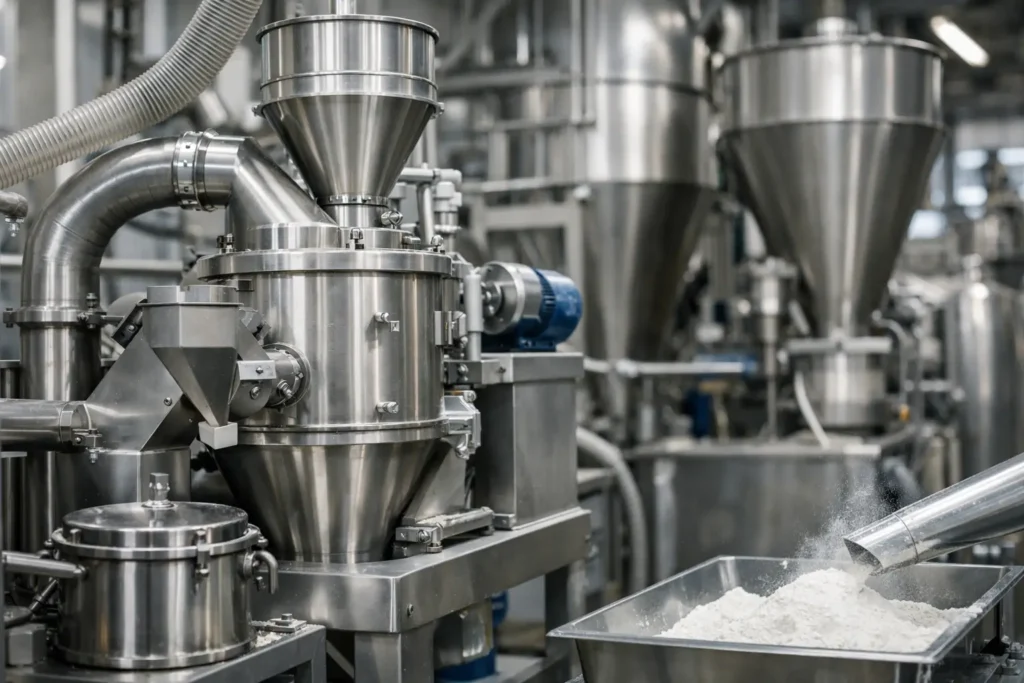
A powder that meets a nominal particle size specification can still fail in production. Oversize particles may affect dissolution, coating quality or tablet uniformity; excessive fines can impair flow, increase dust loading and reduce yield. This industrial micronisation equipment guide sets out how to select a system around the material, the target particle size distribution and the realities of commercial operation.
Micronisation is not simply finer milling. It is a controlled size-reduction process in which impact, attrition, compression or particle-to-particle collisions are matched to the feedstock. The right equipment must achieve the required median size and distribution without damaging the product, introducing contamination, creating an unsafe dust hazard or making the line uneconomic to operate.
Start with the required powder, not the mill
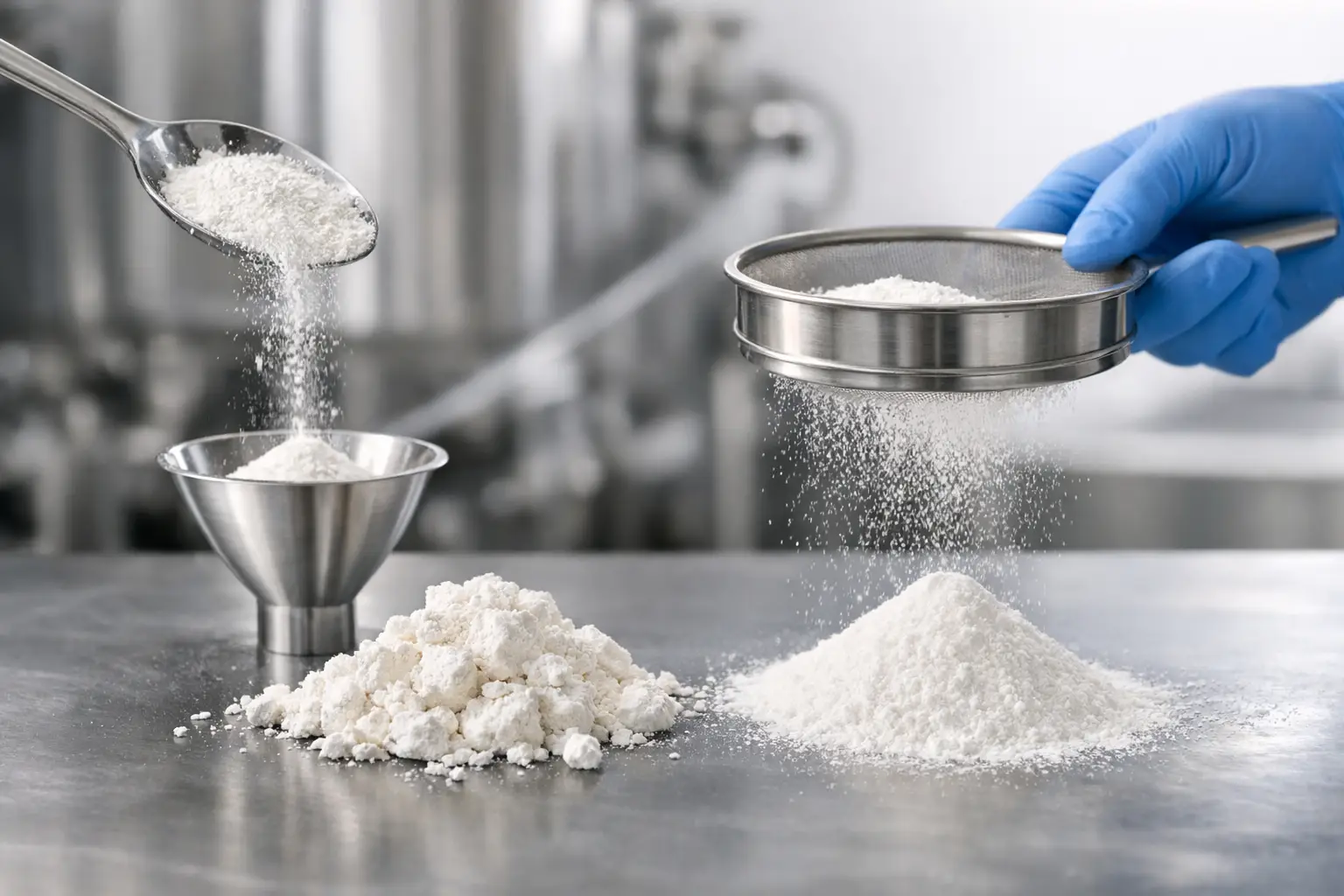
Equipment selection should begin with a clear product specification. A target such as D50 below 20 microns is useful, but it is not enough on its own. Process engineers should also define the permitted coarse fraction, fines content, moisture range, bulk density, flow behaviour, temperature limit and acceptable level of metal or wear contamination.
The product’s response to energy matters equally. A friable mineral may reduce efficiently in a mechanical mill, while a heat-sensitive active ingredient may soften, degrade or agglomerate under the same conditions. Some materials become more elastic as they get finer and resist further breakage. Others are abrasive enough to make wear protection, classifier selection and maintenance access decisive factors in the project.
Feed condition is often the hidden constraint. Lumpy, damp or poorly metered feed can limit an otherwise capable micronisation system. Upstream size reduction, drying, de-lumping, screening and controlled feeding should therefore be considered part of the processing solution rather than separate afterthoughts.
Industrial micronisation equipment guide: matching mill to duty
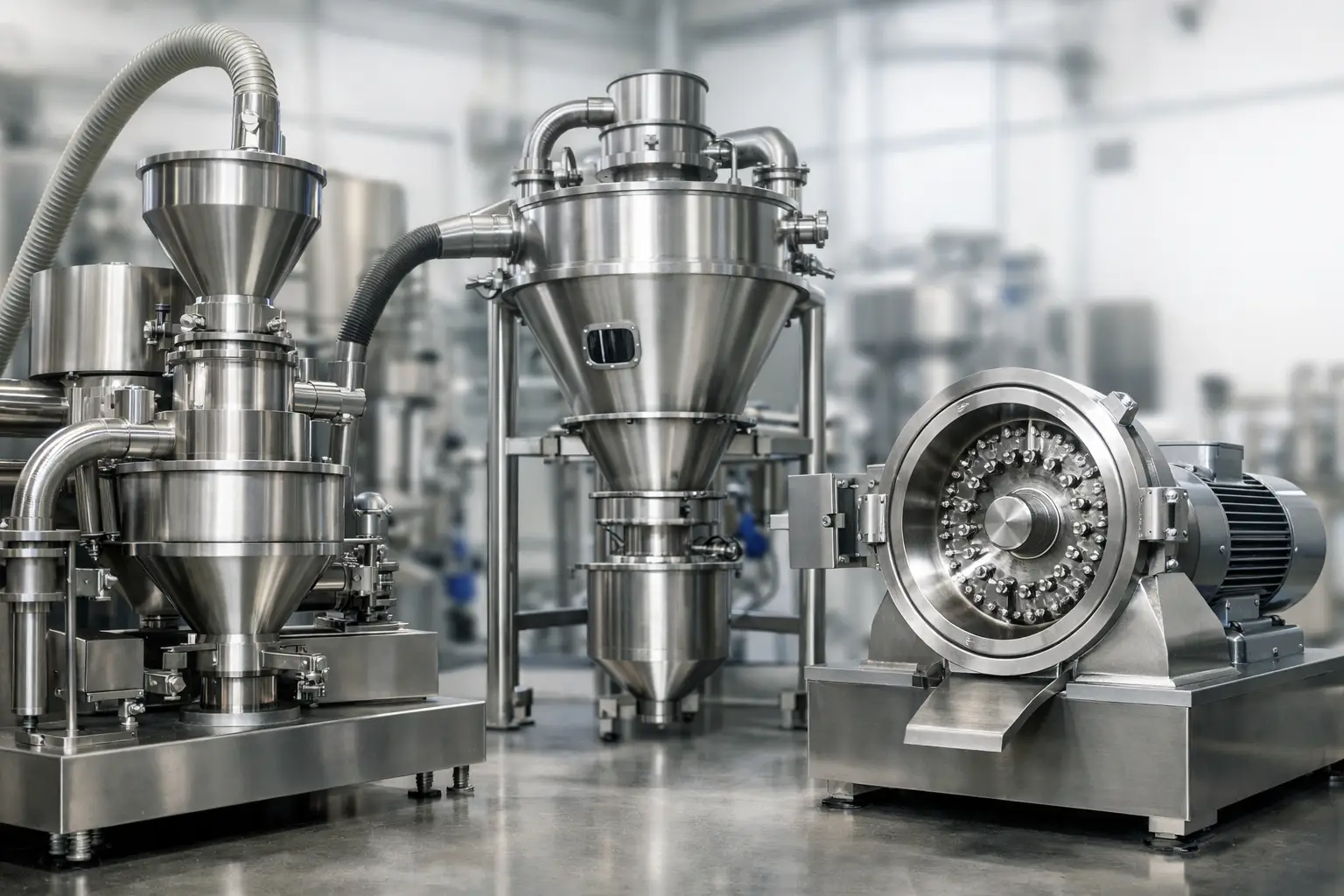
No single mill is best across every powder. The most suitable technology depends on the required cut point, material properties, capacity and containment requirement.
Jet mills for very fine, heat-sensitive products
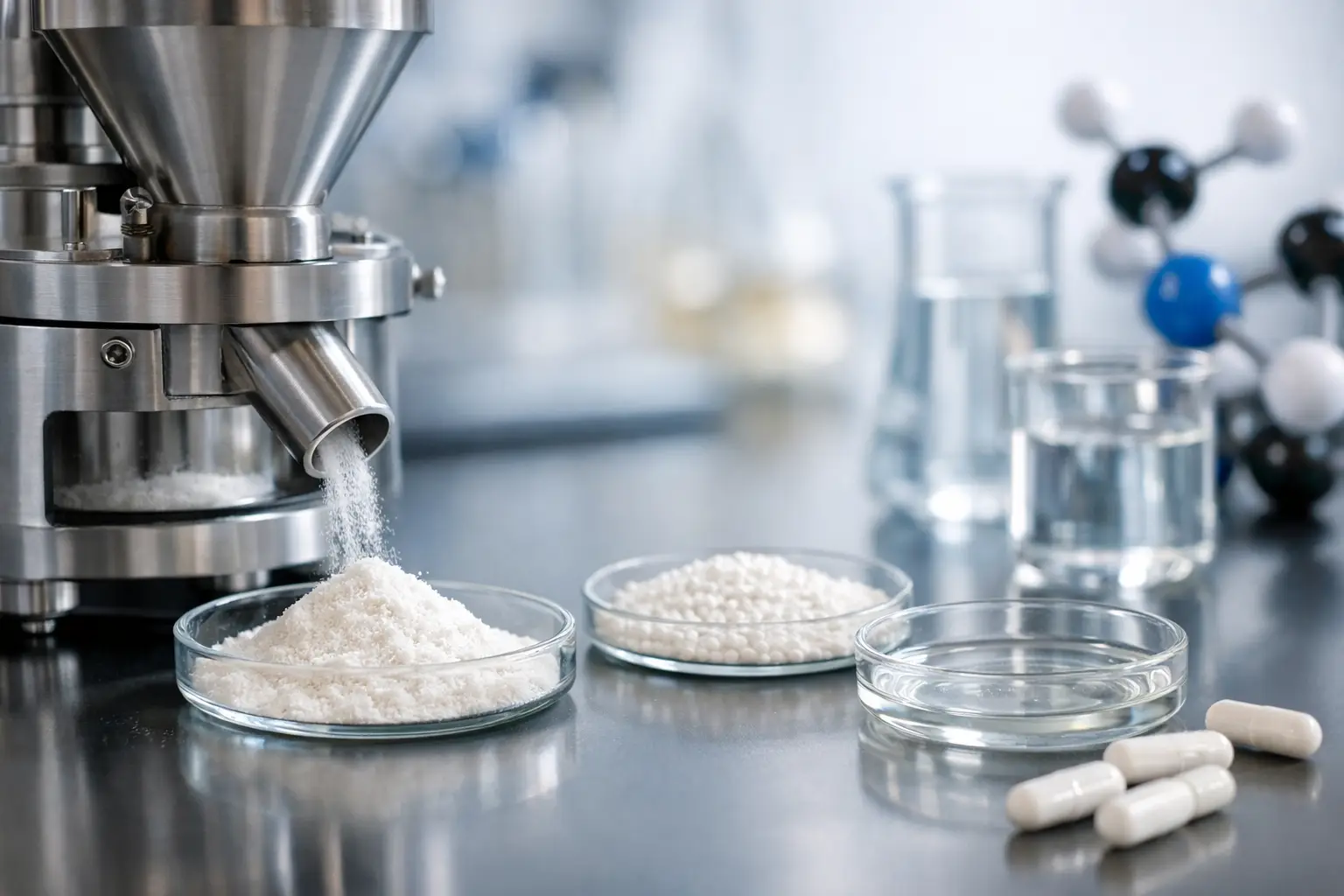
Jet mills use high-velocity compressed gas to accelerate particles into one another. With no conventional mechanical grinding media in the milling chamber, they are well suited to fine products where purity and low thermal exposure are priorities. Integrated dynamic classification enables control of the top size, making jet milling a strong option for pharmaceutical ingredients, pigments, specialty chemicals and high-value battery materials.
The trade-off is utility demand. Compressed air or inert gas consumption can be substantial, and the economic case must account for compressor capacity, gas drying, filtration and recovery where required. Jet mills also need stable, suitably prepared feed to deliver consistent results.
Air classifier mills for controlled fine grinding
An air classifier mill combines impact milling with an integral classifier wheel. Particles that are already fine enough leave with the product air stream, while oversize material remains in the grinding zone for further reduction. This makes the technology effective for many applications requiring a narrow distribution in the fine-to-micron range.
For chemical, food, mineral and powder coating duties, an air classifier mill can offer a practical balance between precision, throughput and operating cost. Classifier speed, airflow, rotor configuration and feed rate must be developed together. Raising classifier speed may reduce top size, for example, but can also reduce throughput and increase energy use.
Pin, turbo and universal mills for versatile fine milling
Pin mills use opposing rows of pins to create high-impact size reduction. They are widely applied to crystalline materials, dry food ingredients, polymers and chemicals where a clean, relatively narrow grind is needed. Turbo and universal mills offer flexible rotor and liner arrangements that can be configured for a broad range of friable materials.
These mechanical mills are often attractive where production needs flexibility across several products. However, product temperature, wear rate and the risk of excessive fines must be assessed during trials. For abrasive powders, engineered wear materials can significantly extend service intervals and protect product quality.
Cone and hammer mills for conditioning and pre-milling
Cone mills and hammer mills generally operate at coarser particle sizes than true micronisation equipment, but they frequently determine whether the downstream process runs reliably. They can de-lump compacted material, prepare a consistent feed for a fine mill, recycle oversize fractions or produce controlled granules for blending and conveying.
Using a pre-mill can improve fine-mill throughput by preventing large particles from consuming disproportionate energy in the main grinding stage. It may also reduce process interruptions caused by bridging at the feeder or unstable material flow.
Cryogenic milling for difficult materials
Cryogenic milling uses low temperatures, commonly generated with liquid nitrogen, to make heat-sensitive, soft, waxy or elastic materials more brittle. It is particularly relevant for spices, polymers, elastomers, nutraceutical ingredients and products with volatile components.
The method can preserve flavour, aroma and functional properties while enabling a finer grind than ambient processing would allow. Its additional cooling infrastructure and nitrogen consumption must be justified by product performance, yield or safety requirements. A cryogenic system is a process decision, not just an add-on to a conventional mill.
Classification is the control point
Many micronisation projects are limited less by grinding energy than by the ability to separate acceptable product from oversize particles. Air classification controls the upper end of the distribution and allows coarse material to remain in the milling circuit. In closed-loop operation, this prevents unnecessarily fine particles from receiving repeated energy input.
Classifier performance depends on airflow stability, wheel speed, feed loading, particle shape and density. A platy pigment, for example, does not classify in the same way as a spherical mineral powder of similar size. The design should therefore be verified using representative material, including realistic moisture and lot-to-lot variation.
Where a narrow distribution is critical, consider the whole circuit: mill, classifier, cyclone, filter receiver and conveying line. Poorly designed transfer points can cause segregation, build-up or attrition after classification, compromising a result that was correct at the mill outlet.
Build the process around containment, cleaning and safety
Fine powders expose weaknesses in plant design quickly. Dust escape affects operator safety, housekeeping, product recovery and regulatory compliance. For hazardous, potent or sensitising materials, containment performance must be specified at the outset, including charging, discharge, sampling, filter changes and cleaning activities.
Combustible dust risk also requires a formal assessment. Depending on the material and site classification, the system may require explosion venting, suppression, isolation, inerting, conductive components and correctly rated electrical equipment. Food, pharmaceutical and chemical applications may additionally require hygienic finishes, validated cleanability, traceable materials of construction and controlled changeover procedures.
An integrated design is usually more reliable than connecting standalone equipment without shared process control. Feeders, mills, classifiers, dust collection, product receivers and conveying systems should communicate through a control philosophy that protects the process. Interlocks can prevent operation without airflow, detect filter pressure rise, regulate feed against mill load and maintain repeatable recipes.
Scale-up must be proven, not assumed
Laboratory trials are essential, but direct scale-up by motor power or chamber volume alone is unreliable. Residence time, airflow, classifier geometry, peripheral speed and feed distribution all change with equipment scale. A material that performs well on a laboratory mill may show different thermal behaviour, yield or particle size distribution at production throughput.
A sound development programme moves from bench testing to pilot trials and then to a defined production duty. It should record particle size distribution, throughput, energy consumption, temperature, yield, wear, cleaning time and product quality. This data gives procurement and operations teams a realistic basis for comparing alternatives.
The final specification should include more than a guaranteed D50. Define the feed envelope, production rate, acceptable distribution limits, moisture conditions, utility consumption, materials of construction, access requirements and acceptance-test method. Clear acceptance criteria prevent disagreement between trial results and site performance.
Assess total cost of ownership
The lowest capital price rarely produces the lowest long-term cost. A system with poor classification efficiency may recirculate product excessively, consume more energy and create more wear. A mill that is difficult to clean can lose valuable production hours during changeovers. Likewise, an undersized filter or conveying line may become the throughput bottleneck after the mill has been commissioned.
Evaluate energy, compressed air or nitrogen, spare parts, wear components, cleaning labour, filter media, downtime and expected product yield alongside purchase cost. Reliability also has commercial value where a missed batch, delayed coating run or inconsistent pharmaceutical blend carries a far greater cost than a replacement rotor.
DP Pulveriser UK approaches micronisation as an engineered line duty, from laboratory development through to full turnkey systems. The most useful next step is to test representative material under realistic operating conditions, then specify the process around the powder behaviour that the data reveals.