DP Pulveriser UK - Innovating the Future of Size Reduction
When a specification calls for tighter particle size, lower contamination, or better flowability, the choice between a jet mill vs pin mill quickly becomes a process decision rather than a simple equipment purchase. Both technologies are proven, both can deliver fine grinding, and both are widely used across pharmaceutical, food, chemical, mineral, and specialist powder applications. The difference is in how they create size reduction, how they handle heat and wear, and what that means for throughput, consistency, and total operating cost.
For technical teams comparing milling routes, the right question is not which machine is better in general. It is which machine is better for your material, your target particle size distribution, and your production environment.
Jet mill vs pin mill: the core difference
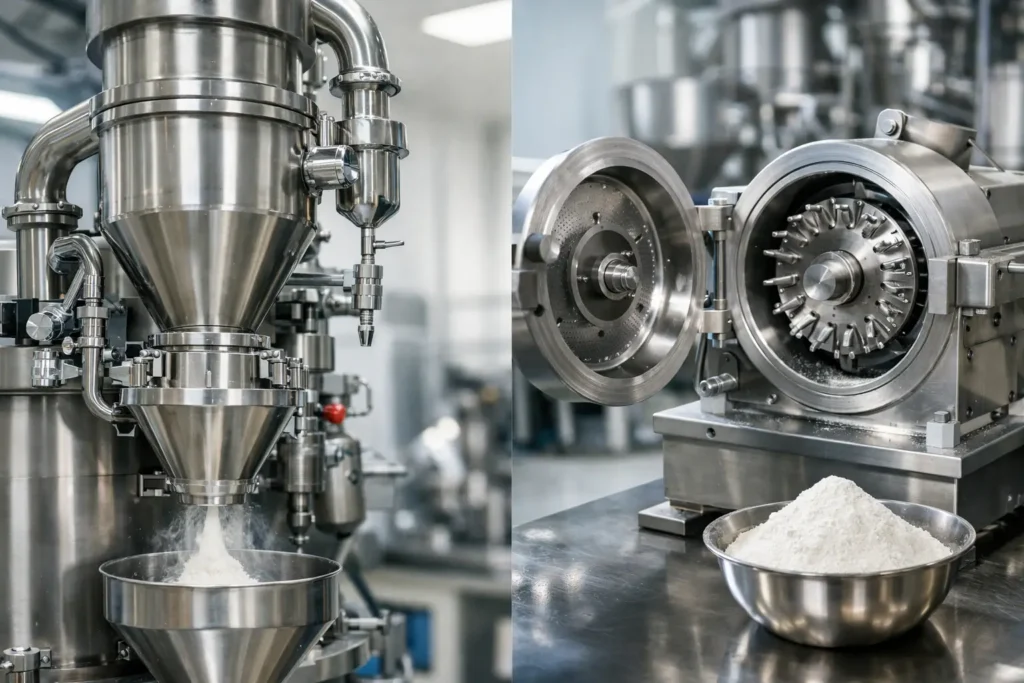
A pin mill reduces particle size through high-speed mechanical impact. The product enters a grinding zone where rotating and stationary pins generate repeated impacts and collisions, breaking the material down rapidly. It is a compact, efficient technology for many powders and is often selected when manufacturers need fine grinding with practical throughput and a relatively straightforward system design.
A jet mill works on a different principle. Instead of relying on mechanical grinding elements inside the reduction zone, it uses high-velocity gas streams to accelerate particles so they collide with one another. Particle-on-particle impact is the main grinding mechanism. That distinction matters because it changes contamination risk, achievable fineness, heat generation profile, and wear behaviour.
In simple terms, pin mills are mechanical impact mills. Jet mills are fluid energy mills. Once that is clear, most of the application differences start to make sense.
Particle size and distribution
If the process requirement is ultrafine grinding, a jet mill will often be the stronger candidate. It is commonly chosen where manufacturers need a tighter top size, finer median particle size, or very narrow particle size distribution. In sectors such as pharmaceuticals, battery materials, speciality chemicals, and high-value pigments, that level of control can directly affect dissolution, reactivity, surface area, and finished product performance.
A pin mill can also produce fine powders, but it generally sits in a different operating window. It is highly effective for controlled fine grinding where the target is not necessarily in the ultrafine range. For many food ingredients, chemicals, fillers, and intermediate products, that is entirely appropriate. In fact, specifying a jet mill for an application that does not require ultrafine performance can add unnecessary capital and energy cost.
This is one of the most common decision points in practice. If your specification is driven by very tight particle size control at the finer end, jet milling becomes more attractive. If you need reliable fine grinding at good throughput with a simpler mechanical solution, a pin mill may be the better fit.
Why the target PSD matters
Average particle size on its own is not enough. Process engineers should look closely at the full particle size distribution, including top size control and the amount of oversize or fines the system produces. Two mills can deliver a similar D50 while producing very different distributions. That difference can affect blending, bulk density, dusting, compaction, suspension stability, and downstream classification.
Heat sensitivity and product integrity
Heat is another major factor in the jet mill vs pin mill comparison. Because a pin mill uses high-speed mechanical impact, product temperature can rise during processing, especially at higher throughputs or when handling tougher materials. For some applications that is manageable. For others, it is a genuine limitation.
Heat-sensitive products such as certain active ingredients, food compounds, nutraceuticals, waxy materials, or products with volatile components may degrade, soften, smear, or lose functional performance if the milling zone temperature climbs too far. In those cases, a jet mill often offers a clear advantage. The expansion of compressed gas can help reduce the thermal load in the grinding chamber, making the process better suited to temperature-sensitive materials.
That said, not every heat-sensitive application automatically requires a jet mill. Feed rate, mill speed, air handling, and system integration all influence temperature control. Some products can be processed successfully in a pin mill with the right engineering approach. The point is that thermal behaviour should be tested, not assumed.
Contamination, wear, and purity
For high-specification applications, contamination risk can be decisive. A pin mill contains mechanical grinding components that are exposed to continuous impact and abrasion. Over time, pins and internal surfaces wear. The rate depends heavily on product hardness, abrasiveness, and operating conditions.
Jet mills reduce this issue because there are no equivalent high-speed mechanical grinding elements acting directly in the milling zone. Particle-on-particle impact can significantly reduce wear-related contamination, which is one reason jet milling is widely specified for high-purity and contamination-sensitive applications.
This does not mean jet mills are wear-free. Abrasive products can still affect internal surfaces, nozzles, and classifiers, and material selection remains critical. But where metallic contamination must be minimised, the jet mill often has an engineering advantage.
For regulated sectors, this links directly to compliance and product quality. For minerals, technical ceramics, electronic materials, and battery powders, it can also protect final product performance.
Throughput, energy use, and operating cost
This is where the trade-off becomes more commercial. Pin mills are often attractive because they offer strong throughput capability with a relatively economical system. They are mechanically straightforward, widely understood by maintenance teams, and can provide an efficient route for a broad range of powder processing duties.
Jet mills, by comparison, usually involve higher energy demand because they depend on compressed gas. That can increase operating cost, particularly in continuous production environments with large volumes. If the application does not truly need ultrafine grinding, low contamination, or tight thermal control, a jet mill may be difficult to justify on cost per kilogram processed.
Even so, headline energy consumption should not be viewed in isolation. If a jet mill eliminates product degradation, reduces contamination rejects, improves yield, or avoids secondary classification steps, the total economics may still be favourable. The right comparison is not machine against machine alone. It is finished product quality and plant performance against total cost of ownership.
Material behaviour changes the answer
Material characteristics often settle the decision faster than any brochure specification. Brittle, friable materials may respond well in either technology, depending on the target size. Fibrous, sticky, oily, elastic, or low-melting products can be more challenging. Hard and abrasive materials raise questions around wear, maintenance intervals, and internal construction materials.
Moisture content also matters. A pin mill handling a slightly damp product may behave very differently from one processing a dry, free-flowing feed. Agglomeration tendency, feed particle size, and bulk density all influence mill performance and system stability.
This is why application testing is so important. The best milling solution is usually confirmed through trials, where particle size distribution, temperature rise, throughput, and product behaviour can be measured under realistic conditions.
When a pin mill is usually the better choice
A pin mill is often the right answer when the process requires dependable fine grinding, practical throughput, and a cost-effective mechanical system. It suits many food, chemical, and general industrial applications where the target particle size is fine but not ultrafine, and where the product can tolerate some mechanical energy input without quality loss.
It can also be a strong option when footprint, simplicity, and maintainability are part of the buying decision. In production environments that value accessible maintenance and flexible operation across several products, that matters.
When a jet mill is usually the better choice
A jet mill is often preferred when the application demands ultrafine particle size reduction, narrow distribution, reduced contamination, or better control over heat-sensitive materials. It is especially well suited to high-value products where quality deviations carry a substantial cost, or where the milling stage directly affects product efficacy and performance.
For manufacturers scaling specialist powders from laboratory development into commercial production, the precision of jet milling can be a major advantage. In those cases, the equipment decision is closely tied to process repeatability and product validation.
The smarter way to decide
A useful evaluation starts with five practical questions. What particle size distribution do you actually need, not just the nominal average? How sensitive is the material to heat? How much contamination can the process tolerate? What throughput is required at full production scale? And what does operating cost look like over the life of the system, not only at the point of purchase?
For many manufacturers, the answer sits beyond a standalone mill. Feed conditioning, classification, containment, dust control, conveying, and discharge all influence final performance. That is why engineered system design matters. A well-matched milling solution should fit the broader process, not create new constraints further down the line.
At DP Pulveriser UK, this is typically where comparison becomes more valuable than specification sheets. The right choice between jet and pin milling is application-led, validated by testing, and shaped around production reality.
The best mill is the one that delivers the particle size you need, at the throughput you require, with the product quality your market will not compromise on.