DP Pulveriser UK - Innovating the Future of Size Reduction
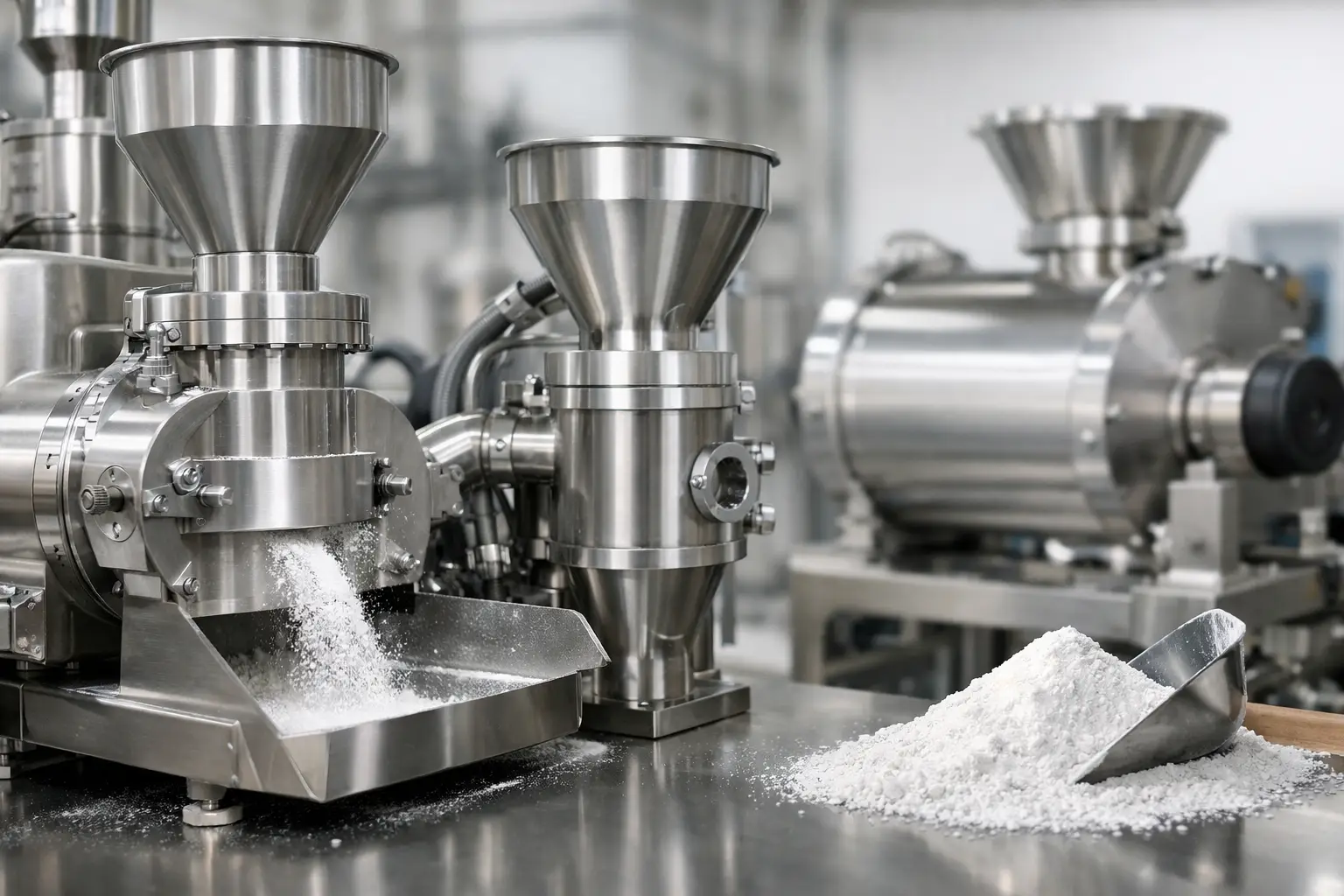
A tablet that fails dissolution by a narrow margin is rarely just a formulation problem. In many cases, the root cause sits further upstream – in how the active and excipients were milled, classified and handled. Particle size reduction in pharmaceutics is not simply a unit operation for making powders finer. It is a process decision that directly influences bioavailability, blend uniformity, content consistency, downstream compression and overall manufacturing efficiency.
For pharmaceutical manufacturers, the challenge is that smaller is not always better. The target is not the finest achievable powder, but the right particle size distribution for the product, process and regulatory requirement. That calls for a controlled, application-specific approach rather than a one-size-fits-all milling strategy.
Why particle size reduction in pharmaceutics matters
In pharmaceutical production, particle size affects far more than appearance. It changes the specific surface area of a material, which in turn can alter dissolution rate, absorption profile and reaction behaviour. For poorly soluble APIs, reducing particle size can materially improve dissolution performance. For granulation and tabletting, particle size influences powder flow, compressibility and segregation risk.
This is where trade-offs start to matter. As particles become finer, dissolution may improve, but flow can deteriorate. Electrostatic behaviour may increase. Dust generation can become more difficult to manage, and heat-sensitive products may degrade if energy input is too high. In inhalation and other high-specification dosage forms, tight particle size control becomes even more critical because performance often depends on a narrow aerodynamic range.
A well-engineered reduction process therefore needs to balance product quality, containment, yield and throughput. That balance will differ between immediate-release tablets, dry powder inhalers, sterile intermediates and nutraceutical formulations.
The main objectives of particle size reduction
The first objective is performance. In practical terms, that may mean improving dissolution for low-solubility compounds, increasing homogeneity in blends, or achieving the feed characteristics required by encapsulation and compression equipment. The second objective is consistency. A process that produces the right median particle size but a broad or unstable distribution can still create major downstream variation.
The third objective is manufacturability. Milling should support production at the required capacity without introducing unacceptable heat, contamination, attrition or cleaning complexity. This is why equipment selection in pharmaceuticals is rarely based on particle size alone. Engineers also assess containment level, cleanability, material of construction, scalability and validation requirements.
Key methods used for pharmaceutical particle size reduction
Different technologies produce different particle size profiles and different process effects. The most suitable option depends on hardness, friability, moisture sensitivity, temperature sensitivity and the final specification.
Hammer and impact milling
Hammer mills and other impact-based systems are often used for coarse to intermediate reduction where high throughput is required. They are effective for many brittle materials and can be suitable for pre-milling before a finer stage. Their strength is productivity, but they may be less appropriate for heat-sensitive APIs or applications requiring very narrow distributions.
Pin and universal milling
Pin mills and universal mills provide greater flexibility across a range of particle sizes and material types. They are commonly selected where controlled deagglomeration or moderate fine grinding is needed. For pharmaceutical processors, this can be useful when balancing throughput with a tighter size target than basic impact milling can typically deliver.
Cone milling
Cone mills are widely used in pharmaceutical environments because they are gentle, hygienic and well suited to size reduction of granules, deagglomeration and conditioning before tabletting or capsule filling. They are not usually chosen for ultra-fine grinding, but they are highly effective for producing a more uniform feed and improving flowability in intermediate process steps.
Jet milling
Jet mills are often the preferred option for fine and ultra-fine particle size reduction where contamination and thermal stress must be minimised. By using high-velocity gas rather than mechanical grinding media, they can achieve very fine particles with a lower risk of product heating. This makes them particularly relevant for potent APIs and temperature-sensitive compounds. The trade-off is that energy demand and system complexity are typically higher than with simpler mechanical mills.
Air classifier milling
Air classifier mills combine size reduction and classification in a single system. This allows tighter control of top size and can improve process efficiency by recirculating oversize material internally. For pharmaceutical applications where a defined distribution is more valuable than just fine output, this integrated approach can offer clear advantages.
What determines the right milling solution?
Material behaviour is the starting point. A brittle crystalline API behaves very differently from a waxy excipient or a hygroscopic botanical extract. Hardness, melting point, moisture content and stickiness all influence whether a product fractures cleanly, smears under stress or forms agglomerates.
The target specification matters just as much. A process designed around D50 alone may miss the importance of the coarse tail, fines fraction or span. In practice, downstream performance often depends on the full distribution, not one number. For example, excessive fines can reduce flow and increase dusting, while a coarse fraction may compromise dissolution or blend uniformity.
Throughput and scale-up are equally important. A technology that performs well in the laboratory may not transfer cleanly into commercial production if residence time, feed behaviour or classifier performance change with scale. This is why process development should focus on the final manufacturing objective from the outset, rather than treating pilot work as a separate exercise.
Common risks in pharmaceutical milling
Over-processing is one of the most common issues. Applying more energy than the product requires can generate excess fines, increase heat load and reduce yield. It may also change bulk density and create handling issues in later stages.
Another risk is contamination, whether from wear parts, cross-batch residues or the surrounding environment. In regulated sectors, equipment design must support effective cleaning, material integrity and documented process control. Stainless steel construction, sanitary design and contained handling are not optional extras in these settings. They are part of the process capability.
Heat is a further concern. Some APIs and excipients undergo polymorphic change, degradation or softening when exposed to excessive thermal input. Where this risk is high, lower-energy technologies or cryogenic milling may be required. Cryogenic systems can also help with elastic or fatty materials that are difficult to mill efficiently at ambient temperature.
Scale-up and process control in pharmaceutics
Successful scale-up depends on controlling more than rotor speed or feed rate. It requires understanding how energy density, airflow, classification efficiency and dwell time interact at different production volumes. Without that understanding, plants often see a gap between development data and full-scale output.
A sound scale-up programme typically includes material trials, particle size analysis, throughput assessment and evaluation of downstream effects such as blending and compression. The purpose is not only to prove that a target size can be achieved, but to confirm that the process remains stable, repeatable and economically viable.
This is where integrated engineering support has real value. Equipment should be selected as part of the wider process line, including feeding, conveying, containment and collection. A mill that performs well in isolation can still become a bottleneck if the surrounding system is poorly matched.
Choosing equipment for long-term performance
For technical buyers, purchase decisions should be based on total process fit rather than headline machine capacity. The right system will deliver precise particle size control, dependable throughput and a design that supports maintenance, cleaning and validation without unnecessary downtime.
It should also allow room for process refinement. Adjustable operating parameters, suitable classifier options and the ability to handle product variation can protect long-term value. In pharmaceutical manufacturing, flexibility matters because formulations, batch sizes and regulatory expectations do not stand still.
For that reason, many manufacturers prefer to work with partners that can support the full path from development to production. DP Pulveriser UK approaches particle size reduction as an engineered process solution, not just a machine selection exercise, which is often the difference between acceptable output and dependable manufacturing performance.
The commercial pressure on pharmaceutical production is clear enough: tighter specifications, faster scale-up and no tolerance for inconsistency. In that environment, particle size reduction should be treated as a precision engineering discipline. When the milling strategy matches the material, product objective and line design, the benefits show up everywhere that matters – better product quality, smoother processing and fewer avoidable surprises on the plant floor.
The most effective next step is usually not asking how fine a product can be milled, but how precisely the process can be controlled.