DP Pulveriser UK - Innovating the Future of Size Reduction
A mill that performs well in a lab trial can become a bottleneck on the production floor if the material behaves differently at scale. That is why selecting particle size reduction equipment is rarely a matter of choosing a machine by output alone. In most manufacturing environments, the real requirement is tighter particle size distribution, stable throughput, cleaner operation and predictable performance across a range of raw materials.
For process engineers and production teams, the best result comes from matching milling technology to the application rather than forcing the application to suit the machine. Material hardness, friability, heat sensitivity, required top cut, moisture content, bulk density and downstream handling all influence the right choice. So do practical constraints such as containment, cleanability, energy use, floor space and integration with feeders, classifiers, conveying systems and mixers.
What particle size reduction equipment must deliver
Particle size reduction is not simply about making material smaller. In regulated and performance-critical sectors, the objective is controlled, repeatable particle engineering. A pharmaceutical powder may need a narrow distribution for blend uniformity and dissolution performance. A food ingredient may require gentle milling to preserve flavour and avoid heat damage. A battery or coatings application may depend on a consistent particle profile to achieve the required surface area, flow and end-product behaviour.
That means equipment selection should be based on the full process outcome. Throughput matters, but so do fines generation, temperature rise, contamination risk, wear rate and maintenance intervals. The most efficient machine on paper can become an expensive choice if it produces too many oversize particles, demands frequent screen changes or struggles with feed variability.
Common types of particle size reduction equipment
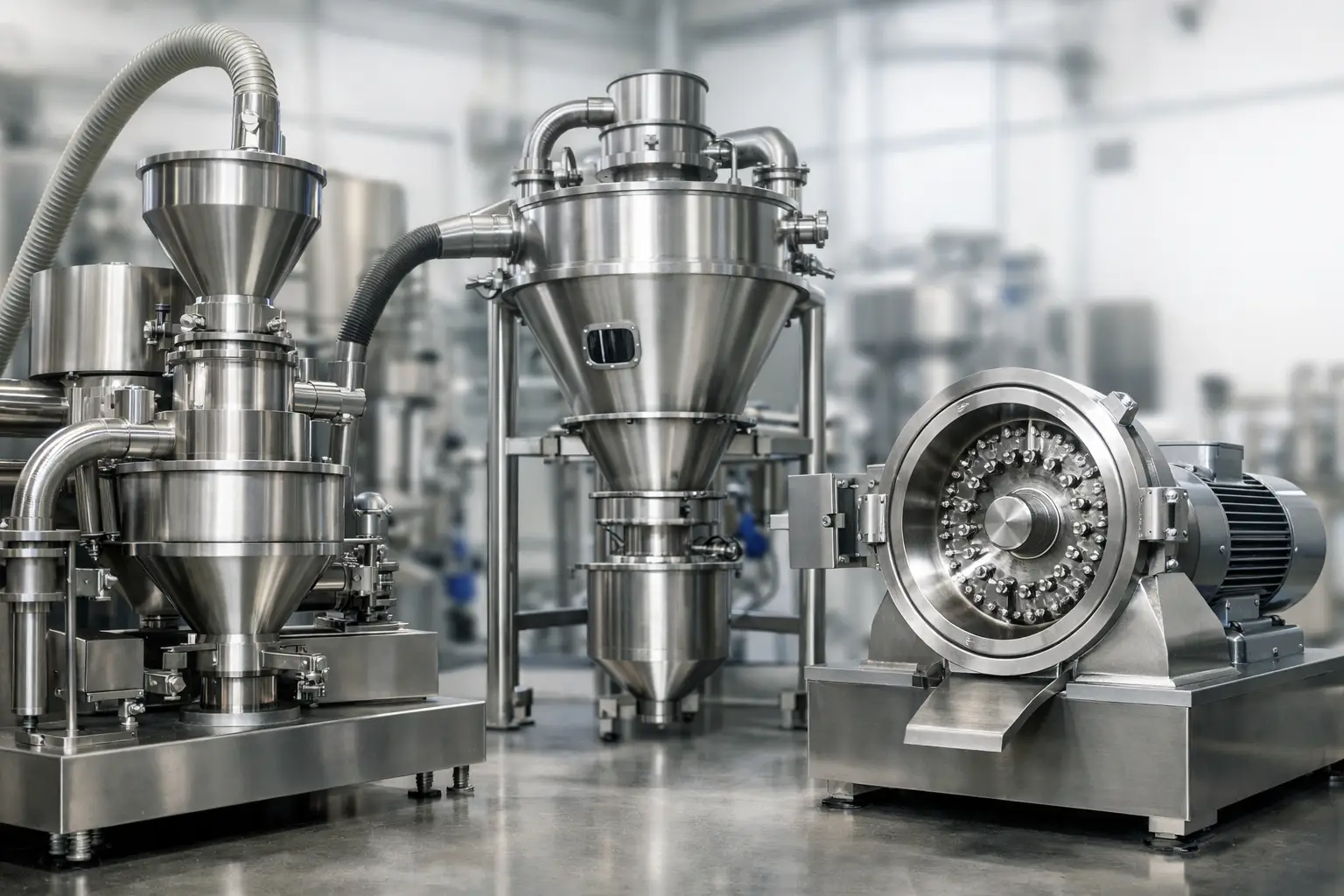
Different milling principles suit different materials and target specifications. The right decision depends on impact, attrition, shear or fluid energy being applied in a way that complements the material rather than fighting it.
Hammer mills and universal mills
Hammer mills are widely used where a practical, high-throughput solution is needed for relatively straightforward size reduction. They suit many food, chemical and mineral applications, particularly where the final specification is moderate rather than ultrafine. Their strength is simplicity, but they can generate more heat and a broader particle size distribution than more specialised systems.
Universal mills offer greater flexibility, often allowing different grinding elements and internal configurations to handle a broader range of materials. For manufacturers processing multiple products, that flexibility can be valuable, especially when production demands change over time.
Pin mills and turbo mills
Pin mills are effective for brittle to medium-hard materials where a finer cut is needed. They are commonly selected for sugars, chemicals, pigments and certain food ingredients. They can achieve good fineness with relatively compact equipment, although heat build-up and wear should still be considered for abrasive or temperature-sensitive products.
Turbo mills are often chosen where a tighter distribution and high-speed impact milling are advantageous. They can perform well on materials that require efficient deagglomeration as well as reduction, but the operating window needs to be engineered carefully around feed condition and target particle size.
Cone mills
Cone mills are frequently used for deagglomeration, delumping and intermediate sizing rather than aggressive fine grinding. In pharmaceutical, nutraceutical and food processing, they are valued for gentle handling, hygienic design and repeatable conditioning of powders before blending, tabletting or packing. If the process requires very fine end sizes, a cone mill may be part of the line rather than the final reduction stage.
Jet mills and air classifier mills
When the target is fine to ultrafine powder with tight control and low contamination, jet mills are often the preferred route. They use high-velocity gas rather than mechanical grinding media, which makes them suitable for heat-sensitive or high-purity applications. The trade-off is that they demand more energy and a more carefully controlled process environment.
Air classifier mills combine mechanical milling with internal classification, allowing the system to control top size more precisely. For many chemical, mineral and performance-material applications, that integrated approach improves efficiency by reducing over-grinding and returning coarse particles for further milling.
Cryogenic milling systems
Some materials simply do not mill well at ambient temperature. Elastomers, waxes, oily products and certain polymers may smear, soften or agglomerate instead of fracturing cleanly. Cryogenic milling addresses that by lowering product temperature so the material becomes brittle enough to reduce effectively. It adds complexity and operating cost, but for the right application it can be the only reliable route to a consistent powder.
The material tells you more than the brochure
A recurring mistake in equipment selection is focusing on machine capability before understanding material behaviour. Two powders with a similar starting size can respond very differently under identical milling conditions. Friable materials may reduce quickly with low energy input, while fibrous or elastic products resist fracture and create handling issues. Abrasive products increase wear and can change internal clearances over time, affecting consistency. Hygroscopic materials may cake within the system if air management is poor.
This is where application testing matters. A proper evaluation should look beyond a single particle size result and assess yield, temperature, product degradation, dusting, flowability and cleanability. It should also consider whether the process can hold that performance over long production runs rather than short development batches.
Throughput, scale-up and system integration
Standalone mills are only one part of the process. Feed consistency, pneumatic conveying, classification, collection and discharge all affect real plant performance. A mill rated at a certain capacity may never achieve that figure in production if the feeder pulses, the filter chokes, the conveying velocity is wrong or the receiving equipment cannot accept the flow.
Scale-up is especially important for manufacturers moving from laboratory work to pilot and commercial production. The target is not only to match the particle size achieved in development, but to reproduce it with stable throughput and acceptable operating cost. That usually requires more than geometric scaling. Tip speed, residence time, classifier settings, gas flow, feed presentation and thermal load may all change as production volume increases.
This is why engineered process support is often more valuable than a catalogue comparison. Suppliers with laboratory, pilot and production experience can identify where a promising trial result may become difficult to sustain at industrial scale.
Hygiene, containment and maintenance
For pharmaceutical, food and high-value chemical production, hygienic design and containment are central to equipment choice. Smooth product-contact surfaces, reduced dead spots, appropriate seals and efficient access for cleaning all affect uptime and compliance. If changeovers are frequent, easy disassembly and repeatable reassembly can have a direct impact on production efficiency.
Containment requirements also shape the solution. Potent compounds, dusty chemicals and reactive materials may require pressure-tight construction, inert gas operation, explosion protection or isolation from operators and the wider plant. These features should be designed into the system from the outset, not added as afterthoughts.
Maintenance deserves equal attention. Screen wear, pin wear, classifier erosion and bearing life all influence total cost of ownership. In abrasive or high-duty applications, an apparently lower capital cost can be offset quickly by downtime and consumable replacement.
Energy performance and total cost of ownership
Energy efficiency is often discussed in broad terms, but in practice it depends on the whole system. A machine that consumes less installed power is not automatically the lower-cost option if it requires longer residence times, multiple passes or additional downstream classification. The more useful measure is how much saleable product is produced to specification, per unit of energy and labour, across a realistic production cycle.
Well-engineered particle size reduction equipment should reduce waste, limit over-grinding and maintain output with minimal intervention. That is where process design, classifier efficiency, wear resistance and controls all contribute to lower operating cost. For many plants, the strongest commercial case is not the cheapest machine purchase but the most predictable long-term performance.
Making the right selection
The best equipment choice usually comes from a structured assessment of product requirements, material behaviour, throughput targets, compliance needs and future production plans. A fine chemical application may justify the precision of a jet mill or air classifier mill. A hygienic food process may favour a cone mill or pin mill. A high-throughput mineral line may be better served by a hammer mill or universal mill with the right wear protection and downstream classification.
What matters is that the system is engineered around the application. DP Pulveriser UK works with manufacturers that need more than a standalone machine – they need a process solution that holds specification, integrates cleanly with the line and supports scale-up without sacrificing efficiency.
When particle size directly affects product quality, yield and plant performance, equipment selection is an engineering decision with long-term consequences. The right answer is rarely the most familiar mill. It is the one that gives your process room to perform reliably, batch after batch.