DP Pulveriser UK - Innovating the Future of Size Reduction

A laboratory result is only as reliable as the powder delivered to the laboratory. A precisely calibrated particle size analyser cannot correct a biased sample taken from the top of a drum, a poorly mixed tote or a segregated conveyor stream. This powder sampling methods guide sets out how industrial processors can obtain representative samples that support reliable decisions on milling, blending, classification and final product release.
For plants handling pharmaceutical excipients, food ingredients, battery materials, pigments, minerals or speciality chemicals, sampling is not a routine administrative task. It is a controlled part of process engineering. The method must reflect how the material behaves, where variation can occur and which quality attributes the sample is intended to verify.
What makes a powder sample representative?
A representative sample reflects the average condition of the defined material lot or process stream. That sounds straightforward, but powders do not behave like homogeneous liquids. Differences in particle size, density, shape, moisture content and electrostatic charge can cause segregation during filling, conveying, discharge and storage.
Fine particles may adhere to vessel walls, while coarser fractions migrate through a powder bed. Free-flowing granules can segregate during vibration or transport. Cohesive materials may form stable agglomerates that a small scoop does not break apart. A sample taken from one accessible point may therefore be accurate for that point, but misleading for the batch.
The first engineering question is not which sampler to buy. It is what decision the sample must support. Incoming material verification, in-process particle size control, blend uniformity assessment and final release testing each require a different sampling plan. The plan should define the lot, sampling locations, increments, frequency, equipment, sample mass, container, handling method and analytical test.
Powder sampling methods for industrial applications
No single method is correct for every powder. The best approach depends on whether material is stationary or moving, the degree of segregation risk, the required sample quantity and whether containment is necessary.
Sampling from a moving stream
Where practical, sampling from a moving stream is generally the most dependable approach. A properly designed cross-stream cutter captures material across the full depth and width of the flow at a controlled interval. This reduces the bias that can occur when samples are taken only from the surface or one side of a vessel.
For continuous milling and classification systems, timed increments from a conveyor, chute or discharge stream can show whether particle size distribution remains stable over the run. The cutter opening must be sufficiently wide for the largest particles or agglomerates, and its travel must be fast enough to avoid preferentially collecting fine or coarse material.
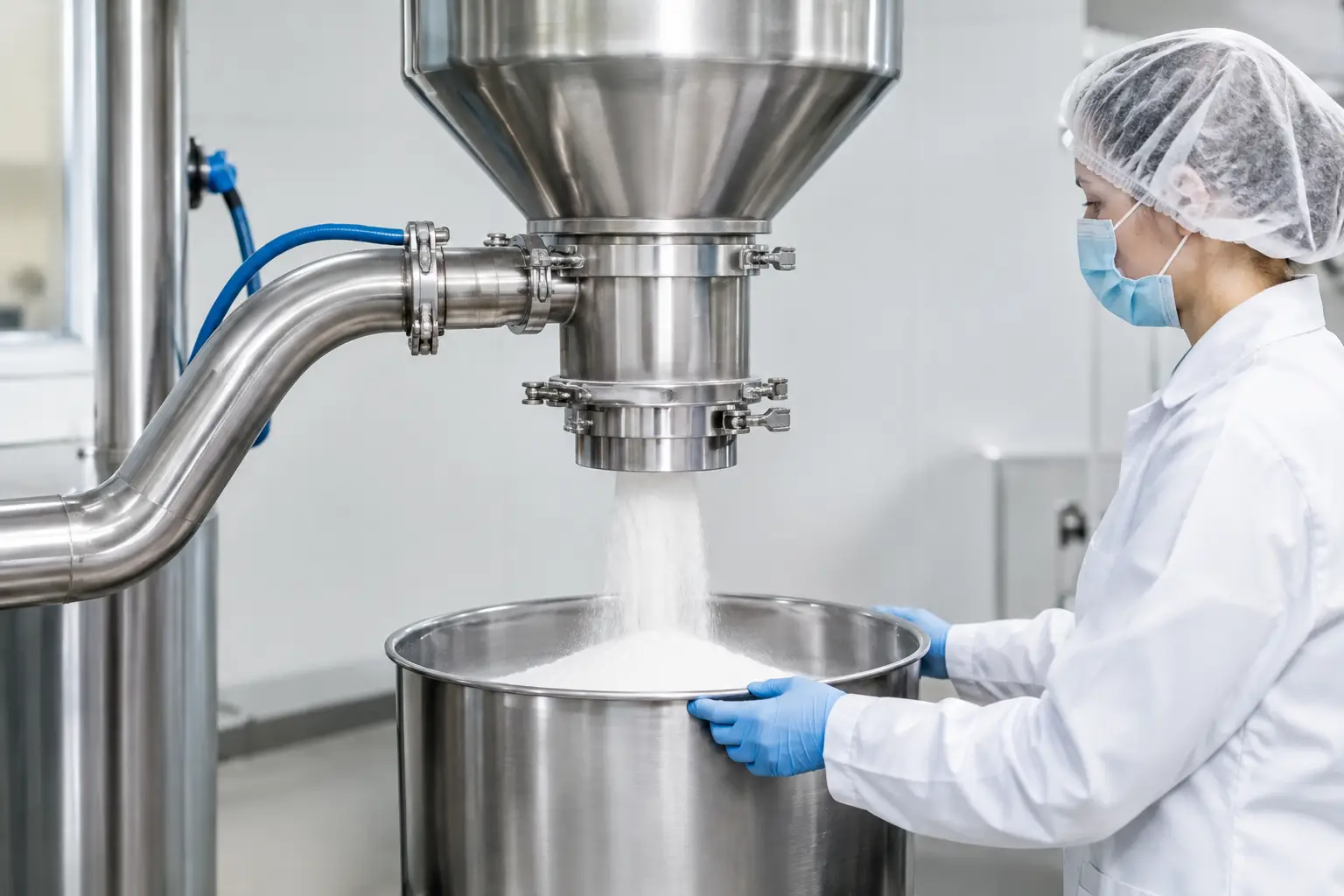
A stream sampler must not obstruct flow, create material build-up or introduce contamination. In high-value or regulated applications, enclosed automated samplers can improve operator safety, repeatability and traceability. They also reduce exposure to airborne dust and minimise disturbance to the process.
Sampling from bags, drums and intermediate bulk containers
Stationary containers present a greater challenge because filling, handling and settling can segregate powder before sampling begins. A single scoop from the top is rarely sufficient for a batch-level decision.
A powder thief or zone sampler can collect increments at different depths within bags, drums or intermediate bulk containers. The design must suit the material. A narrow tube may bridge in cohesive powder, while a poorly designed thief can separate particle fractions as it enters or withdraws from the bed. For free-flowing products, multiple increments from upper, middle and lower zones provide a more realistic picture than one deep sample.
When sampling several containers within a lot, the selected containers should be distributed through the consignment rather than chosen solely for convenience. The required number depends on material variability, supplier consistency, risk level and the consequence of accepting a non-conforming batch. There is no substitute for a documented, risk-based rationale.
Sampling during discharge
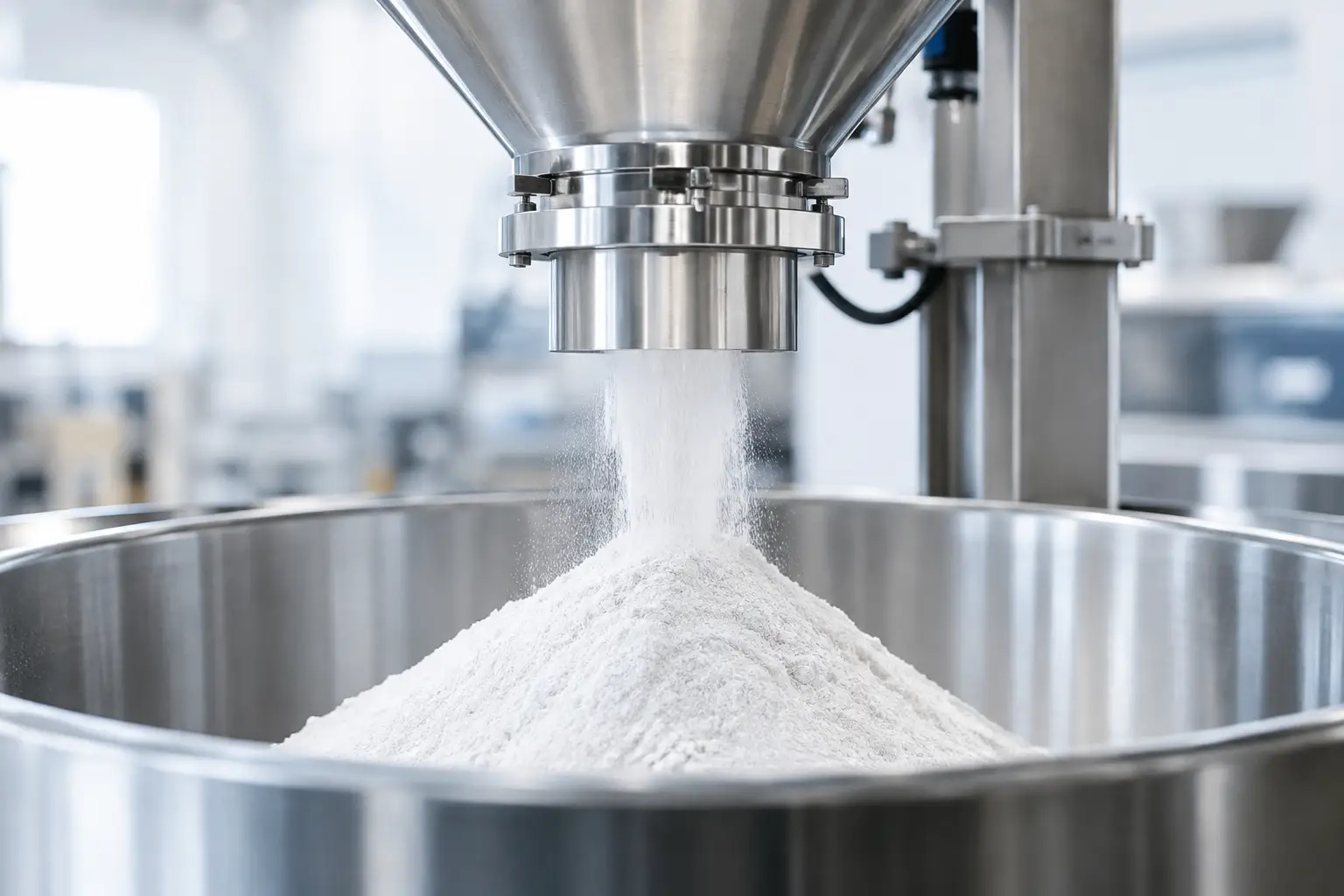
Sampling at the discharge point of a hopper, mixer or IBC is often highly effective because the material is moving and the sample can be taken through the production sequence. However, it can also reveal segregation created upstream. Early, middle and late discharge increments may differ significantly when a blend has stratified during transport or storage.
This is useful diagnostic information. If particle size, assay or moisture changes across the discharge profile, the problem may lie in blending, vessel filling, conveying or hopper geometry rather than in the sampling operation itself. A process engineer should treat the profile as evidence for improvement, not simply as a pass-or-fail quality result.
Manual scoop sampling
Scoop sampling has a place for preliminary checks, development work and materials where the full bulk is genuinely homogeneous. It is quick and inexpensive, but it is also highly dependent on operator technique. For critical quality decisions, a scoop should not be the default method unless its representativeness has been demonstrated.
Use a clean, correctly sized scoop, take increments from defined positions and transfer them without shaking, sieving or excessive handling. If a composite sample is required, combine equal increments in a clean container before any laboratory sub-sampling begins.
Designing a sampling plan that controls variation
A strong sampling plan connects material behaviour to the process risk. Start by identifying the characteristics most likely to vary: particle size distribution, moisture, bulk density, active concentration, flowability, colour, contamination or chemical composition. Then identify where those characteristics can change.
For example, an air classifier mill producing a tight top cut may require frequent discharge samples during commissioning to confirm classifier speed, airflow and feed rate are delivering the specified particle size distribution. Once the process is proven stable, sampling frequency may be reduced under a controlled plan. Conversely, a hygroscopic food powder may need closer monitoring after changes in ambient conditions, packaging or dwell time.
Sample mass matters as much as sampling location. The quantity must be large enough to include the particle population relevant to the test. A small analytical portion may be suitable for moisture testing but insufficient for a representative particle size analysis where coarse particles are sparse. Collect enough primary material to permit proper mixing, division, retain samples and repeat analysis where required.
Do not confuse a composite sample with proof of uniformity. Combining increments can provide a useful average for lot release, but it may hide variation between containers or across a discharge run. Where consistency itself is the concern, retain and test selected individual increments alongside the composite.
Reducing contamination and sample handling errors
A representative sample can still become invalid through poor handling. Sampling tools, transfer containers and work surfaces must be compatible with the material and cleaned between use. Stainless steel is common, but it is not automatically suitable for every application. Abrasive powders, reactive materials, sticky products and trace-metal-sensitive formulations may require different contact materials or dedicated equipment.
Control exposure to moisture, oxygen, light and temperature where these affect product quality. Fine powders can gain or lose moisture rapidly after collection, changing flow, bulk density and measured particle size. Antistatic measures and grounded equipment may be necessary for materials that cling to sampling tools or present a dust ignition hazard.
Labelling should identify the material, lot, location, time, sampler, process conditions and intended test. These details make results actionable. A particle size failure without the associated mill settings, feed rate and sample point is far harder to investigate than one with a complete process record.
Preparing the laboratory test portion
The laboratory should not simply take the first handful from the container. Sub-sampling can introduce the same bias as primary sampling. For dry, free-flowing materials, a validated rotary divider or riffle splitter generally provides better control than repeated scooping. Cohesive material may need carefully defined conditioning or de-agglomeration before testing, provided that preparation does not alter the property under investigation.
This stage deserves particular attention when comparing pilot trials with commercial production. A lab-scale sample may be well mixed and freshly produced, while a production sample has passed through conveyors, bins and packaging. If sampling and sample preparation differ, apparent scale-up problems may actually be measurement problems.
When sampling results point to process change
Recurring variation should trigger an engineering review rather than repeated re-testing. Examine feed consistency, mill configuration, classifier settings, airflow, rotor speed, screen condition, blending time, conveying velocity and hopper design. Sampling data is most valuable when it identifies the source of variation early enough to correct it.
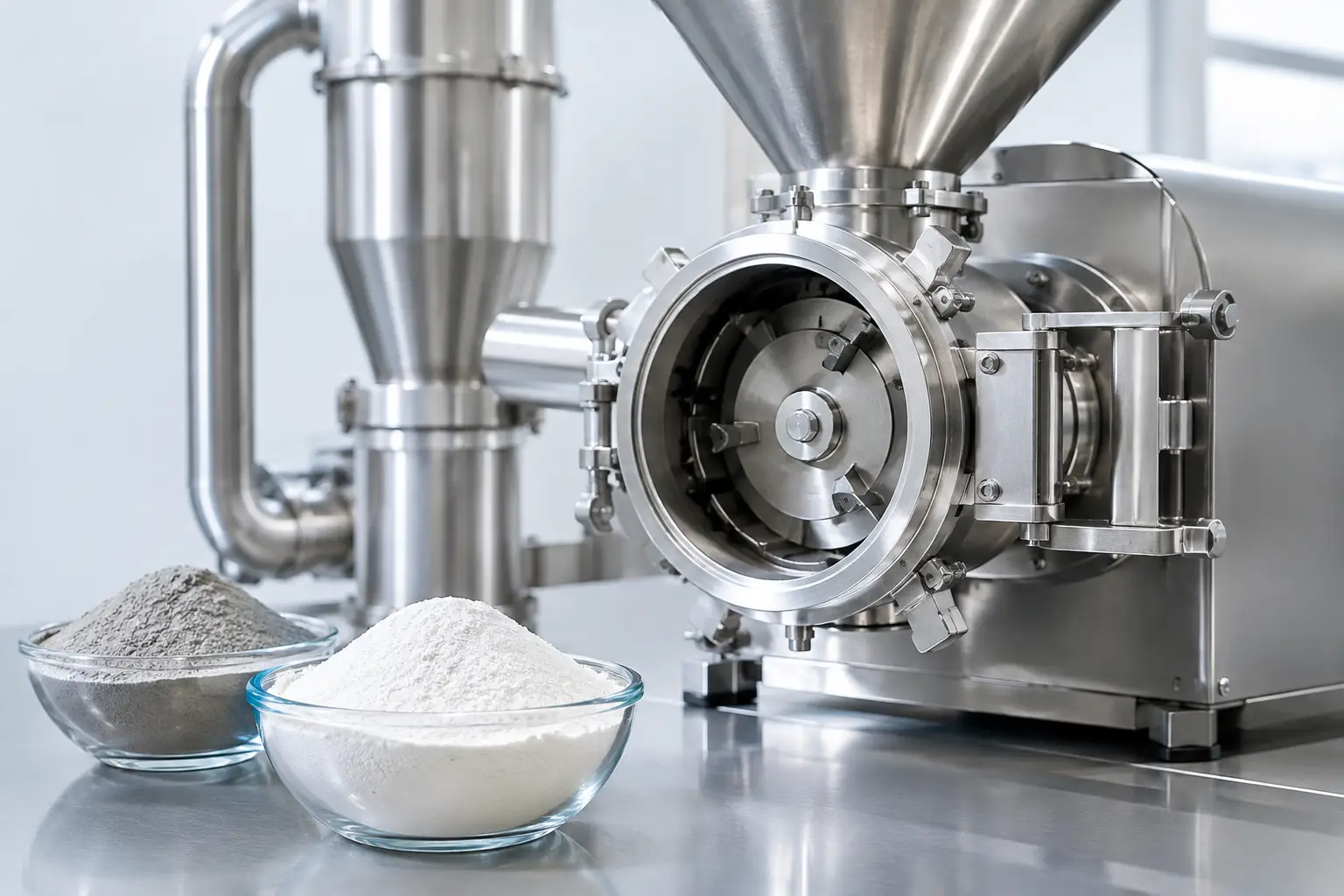
DP Pulverizer UK supports this approach by considering sampling requirements alongside milling, classification, mixing and powder handling design. The aim is not only to achieve precise particle size reduction, but also to maintain a process that can be measured, controlled and scaled with confidence.
Well-designed sampling is a practical investment in dependable process decisions. When the sample genuinely represents the material, quality teams can release product with greater assurance and process teams can improve performance using evidence rather than assumption.