DP Pulveriser UK - Innovating the Future of Size Reduction
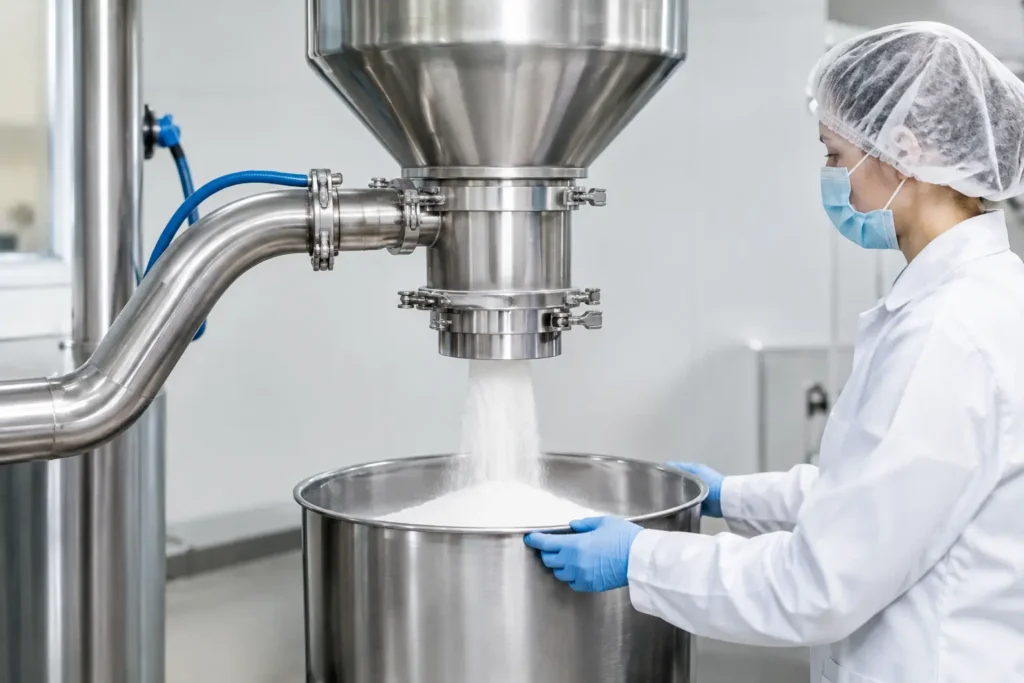
A powder transfer line can be the point at which an otherwise well-engineered process loses control. Material may bridge in a hopper, segregate during conveying, retain in a bend, or escape at a connection. In food, pharmaceutical and nutraceutical production, those failures create more than lost yield. They can compromise hygiene, batch consistency, operator safety and release schedules. Designing sanitary powder transfer systems therefore starts with the powder itself and the process risk around it, not with a preferred conveyor.
The correct system must protect product quality while moving material at the required rate, with repeatable cleaning and practical access for maintenance. It must also integrate properly with upstream milling, classification, mixing and downstream packing or processing equipment. That is where application-specific engineering delivers a better result than adapting a standard conveying arrangement.
Start with the powder and the process duty
Powders behave differently under pressure, vibration, aeration and shear. A free-flowing granular ingredient may transfer efficiently through a straightforward vacuum system. A cohesive fine powder, a hygroscopic material or a blend with a wide particle size distribution may compact, smear, fluidise unpredictably or separate in transit.
The design brief should establish the target throughput, batch size, transfer distance, vertical lift, operating hours and permissible residence time. It should also define bulk density, particle size distribution, moisture sensitivity, temperature, abrasiveness, electrostatic behaviour and flowability. These factors determine pipe diameter, conveying velocity, hopper geometry, feeder selection and filter sizing.
Product value matters as well. Where active ingredients, specialist pigments or battery materials are involved, loss to retained residue can be commercially significant. In allergen-managed food applications, retained material can become a changeover and contamination concern. A sanitary design should minimise hold-up from the outset rather than attempting to solve it with increasingly intensive cleaning procedures.
Choose a transfer method that suits the material
There is no universally superior powder conveying technology. The right approach depends on the material, capacity, layout and hygiene requirement.
Vacuum conveying is often well suited to enclosed, sanitary transfer between process stages. It can reduce dust release, support flexible routing and feed mills, blenders, reactors or filling lines. However, system performance depends on stable vacuum generation, correctly sized filters and effective discharge from the receiver. Fine or sticky powders may require filter cleaning strategies and discharge assistance that are matched to their behaviour.
Pressure conveying can be effective across longer distances and at higher throughputs, particularly where plant layout demands it. Dense-phase conveying may reduce velocity and pipe wear for some materials, but it requires careful control. If the powder is prone to plugs, degradation or segregation, an apparently efficient low-velocity design can become difficult to operate consistently.
Mechanical conveyors, including screw systems, can offer controlled metering and compact layouts. Their trade-off is direct product contact with moving components and potentially greater cleaning effort. They are often appropriate where transfer distance is short, where a controlled feed into a mill or mixer is required, or where pneumatic air use is undesirable.
For high-care applications, the decision should account for every transition point, not only the main conveyor. The inlet, discharge, rotary valve, diverter, flexible connection and collection filter must all be evaluated as one hygienic process system.
Sanitary design is about cleanability, not surface finish alone
Stainless steel construction and polished surfaces are useful, but they do not by themselves make a powder system sanitary. Cleanability depends on geometry, accessibility, drainage where wet cleaning is used, and the elimination of product traps.
Internal surfaces should be continuous and free from ledges, dead legs, exposed threads and poorly aligned joints. Pipework requires smooth bore transitions and sweep bends where practical. Sudden diameter changes, sharp elbows and unnecessary branches encourage powder deposition, particularly with fine or electrostatically charged products.
The system should be designed around the required cleaning method. Dry cleaning may be appropriate for many powders where water would create caking, microbial risk or extended downtime. In these cases, operators need safe access to filters, receivers and contact parts, with enough visibility to verify cleaning. Where clean-in-place or wash-in-place is required, pipework, valves and receivers need validated coverage, suitable drainage and materials that tolerate cleaning chemistry and temperature.
Quick-release clamps can reduce changeover time, but only where they are specified correctly and remain accessible. A connection that is technically removable but requires awkward lifting, excessive dismantling or unplanned tool use will not support reliable hygienic operation on a production shift.
Design for inspection and maintenance
A transfer system cannot remain sanitary if it is difficult to inspect. Access doors, sight glasses, removable filter assemblies and sensible equipment positioning allow maintenance teams to identify build-up before it becomes a quality issue. At the same time, access points must seal consistently and avoid introducing crevices or leakage paths.
Filter selection deserves particular attention. Filters must retain fine product effectively while releasing it during pulse cleaning or other cleaning cycles. Poor filter performance reduces conveying capacity, increases energy use and can create dust emissions at the most sensitive point in the process.
Containment and dust control must be engineered together
Sanitary powder handling and contained powder handling are closely linked. Dust generated at bag tipping, intermediate bulk container discharge, mill feeding or vessel filling can spread product beyond the intended process boundary. This affects housekeeping, cross-contamination control and operator exposure.
Effective containment begins with enclosed transfer routes and balanced airflow. Too little extraction allows dust to escape. Too much extraction can disturb the powder stream, pull fine material into filters or reduce the performance of a feeder. The system needs defined air paths, correctly specified filtration and pressure management at each transfer point.
For hazardous or combustible dusts, the design must also address the relevant dust explosion assessment. Earthing and bonding, explosion isolation, venting arrangements, suppression or containment measures may be required depending on the powder and plant configuration. Hygiene cannot be considered separately from process safety.
Prevent segregation and protect particle integrity
Powder transfer is not neutral. Air velocity, drop height, vibration and mechanical agitation can alter the blend that reaches the next process stage. This is especially relevant where formulations contain ingredients with different particle sizes, densities or shapes.
Long vertical drops should be avoided where practical, or controlled using suitable chute geometry. Conveying velocity should be high enough to maintain reliable transport but not so high that it damages friable particles, increases attrition or drives excessive separation. A system handling milled food ingredients may require a different design balance from one moving abrasive mineral powders or carefully blended pharmaceutical excipients.
Feed consistency is equally important. A well-designed transfer line cannot compensate for erratic discharge from a hopper. Hopper wall angles, agitation, flow aids and feeder type should be selected from measured powder properties wherever possible. Mass flow may be necessary for some products, while a simpler funnel-flow arrangement may be sufficient for others. The appropriate choice depends on sensitivity to residence time, segregation and material degradation.
Build scale-up into the original system concept
A laboratory or pilot process may transfer kilograms per hour through short, flexible connections. Commercial production may require hundreds or thousands of kilograms per hour, longer routes, multiple destinations and defined cleaning validation. Scaling by simply enlarging pipework or increasing blower capacity can introduce new problems with velocity, receiver filling, filter loading and product retention.
A stronger approach is to test the material under representative conditions, then translate those findings into an integrated production design. This includes the feeder, transfer method, receiver, controls, dust collection and downstream interface. It also provides an opportunity to assess energy demand and identify whether a lower-pressure or lower-velocity arrangement can meet the duty with lower operating cost.
Automation should support process control rather than add unnecessary complexity. Level sensing, pressure monitoring, filter differential pressure, weigh systems and recipe-controlled routing can improve repeatability and traceability. The controls architecture should also make abnormal conditions visible, including blocked lines, incomplete discharge, low vacuum and open access doors.
Specify the complete powder handling system
The most effective sanitary transfer systems are specified as part of the wider process. A mill, classifier, mixer and conveyor influence one another through feed rate, air balance, particle characteristics and batch sequence. Treating each item as an isolated purchase often transfers integration risk to the production team.
DP Pulverizer UK engineers complete powder processing lines around the required particle size, throughput, hygiene standard and operating environment. That approach enables the transfer system to be matched to upstream and downstream equipment, rather than forcing the process to adapt to a generic conveyor.
A well-designed sanitary transfer system should give operators confidence: product arrives where it should, in the condition required, without hidden residue, uncontrolled dust or avoidable intervention. That confidence is built into the design long before the first batch reaches the line.