DP Pulveriser UK - Innovating the Future of Size Reduction
Cryogenic Grinders, the new standard in performance enhancement of grinding
When a material softens, smears or loses volatile compounds under ambient grinding, a standard mill stops being a production asset and starts becoming a quality risk. That is where a cryogenic grinders machine review becomes useful – not as a catalogue exercise, but as a process evaluation. For manufacturers handling heat-sensitive, elastic or high-value materials, cryogenic milling can shift both product quality and line efficiency.
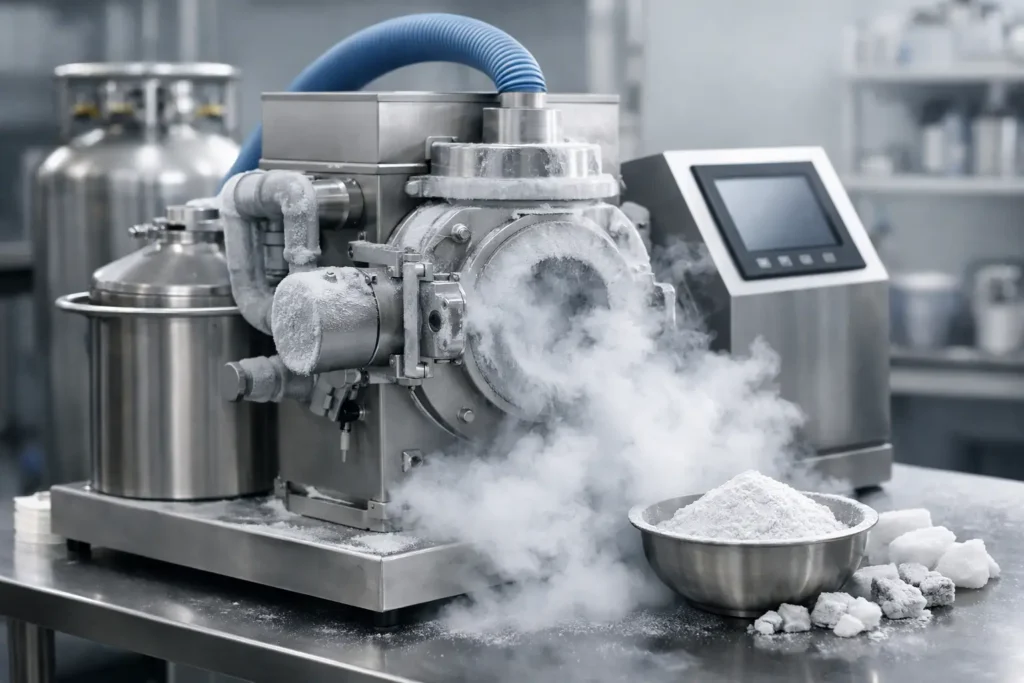
The core principle is straightforward. The feed material is cooled, typically with liquid nitrogen, until it becomes brittle enough for efficient size reduction. In practice, however, machine performance depends on far more than low temperature alone. Mill geometry, nitrogen control, feed stability, classifier performance, containment, throughput range and downstream integration all determine whether a system delivers repeatable industrial output or merely acceptable test results.
What a cryogenic grinders machine review should measure
For technical buyers, the right review criteria start with the application, not the brochure specification. A cryogenic grinding system used for spices, polymers, battery materials or pharmaceutical intermediates will face very different process demands. Even when two machines quote similar fineness, they may behave very differently in terms of temperature stability, nitrogen consumption and product uniformity.
The first point to examine is particle size control. A capable cryogenic system should not simply reduce average particle size. It should narrow the particle size distribution and maintain consistency over extended production runs. This is especially relevant where downstream blending, dissolution, compaction or filling performance depends on stable PSD.
The second is throughput under real operating conditions. Published capacities are often based on a narrow material range and ideal feed presentation. In production, actual throughput is shaped by feed temperature, moisture, bulk density, oil or fat content, and the degree of fineness required. A serious review should consider whether the machine maintains target output without excessive recirculation, blockages or unstable product temperature.
The third is thermal protection. Some materials degrade chemically, lose aroma, oxidise or become adhesive when exposed to grinding heat. In those cases, the value of cryogenic milling lies in preserving product integrity while still achieving fine particle reduction. This matters in food ingredients, nutraceutical actives, elastomers and specialist chemicals where thermal damage has a direct cost.
Cryogenic grinder machine review: key engineering criteria
A strong cryogenic grinder machine review should look closely at the engineering around the mill, not just the mill itself. Cooling the material is one part of the system. Controlling how the material enters, moves through and exits the process is equally important.
Pre-cooling and feed control
Effective pre-cooling improves brittleness and reduces load variation inside the grinding chamber. Systems with controlled residence time in the pre-cool stage generally deliver more stable grinding behaviour than those relying on direct nitrogen injection alone. Feed rate control must also be precise. If feed surges, product temperature can rise and size reduction becomes inconsistent.
For difficult materials such as elastomers, waxy compounds or oily botanicals, feed conditioning often determines whether the process remains continuous. Buyers should check whether the system has been engineered for their exact material class rather than a generic cryogenic duty statement.
Mill type and grinding mechanics
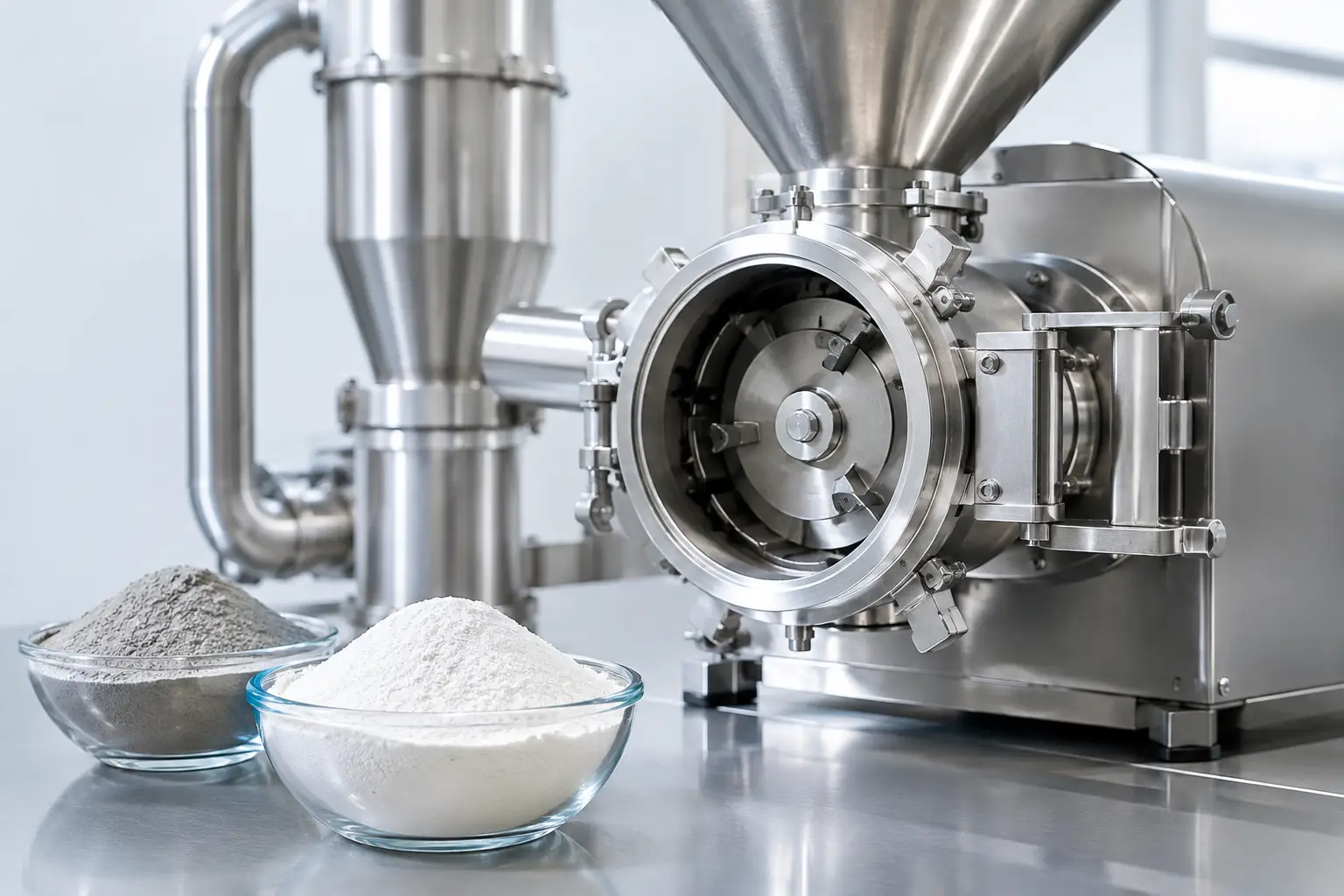
Not every mill performs equally well under cryogenic conditions. Pin mills, hammer mills and impact mills each have strengths depending on target size, feed properties and throughput expectations. The review should focus on how the chosen mill design interacts with embrittled material. High impact may work well for certain polymers, while other products benefit from more controlled reduction to avoid excessive fines.
The right machine is rarely the one with the widest claimed application range. It is the one configured for the material’s fracture behaviour, required top size and production duty.
Nitrogen efficiency and operating cost
Liquid nitrogen consumption can be a decisive factor in total cost of ownership. A machine that achieves fine grinding but uses nitrogen inefficiently may deliver poor economics at scale. This is why thermal insulation, injection control, chamber design and process tuning deserve close attention in any review.
There is often a trade-off between the lowest possible product temperature and the most economical operating point. In some applications, holding the material just below the embrittlement threshold is enough. In others, particularly where oxidation or volatilisation must be minimised, colder operation is justified. The correct balance depends on product sensitivity and margin structure.
Where cryogenic systems outperform ambient grinding
Cryogenic grinding is not automatically the best choice. For many standard mineral or dry chemical duties, ambient milling remains more economical and mechanically simpler. The case for cryogenic processing becomes stronger when the material presents one or more of three issues: heat sensitivity, elasticity, or high oil and fat content.
Spices are a common example. Under ambient grinding, volatile oils can be lost and product temperature can rise quickly, affecting aroma and flavour consistency. Cryogenic grinding can help retain volatile fractions while improving fineness. The same logic applies to certain nutraceutical ingredients where active compound preservation matters as much as size reduction.
In polymers and elastomers, cryogenic conditions can transform a difficult, resilient feed into a brittle, grindable one. That can open up particle size targets that would be impractical under conventional milling. Recycled rubber, engineered plastics and specialist compounds often fall into this category.
Pharmaceutical and speciality chemical applications introduce another layer: controlled processing with low contamination risk and high repeatability. Here, the review should also consider cleanability, material of construction, containment and validation requirements.
Performance trade-offs buyers should not ignore
The strongest equipment evaluations are rarely based on headline fineness alone. Industrial performance is shaped by trade-offs, and cryogenic systems are no exception.
A finer product usually means lower throughput and higher energy or nitrogen demand. Tighter particle size distribution may require more classifier control or additional process stages. Lower product temperature can improve quality retention but raise operating cost. None of these are faults in the machine. They are process realities that should be understood before procurement.
Maintenance access is another practical point. Cryogenic systems operate in demanding conditions, and uptime depends on straightforward inspection, wear part replacement and cleaning. If the system is difficult to service or requires excessive downtime between campaigns, nominal technical performance may not translate into plant productivity.
Utilities and site infrastructure also matter. Nitrogen supply, storage, safety systems, ventilation and operator procedures must be considered early. A machine can be technically suitable yet operationally inefficient if the plant is not configured to support cryogenic processing properly.
How to compare machines beyond specification sheets
For most industrial buyers, the best comparison method is application-led testing. A specification sheet can confirm motor size, capacity range and materials of construction, but it cannot fully predict product behaviour. Trial data on your material remains the most reliable basis for selection.
Look for evidence of repeatability across multiple runs, not a single favourable result. Review the relationship between feed condition, final PSD, product temperature and nitrogen use. Ask whether the same system architecture can scale from lab or pilot work into commercial operation without changing the core grinding principle.
This is where engineered process support becomes significant. A supplier that understands milling, classification, feed handling and system integration can usually provide a more accurate view of long-term operating performance than one supplying a stand-alone machine. For buyers planning phased scale-up, that difference is material.
DP Pulveriser UK operates in precisely this application-specific space, where machine selection is tied to process outcome rather than generic equipment matching. That approach is especially relevant for cryogenic projects, where upstream and downstream conditions have a direct effect on grinding performance.
Who should invest in cryogenic grinding
A cryogenic system makes commercial sense when product quality gains outweigh the added complexity of low-temperature operation. That may mean better retention of active ingredients, improved flowability, lower agglomeration, tighter particle size distribution or access to target fineness that ambient milling cannot achieve.
It is particularly well suited to manufacturers processing spices, herbs, food ingredients, plastics, elastomers, heat-sensitive chemicals and selected pharmaceutical or nutraceutical materials. It is less compelling where the feed is already brittle, thermally stable and easy to mill conventionally.
The right buying question is not whether cryogenic grinding is technically impressive. It is whether the process delivers measurable value in your plant – in yield, quality, throughput, consistency or downstream performance.
A useful review should leave you with a clear engineering picture: what the machine can do, where it will struggle, and how it fits into the wider production line. If those answers are specific to your material and your required output, you are no longer reviewing a cryogenic grinder machine in abstract terms. You are assessing a production solution that has to earn its place on the factory floor.